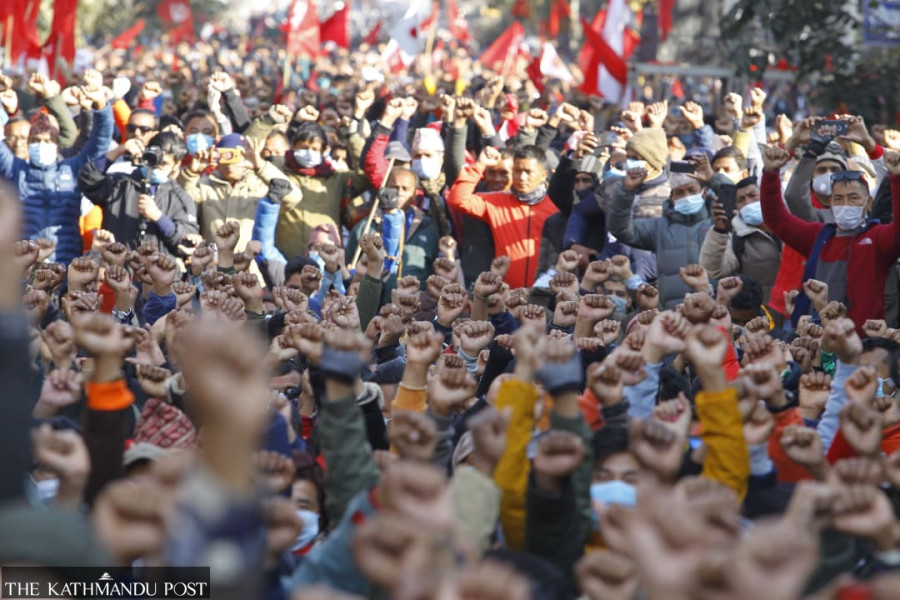
In Nepal, prior to the March 5 House of Representatives elections, the communist vote share had consistently hovered around 40 percent in seven past elections—dating back to 1990 and including the 2022 polls.
But the March 5 results show that overall support for communist parties has roughly halved, dropping to around 21 percent. This is true for votes secured by the CPN-UML and the Nepali Communist Party (NCP) both in the direct and proportional representation categories.
Under the first-past-the-post (FPTP) or direct category, the UML won 9 out of 165 seats, while the NCP, an amalgam of over a dozen leftist groups and parties including the former CPN (Maoist Centre), secured 7 seats. (Although the victory of NCP’s Matrika Yadav was announced in Dhanusha constituency 1, the result has not been finalised due to ongoing disputes.)
Under the proportional representation (PR) category, the UML got 13.49 percent of the votes, while the NCP garnered 7.49 percent.
In the 2017 elections, UML and then CPN (Maoist Centre), a major component of the NCP, had contested in an alliance and together won 174 seats in Parliament. According to the current election results, their combined seat count has now shrunk to around 40.
Even the Rastriya Janamorcha, which had consistently managed to win elections from Pyuthan despite adverse circumstances, and the Nepal Majdoor Kisan Party (NMKP), which had likewise long held Bhaktapur constituency 1, were unable to defend their strongholds this time. Rastriya Swatantra Party (RSP) won both constituencies.
RSP in total won 125 seats in FPTP and holds 47.8 percent in the PR category.
Was the failure of both the major and fringe communist parties to retain their traditional strongholds solely due to the “wave of hope” that the people placed in the RSP and its prime ministerial candidate Balendra Shah, the former Kathmandu mayor respected for his clean image? Or does it indicate that the communist parties’ support base in Nepal has genuinely shrunk?
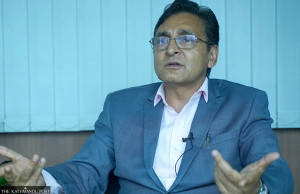
Political analyst Arun Kumar Subedi claims that the March 5 election has effectively ‘sterilised’ Nepali communist forces, arguing that they won’t be able to regain the momentum they once had in the country’s politics.
“The condition in which the Nepali Congress finds itself in this election is the result of the party becoming ‘communist’ itself,” argues Subedi.
Congress won 18 FPTP seats and 16.3 percent of PR votes in the just-concluded elections.
In the 2017 local-level elections, Congress had formed an election alliance with the then Maoist Centre, and in the 2022 elections for all three tiers of government, it had alliances with the Maoist Centre and the CPN (Unified Socialist). These two communist parties, among several others, formed the NCP ahead of the March elections.
The Nepali Congress also saw its vote share and seat count plunge in this election. Yet political analyst Subedi argues that the RSP’s adoption of Congress-style democratic ideals has further weakened communist support while boosting democratic forces.
Meanwhile, Prem Suwal, who contested the election from Bhaktapur-1 on Nepal Majodoor Kisan Party ticket and was defeated by an RSP candidate, alleges that Nepal’s communist parties are only nominally communist.
Pointing particularly to the UML and the former Maoist Centre, he argues that the current situation stems from their habit of partnering with just about any political force to contest elections and form governments. However, he declined to say whether the overall support base of Nepali communist parties has actually shrunk.
However, Surendra Pandey, a UML leader, says that nothing in politics is permanent. According to him, the fact that forces that won yesterday have lost today does not necessarily mean that those defeated today cannot win again in the future. Nevertheless, he admits that there is no reason to deny that communist forces have weakened after recent elections.
At the same time, he believes that in an “era dominated by data-centric capitalism and platform capitalism”, the relevance of traditional political forces could increasingly come under question. The way global politics is evolving, he argues, may not only weaken communist forces but also undermine democratic forces.
“As for the question of whether Nepal’s communist movement is weakening, a similar concern had emerged in 1990 following the collapse of the Soviet Union,” Pandey argued. “Therefore, it will be hasty to conclude, based on the results of a single election, that the Nepali communist movement is dead.”
Does this mean that the communist parties may still have the potential to increase their vote share again in future elections?
Refusing to even describe Nepal’s communist parties as truly communist, a young Marxist scholar, Nabean Tiwari, says that there is still considerable public interest in the agenda of socialism.
He recalls that during the first election rally of the RSP in Janakpur on January 19, the party’s senior leader and prime ministerial candidate Balen Shah also referred to socialism in his address.
However, Tiwari argues that the essence of socialism has been undermined in Nepal because profits have been privatised while losses have been socialised.
“Although the vote share of parties carrying the socialist agenda has declined due to the conduct of corrupt leaders, a large number of people in Nepal still believe in the principles of socialism,” Tiwari says. “If a right party emerges in the scene, the ideology could once again regain significant public support.”
At present, it is not so much the ideology that people have rejected; rather, voters appear to have punished those who call themselves communists but whose conduct and political behaviour suggests otherwise, he adds.




 14.85°C Kathmandu