High tax burden on people, state coffers remain in deficit
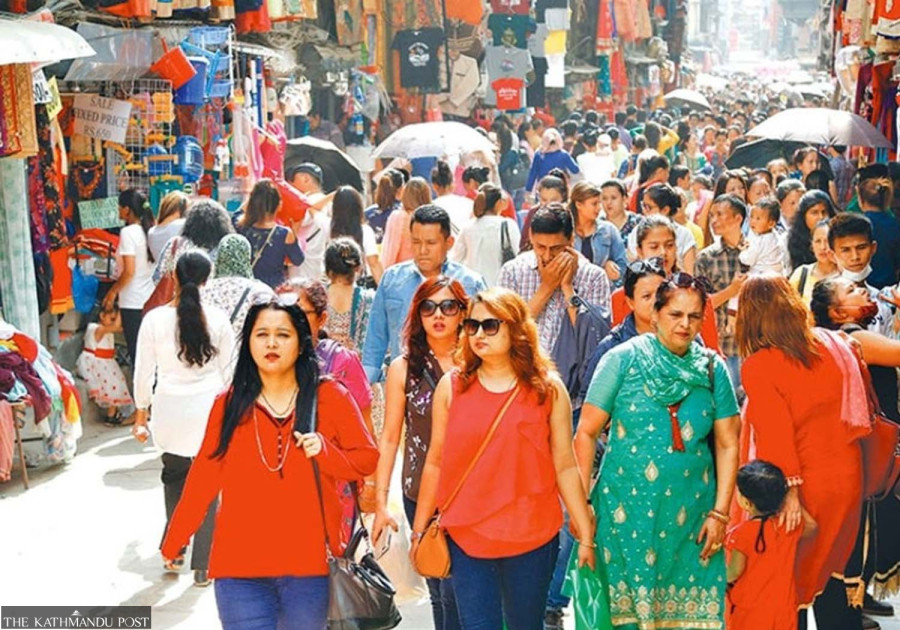
Ordinary Nepalis, burdened by rising living costs and shrinking incomes, complain they are paying increasingly high taxes while receiving poor public services in return. Public frustration has deepened as many middle-class families continue to spend heavily on private education, healthcare and transport. Post file photo
Despite collecting more than one and a half dozen different taxes from people and businesses, the Nepal government continues to struggle with widening fiscal deficits and weak revenue growth, raising concerns over the sustainability of the country’s public finances.
Ordinary Nepalis, already burdened by rising living costs and shrinking incomes, complain that they are paying increasingly high taxes while receiving poor public services in return. Apart from primary agricultural productions and medicines, most goods and services consumed in Nepal are subject to a 13 percent value added tax, while personal income tax can reach as high as 39 percent.
Nepal imposes one of the highest tax burdens in South Asia, not only in terms of rates but also in the number of taxes collected by the federal government. When taxes levied by provincial and local governments are included, the number rises to nearly four dozen.
Yet despite the broad tax net, revenue collection has slowed in recent years and remains insufficient even to cover the government’s recurrent expenditure.
“People pay a large portion of their income to the state, but they still face poor roads, weak healthcare, low-quality public education and unreliable public services,” said former finance secretary and tax expert Laxman Aryal. “Nepal now needs to move towards a more integrated tax system and gradually lower tax rates.”
Under the federal government alone, citizens pay income tax, value added tax, customs duties, excise duty, education service tax, foreign employment service tax, infrastructure development tax, road maintenance tax, pollution control tax, telephone ownership tax, digital service tax, luxury tax, health risk tax and green tax, among others.
Economists say the problem lies not only in the number of taxes but also in weak implementation and a narrow economic base. Nepal’s economy has struggled to sustain average growth above 4 percent in recent years, limiting income expansion and weakening consumption.
“The informal economy remains large and the real size of Nepal’s gross domestic product has not been properly measured,” Aryal said. “Unless the revenue system is reformed and implemented effectively, there is little possibility of substantially increasing revenue collection.”
Government reports also show a steady slowdown in revenue mobilisation, particularly after the Covid pandemic. According to the white paper presented by Finance Minister Swarnim Wagle, average annual revenue growth fell from 14.9 percent in the five fiscal years before 2019-20 to 8.7 percent in the following five years.
The ratio of federal revenue collection to gross domestic product has also declined. It stood at 21.5 percent in the fiscal year 2020-21 but has fallen to 19.3 percent in the last fiscal year of 2024-25.
As of May 23 this year, the government had mobilised Rs1.012 trillion in revenue, an increase of 7.7 percent compared to the same period last year. However, actual collection remains well below the government’s annual target.
The government’s weak fiscal position has become increasingly visible in recent months. According to data from the Financial Comptroller General Office, the federal government’s treasury remained in deficit by Rs179.48 billion as of May 23. During the same period last year, the government earned Rs1.03 trillion but spent Rs1.21 trillion.
Public frustration has deepened as many middle-class families continue to spend heavily on private education, healthcare and transport despite paying high taxes.
Nepal’s social security system also remains weak compared to many South Asian countries. Public hospitals continue to struggle with staff shortages and inadequate facilities, while the quality of community schools and public transport services remains poor.
Tax expert and chartered accountant Sudarshan Raj Pandey said the government should simplify the tax system so that taxpayers are not forced to deal with overlapping laws and multiple payment channels.
“Many people still do not know where and how much tax they are required to pay,” said Pandey. “In some cases, laws introduced by different levels of government even contradict each other. The tax system should be simplified and digitised.”
Pandey, however, argued that reducing taxes immediately may not be practical because the government’s income sources are already shrinking. “If the government reduces taxes now, it may face even greater difficulty in financing basic state functions and social obligations,” he said. “The priority should be improving efficiency, not abruptly lowering taxes.”
Actual revenue collection has consistently fallen short of targets. A report shows that over the past 10 years, revenue mobilisation reached only an average of 87.6 percent of the targets set in the budget. As of May 23 in the current fiscal year, revenue mobilisation stood at around 82 percent of the monthly target and 68.39 percent of the annual target. The white paper states that revenue collection needs to be strengthened through tighter control of revenue leakage, expansion of the tax base, simplification of tax administration and greater digitalisation.
According to government data, Nepal’s revenue system remains heavily dependent on imports and consumption. Nearly 45 percent of total tax revenue comes from imported goods, leaving the economy highly vulnerable to external shocks and fluctuations in global trade.
The white paper report has also warned that conflict in West Asia could disrupt import supply chains and further affect revenue collection in Nepal. Economists say weak domestic demand and sluggish capital spending have repeatedly prevented the government from meeting ambitious revenue targets.
In the fiscal year 2024-25, value added tax contributed 29 percent of total revenue, while income tax accounted for 25.2 percent. Customs duties contributed 19.6 percent and excise duties 14.8 percent.
At the same time, the government’s unpaid liabilities continue to rise. The white paper states that although federal ministries received approval for multi-year contracts worth more than Rs1.03 trillion, only Rs806 billion worth of contracts were signed.
Of those commitments, around Rs402 billion in payment obligations have already been carried into the current fiscal year, but only Rs128 billion has been allocated in this year’s budget.
The government also still owes nearly Rs4 billion in subsidised loan interest payments and Rs16.87 billion under the national health insurance programme.
Economists warn that widening budget deficits and rising debt dependency could create long-term fiscal risks if reforms are delayed further.
Over the past decade, Nepal’s federal budget deficit has averaged around 7 percent of gross domestic product due to high recurrent expenditure and weak revenue growth. Analysts say the trend could eventually force the government to borrow simply to repay existing debt, increasing pressure on future public finances.




 24.23°C Kathmandu