They were rescued from the streets. Then they went back
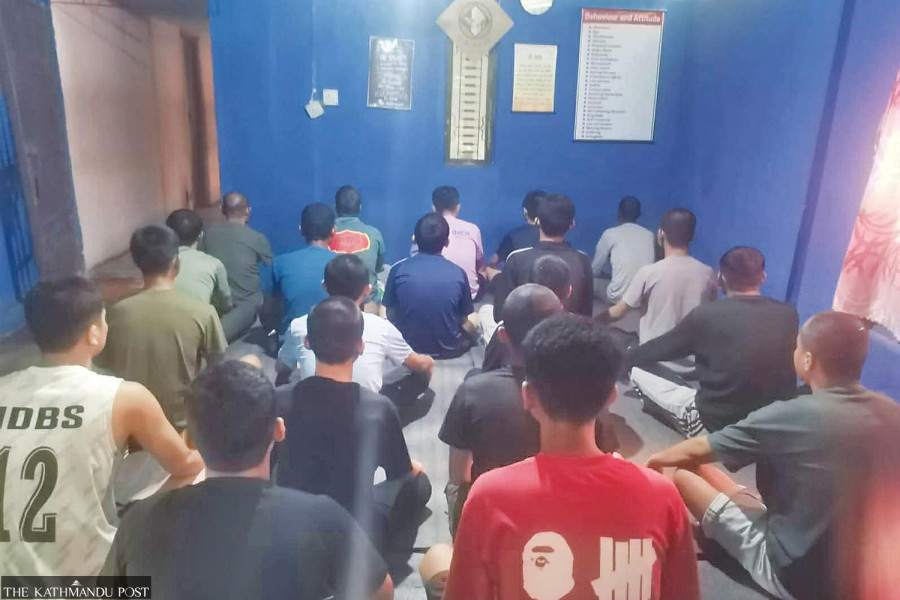
Family breakdown, poverty and neglect push children onto the streets, where a grim cycle of survival and addiction takes hold, and repeated rescue attempts rarely offer a lasting way out. Boys at a rehabilitation centre in Dharan. Elina Rai/TKP
For Vinay, home had become unbearable long before he turned eight. The constant quarrels inside the house and the sense of insecurity pushed him to make a decision no child should have to make: he left home.
While children his age slept in the warmth of their families, Vinay spent his nights on cold pavements and street corners in Dharan. In the beginning, the silence of the night, hunger and unfamiliar faces terrified him. Over time, he met other children living on the streets and slowly found a world of his own.
Street life started to feel enjoyable once I made friends,” Vinay recalled.
During the day, they wandered around Bhanuchowk market, the bus park and nearby streets. They begged for money, carried small loads for passers-by and collected recyclable waste to earn a few rupees. The money first went towards food, but gradually it began funding addiction. Instead of books and pens, Vinay’s hands became familiar with tubes of dendrite glue.
Street life gave him a sense of freedom. No one stopped him, questioned him or imposed rules. He could walk where he wanted, sleep where he wished and spend time with friends. But the same freedom also dragged him towards violence, danger and substance abuse.
Although his father and younger brother were at home, Vinay said he constantly felt neglected and discriminated against.
“My mother died, and my father remarried. My stepmother never loved me,” he said. “She beat me, made me work and even discriminated against me in school. My younger brother went to a private school while I studied in a government school. I used to wish they loved me the way they loved him. Eventually, the mental stress became too much, and I left home.”
At the age of nine, Vinay was first taken to Voice of Children in Itahari, an organisation working to protect and rehabilitate street children. The organisation rescued him from the streets and tried to provide a safe environment.
But institutional life felt alien to him.
“It felt like being imprisoned,” he said.
By then, he had become used to the openness of street life. Waking up on time, attending classes and following routines were all unfamiliar. After spending a year there and showing signs of behavioural improvement, he was sent back home for reintegration. Within days, he returned to the streets.
Nothing at home had changed.
The cycle repeated itself many times. He moved from the streets to the institution, then back home, and eventually back to the streets again.
Now 20, Vinay says little has changed in his life. The journey that began in childhood has never truly ended. He still survives on the streets, collecting discarded plastic bottles for income. A portion of what he earns still goes towards illegal substances.
Like Vinay, Roman Karki was pushed onto the streets by family breakdown and poverty.
His father died during the Covid pandemic, plunging the family deeper into hardship. His mother struggled to support the household and later remarried. A new family was formed, but for Roman, a new struggle began.
After his father’s death and his mother’s remarriage, responsibility for his younger sister fell on his shoulders. His elderly grandmother also depended on him. Unable to manage even daily meals, Roman left for the streets at the age of 11.
He began begging from strangers and says he could earn as much as 500 rupees a day in the beginning.
Soon, he too found companionship among other street children. Together, they bought dendrite glue for 100 rupees and spent entire days inhaling it.
Eventually, he was reached by an organisation that rescued him from the streets and placed him in protective care. For the first time in a long while, he had regular meals, clean clothes and a safe bed. He met other children with similar experiences, and the organisation tried to reconnect him with school.
Later, after coordinating with his family, he returned home. He was excited to reunite with his grandmother and sister.
But the same economic hardship awaited him there.
The organisation continued supporting his schooling, clothes and stationery, yet the family’s financial condition remained dire. Before long, he was back on the streets.
He was rescued again and returned to the institution. Life there remained stable as long as he stayed, but the absence of a supportive environment repeatedly pushed him back to the streets.
Today, Roman still survives on the streets. Addiction has taken hold of his life. Some days he collects plastic bottles, other days he works as a labourer to sustain himself.
Children like Vinay and Roman are often driven onto the streets by poverty, family disintegration and the absence of parental care. Many become trapped in substance abuse. Although various organisations work on rescue and rehabilitation, many children eventually return to street life.
The story of 14-year-old Roshan follows a similar pattern.
He now spends his nights on the streets of Dharan with friends, sleeping on the porches of closed shops after spending the day cleaning vehicles or collecting plastic and bottles.
His parents separated when he was five. After his father remarried, Roshan stayed with his mother, who later remarried after leaving him in his grandmother’s care. When his grandmother died, he moved to relatives’ homes where, he says, he received more scolding than affection.
“They hardly gave me proper food and constantly shouted at me,” he said. “So I ran away and came to the streets.”
Sometimes he went hungry. Other times, he survived on leftover food from hotels. He has witnessed violence, abuse and widespread drug use on the streets.
A few months ago, he was rescued and placed in a shelter where he received food, accommodation and access to education. But he soon returned to the streets.
“There were too many rules there,” he said. “We couldn’t go outside the gate, and most of my friends were already on the streets, so I ran away again.”
In the third week of April, a joint team comprising the Child Search Coordination Centre, local governments, police and the National Child Rights Council conducted a field survey of street children in Kathmandu.
As soon as some children spotted a vehicle marked with the number 104, the hotline operated by Nepal’s child helpline service, several hid behind shops, some disappeared into crowds, while others turned back from a distance. Many refused to speak when approached.
According to a report prepared by the centre, between 20 and 30 children were found begging daily around the Pashupatinath temple premises.
A 14-year-old boy from Dhading found in the area said his mother had abandoned him in childhood, and his father’s remarriage left him neglected. Unable to afford food and clothing at home, he came to Kathmandu with friends. He is now under the centre’s protection.
A 13-year-old boy from Makawanpur, rescued from Chuchepati, had already developed a routine of begging, inhaling illegal substances and sleeping on the streets. During questioning, he said his mother had abandoned him when he was young, while his father, a daily wage labourer, failed to care for him properly.
A 17-year-old girl rescued from the Swayambhu area, originally from Rolpa, also cited family breakdown as the reason she ended up on the streets. She said her mother remarried and her father neglected her. Since her rescue, she has spoken very little, answering questions briefly and spending most of her time alone.
A 15-year-old boy from Sindhuli had spent three years collecting scrap materials on the streets before being rescued from Banepa in April. He said his father drank heavily, neglected him and made him feel unsafe at home.
Another 13-year-old boy rescued from Kathmandu’s New Bus Park said he came to the streets after his mother remarried. He had become involved with groups engaged in begging, theft and drug abuse.
Santosh Adhikari, coordinator of the Child Search Coordination Centre, said parental neglect, remarriage, domestic tension and the absence of affection are major reasons children end up on the streets.
Field surveys conducted in 15 areas, including Pashupati, Gaushala, New Bus Park, Chabahil, Gwarko and Kumaripati, identified 191 children. Some had no guardians, while others still lived with their families.
Adhikari said many of those found were of Indian origin or non-Nepali nationals. Children without guardians have been placed in child protection homes.
“Many children ran away as soon as they saw us,” he said. “Even when we approached them, some refused to speak. Some were begging alone while others were doing so with their families.”
The survey report also found cases where people used fake recommendation letters from local governments and documents claiming financial hardship to collect money.
Some groups of children were found moving between temples and public spaces across the Kathmandu Valley, staying in one area for only a few days before shifting elsewhere.
The report recommends an integrated approach covering identification, rescue, protection, rehabilitation, education, healthcare, psychosocial counselling, skills development and family reunification.
Under the Street Children Special Protection Guidelines 2025, provisions exist for temporary shelters, socialisation centres, service-provider organisations and rehabilitation centres for substance abuse treatment. The guidelines also require arrangements for housing, nutrition and overall care.
However, Ram Bahadur Chand, information officer at the National Child Rights Council, said implementation remains weak due to inadequate budgets and a lack of infrastructure.
“The institutions are operating with whatever physical infrastructure they currently have,” he said. “We allocate some funds through annual performance agreements, but it is not enough. We ask organisations to contribute based on their own expertise as well.”
According to Chand, many children escape from shelters by breaking walls, damaging gates or fleeing secretly.
“The biggest weakness is our inability to understand the mental state of rescued children and help them remain in the centres,” he said.
He said the government currently spends around Rs30 million annually on managing street children, but at least Rs150 million would be needed for effective long-term rehabilitation and reform.
Leela Bhujel, a staff member at Voice of Children, said most children end up on the streets because of family breakdown, domestic violence, poverty and parental neglect.
“Some children run away because they cannot tolerate violence at home, while others are pushed onto the streets by economic hardship,” she said.
According to her, rescue alone cannot solve the problem.
“To rehabilitate these children, we need to improve family environments, provide psychosocial counselling, education and long-term protection,” she said. “Otherwise, they return to the streets again.”
Child rights activist Milan Darnal said children who are forced onto the streets despite having parents have the right to state protection and that all three tiers of government must take responsibility for their management and rehabilitation.
Editor’s note: Names of all children in this story have been changed to protect their identities.




 23.25°C Kathmandu