Voter turnout revised to 60 percent, lowest since 1991
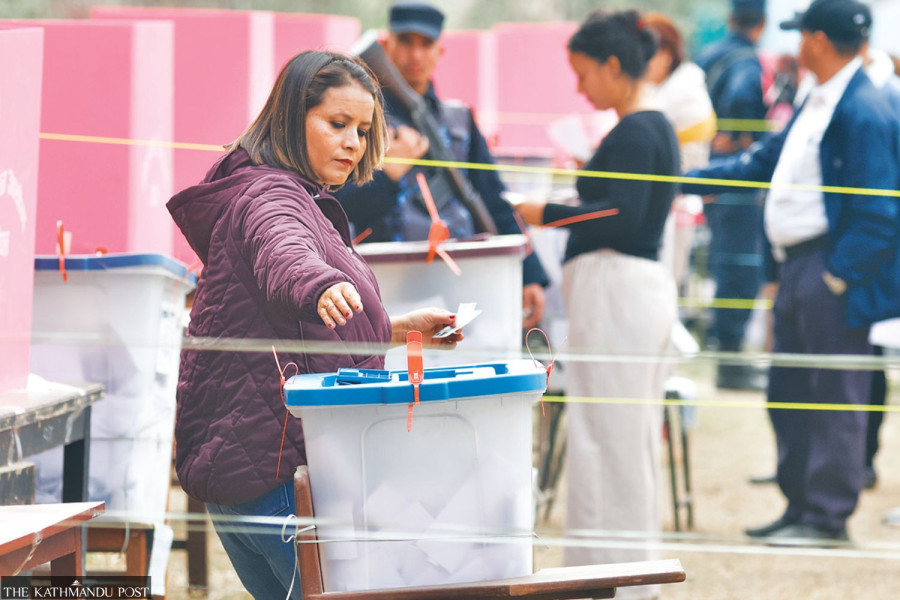
Six parties cross PR threshold to become national parties. RSP nears two-thirds majority. A woman casts her vote at a polling centre in Dudhpati, Bhaktapur on March 5. Post Photo: Hemanta Shrestha
The Election Commission has revised the voter turnout in the March 5 parliamentary elections to around 60 percent as it completes the count under both the first-past-the-post and proportional representation categories. Earlier, it had put the turnout at 58.07 percent.
Updating its report on Wednesday, the constitutional election management body said that as many as 11,312,445 voters, or 59.84 percent, exercised their franchise.
The commission’s preliminary report said that of the 18,903,689 eligible voters, only 10,977,711 had actually voted. As per the latest report, the number of valid votes stands at 10,849,082, which is 94.9 percent of the total cast. This means the share of invalid votes so far is 5.1 percent.
“Counting has completed, but we are still verifying the data. There can still be slight changes in the final tally, which will be published tomorrow (Thursday),” Kul Bahadur GC, assistant spokesperson at the commission, told the Post. Even as the turnout has reached close to 60 percent, it is still the lowest since the 1991 democratic elections, as turnout had always stood above 61 percent.
Similarly, the average voter turnout since the 2008 Constituent Assembly elections is also way higher, 69.4 percent, than in the latest polls. While the highest (78.3 percent) was seen in the 2013 second Constituent Assembly elections, and the previous lowest (61.4 percent) came in the 2022 elections.
As the commission completes the counting, the Rastriya Swatantra Party, which registered an unprecedented victory in modern democratic history, may still fall two seats short of a two-thirds majority.
The four-year-old party won 125 out of 165 first-past-the-post (FPTP) seats. It has managed to bag around 48 percent of the total votes cast under the proportional representation (PR) category. Even though the commission has not made an official seat allocation, the largest party will get 57 seats under the PR category as it has secured around 48 percent of the valid votes. A total of 5.18 million votes have fallen in the RSP’s kitty. The RSP will have 182 members in the 275-strong House of Representatives, two seats short of the 184 mark for the two-thirds.
The Nepali Congress, the second largest party, has secured slightly above 16 percent vote share under the PR category. The Congress, which won 18 FPTP seats, will get 20 PR seats. The final tally of the grand old party will reach 36.
The CPN-UML is the biggest loser in the present election. With just nine FPTP seats, the party has lost 50 percent of the vote shares under the PR category compared to the 2022 elections. It will get 16 PR seats, taking the total number to 25.
The Nepali Communist Party will have 17 seats in the new parliament, including nine PR seats. The Shram Sanskriti Party led by maverick Harka Sampang, has become a national party in its first attempt, with seven seats, including four under the PR category. The Rastriya Prajatantra Party, the last party to be recognised as a national party, will have five seats, with four under the PR category.
After the formal seat allocation on Thursday, the commission will write to the respective parties to request that they name their PR members within three days. “The commission will elect the members after verifying that the nominations comply with the seat shares required for each cluster under the inclusive principle,” said GC. The commission plans to submit the final election results to the President on March 19, formally opening the door to call the House session.
As many as 6,541 party and independent candidates were in the race on March 5. Among them, 3,406 were candidates in the first-past-the-post system, and the remaining were in the proportional representation system.
Under the FPTP, 65 parties fielded 2,263 candidates for 165 seats, and 1,143 were running as independents. Of the total candidates contesting direct elections, 3,017 were male, and 388 were female. Only one was from the sexual and gender minority community.
Binod Ghimire covers parliamentary affairs and human rights for The Kathmandu Post. Since joining the Post in 2010, he has reported primarily on social issues, focusing on education and transitional justice.




 23.73°C Kathmandu