Nepal set for fresh fertiliser crunch as Iran war hits supply, pushes up prices
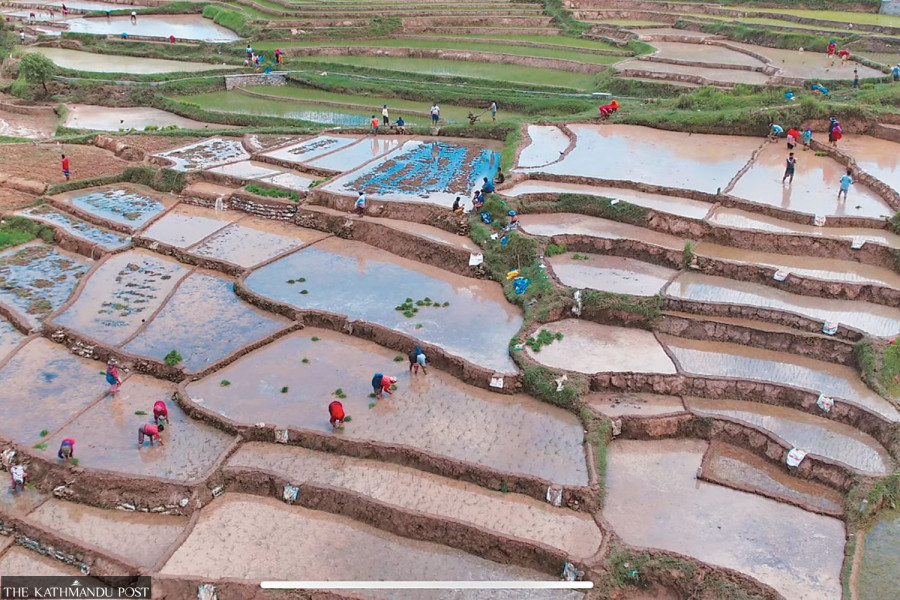
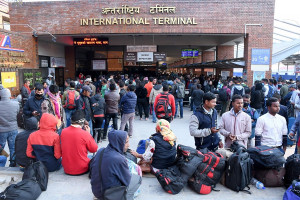
Conflict in West Asia is disrupting global fertiliser markets and threatening Nepal’s rice inputs ahead of crucial planting season. A drop in fertiliser imports impacts crop yields, potentially driving up food prices and worsening inflation. POST FILE PHOTO
The war in Iran is pushing already high chemical fertiliser prices higher still, potentially affecting imports to countries like Nepal that are fully dependent on the vital farm inputs to grow food. A prolonged chemical fertiliser crisis could be a big headache for the new government.
As Nepal’s paddy transplantation begins in June, the ongoing war has worried policymakers and farmers about potential supply chain disruptions.
Rice is the dominant staple in Nepal, accounting for roughly 67 percent of total cereal consumption and over 50 percent of calorie intake. With an average annual consumption of 137.5 kg per person, rice plays a critical role in food security and, when combined with legumes, provides about 23 percent of the total protein intake, the cheapest source of protein.
Nepal has seen fertiliser shortages time and again, as the farm sector is neglected: it is labour-intensive and yields low income.
The International Food Policy Research Institute (IFPRI), an international research center focussed on agriculture and food systems, has warned of potential food security impacts in a number of countries fully dependent on imported chemical fertilisers to grow food.
According to the Ministry of Agriculture and Livestock Development, the fertiliser stock currently stands at 137,500 tonnes.
A consignment of 45,000 tonnes is en route and may reach the country within a few weeks.
“This means around 183,000 tonnes will be available for the peak paddy transplantation period,” said Ram Krishna Shrestha, joint secretary at the ministry. “But the three-month paddy transplantation period needs at least 250,000 tonnes.”
According to Shrestha, who is also the chairperson of the Agriculture Inputs Company, a state-owned company dedicated to supplying fertilisers, a contract for another 90,000 tonnes has also been signed.
But government officials are unsure whether the contract will be honoured given the ongoing tensions in West Asia, particularly the Strait of Hormuz—the Persian Gulf’s only sea passage to the open ocean.
The attack on Iran by US and Israeli forces and Iranian retaliation against US allies in the Gulf have roiled energy and fertiliser markets by disrupting shipping through the strategically crucial strait.
Importing fertiliser will be a difficult task.
Officials privy to the matter said that the first reason is the price, which has jumped by over $100 per tonne just within a week. The supplier normally does not take risk to fulfill contracts when prices become volatile in the global market. If global prices rise, suppliers often prefer to forfeit their performance bonds rather than deliver expensive goods.
For example, in 2019-20, when the fertiliser prices peaked to record high, seven out of 10 global suppliers in Nepal failed to deliver fertiliser on time. The retender process is tardier still. It takes approximately six months to procure fertiliser via global tenders, and only a few contractors consistently meet deadlines. As a result, shortages in Nepal keep recurring.
According to Shrestha, the price of urea in the global market has already jumped to $700 per tonne, a rise of $100 per tonne in a week.
Nepal’s agriculture inputs company had last signed a contract for the supply of urea at $585 per tonne.
In Nepal, urea now costs Rs130 per kg on the open market, while state-owned suppliers are selling it at Rs14 per kg. Similarly, diammonium phosphate (DAP) is priced Rs43 per kg, a subsidised rate.
A drop in fertiliser imports impacts crop yields, potentially driving up food prices, worsening inflation in a country where, according to the National Statistics Office, 20.27 percent of the population lives below the poverty line, with rural poverty at 24.66 percent and urban poverty at 18.34 percent.
High fertiliser prices mean low profitability margins for farmers, and they would apply less fertiliser on their crops. Low inputs lead to low yields, which may hurt the incomes of small farmers who make up more than 60 percent of Nepal’s agricultural sector.
According to officials at the agriculture inputs company, the insurance and transport charges of shipping companies have increased significantly due to the Iran war.
“All these scenarios suggest a low likelihood of fertiliser arriving on time,” an official told the Post, requesting anonymity. He added that unavailability could affect the country’s economy and worsen food insecurity.
The IFPRIreported that about 27 percent of the world’s oil exports, 20 percent of global liquified natural gas (LNG) exports, and 20-30 percent of global fertiliser exports, including urea, ammonia, phosphates, and sulphur, pass through the Strait of Hormuz.
Drone and rocket strikes on tankers pose ongoing danger and have made maritime insurance costs prohibitive in the region, resulting in a more than 70 percent decline in shipping through the strait since February 28, when the conflict began.
A prolonged conflict could choke global sea trade from the Persian Gulf and raise the costs of energy and fertiliser prices globally.
Qatar, Saudi Arabia, Bahrain, and Oman are major fertiliser exporters, particularly of urea, DAP, and anhydrous ammonia. Some estimates suggest that as much as one-third of global fertiliser trade could be affected.
Urea prices in West Asia closed over $590 per tonne on March 5, up over $90 per tonne compared to a week earlier, a 19 percent increase, while US Gulf DAP prices hit $655 per tonne, up over $30 per tonne, a 5 percent increase, the IFPRI reported.
Nepal’s agriculture ministry said it is closely assessing the situation.
“We have been discussing the issue. We are exploring many alternatives to ensure that chemical fertilisers are available to our farmers. One alternative is neighbouring India,” said Shrestha.
India, the world’s largest buyer of urea and DAP, also imports up to a third of its fertilisers.
Nepal and India signed a 5-year government-to-government (G2G) MoU on February 28, 2022, to secure long-term supplies of urea and DAP fertiliser, aiming to resolve Nepal's chronic shortages.
The agreement guarantees at least 30 percent of Nepal's annual requirement, with supply volumes rising from 150,000 tonnes in the first year to 210,000 tonnes by the fifth year.
The MoU is ending in March 2026.
“We sent a draft to renew the MoU two months ago through the Ministry of Foreign Affairs. We are waiting for India’s response,” said Shrestha. “As Nepal is getting a new government, we hope India may support it during this crisis.”
The Ministry of Agriculture and Livestock Development has estimated that the annual demand for fertilisers stands at around 800,000 tonnes. Of this, 500,000 tonnes are imported and there is a shortfall of 300,000 tonnes.
A separate report by USAID, an international development agency, has shown that Nepal is highly dependent on smuggled fertilisers, and estimates that nearly 70 percent of the 600,000 to 800,000 tonnes of fertilisers consumed in the country is improperly imported.
Sangam Prasain is Business Editor at The Kathmandu Post, covering tourism, agriculture, mountaineering, aviation, infrastructure and other economic affairs. He joined The Kathmandu Post in October 2009.




 15.26°C Kathmandu