Everest drone ban, which supposedly exposed geopolitical fault lines, lifted after five days
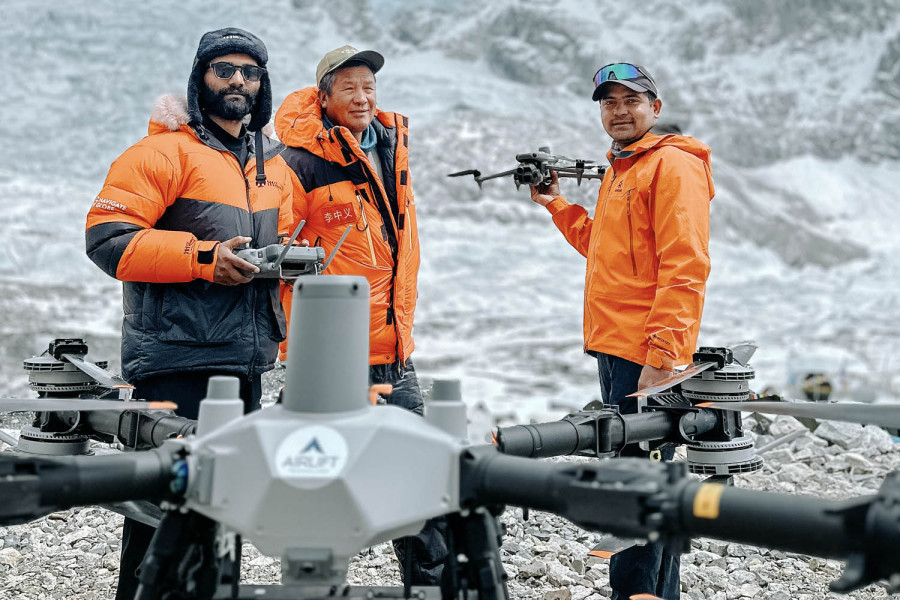
Sudden suspension of Airlift Technology’s drone operations disrupted search efforts in Khumbu amid unexplained security concerns. Airlift representatives said they had been in continuous communication with the home ministry since Monday and reapplied for permission as instructed. Photo: Courtesy of Airlift Technology.
In the early hourson Tuesday, the Expedition Operators Association Nepal reached out to a drone operator to help locate climbers after a serac collapse in the Khumbu Icefall triggered panic along the Everest climbing route.
But the operator—Airlift Technology, a Nepali tech startup—could not respond.
The company, which has a tripartite agreement with the Sagarmatha Pollution Control Committee (SPCC) and the Khumbu Pasang Lhamu Rural Municipality to transport garbage and supplies between Base Camp and Camp I, had its operations abruptly suspended on April 30 evening by the home ministry, citing unspecified security concerns.
The suspension came without a detailed explanation, leaving local authorities and operators in confusion at a critical moment.
The order appeared to target two drones—the Chinese-made DJI FlyCart 100 and the American-made Freefly Systems Alta X Gen 2—both associated with Airlift’s operations.
Seven Summit Treks, Nepal’s leading expedition operator, had subcontracted Airlift to conduct a test flight of the American drone following the success of Chinese heavy-lift drones last year.
The issue, however, quickly spiralled into controversy in Kathmandu, where observers pointed to a possible geopolitical dimension, with the US and China competing to establish a technological foothold on the world’s highest peak.
A home ministry official said the decision to suspend Airlift’s operations was influenced in part by concerns relayed through the foreign ministry, amid heightened sensitivity over the presence of both American and Chinese technologies on Everest.
“There were also reports circulating that Airlift was planning to deploy a robot from an American company,” the official said.
Amid speculations, Airlift’s operations were abruptly halted.
A planned test of the American-made Alta X Gen 2 was stopped at Everest Base Camp after officials determined that the required permissions had not been secured.
According to officials stationed at Base Camp, the drone was only showcased at an altitude of 5,364 metres rather than flown. The demonstration was attended by Sergio Gor, special envoy for South and Central Asian Affairs under US President Donald Trump.
Mingma Sherpa, chairman of Seven Summit Treks, which managed logistics for the American team, said the objective was to test the feasibility of using drones for cargo transport and waste management on Everest.
“The drone was only showcased as the permission for a test flight had not been granted,” he said.
The Alta X Gen 2 has a payload capacity of around 15.88 kilograms at sea level, though its performance in extreme high-altitude conditions remains untested.
Debendra Subedi, assistant chief district officer at the District Administration Office in Solukhumbu, said the home ministry’s order applied only to two drones operating at the Everest Base Camp.
However, he added that the district office had yet to get an official communication.
The urgency of drone deployment became evident following a fresh incident in the Khumbu Icefall.
A massive, unstable serac blocked the climbing route shortly after it was opened on April 28, briefly disrupting the 2026 season.
According to the Department of Tourism, climbers and Sherpa guides heading towards Camp II for acclimatisation were struck when part of a serac collapsed onto the route at around 4:45 am on Tuesday.
Of the four individuals affected, one Sherpa guide and one Indian climber were injured and later airlifted to Kathmandu, where they are undergoing treatment at HAMS Hospital.
Though not a major accident, Tuesday’s incident caused immediate panic, prompting the Expedition Operators Association Nepal and the Icefall Doctors to seek drone assistance to assess the situation and locate climbers.
“We were unable to proceed because a suspension order had been issued,” said Raj Bikram Maharjan, CEO of Airlift Technology, a tech startup.
“There has been confusion over our operation, even though we have been working with SPCC and the local government since last year.”
The rescue operation, however, was completed about 45 minutes later without drone support.
Airlift representatives said they had been in continuous communication with the home ministry since Monday and reapplied for permission as instructed.
The ministry granted approval on Tuesday evening after a five-day halt. The company now plans to seek clearance from Sagarmatha National Park before resuming full operations.
Mingma Chhiri Sherpa, chairman of the Khumbu Pasang Lhamu Rural Municipality, confirmed receiving a letter announcing the temporary suspension but said no reason had been provided.
“We cannot comment without clarity. The Home Ministry should explain,” he said.
The Post’s repeated attempts to contact ministry officials since Monday were unsuccessful.
Delays, however, could prove costly. The Everest spring climbing window typically runs only until the end of May, and Airlift is contractually obliged to remove 10 tonnes of garbage from Camp I this season while supplying logistics to support high-altitude workers.
Drone use has increasingly been seen as a game changer in mountain logistics.
Airlift charges about Rs1,000 per kg to transport goods up to Camp I, significantly lower than helicopter costs. Tests for flights beyond Camp I, including up to Camp II, are yet to be conducted.
Last year, during route preparation on Mount Pumori, an Airlift drone identified a dangerously hanging serac, prompting the expedition to halt. Hours later, a massive avalanche struck the same area, narrowly avoiding casualties.
With 3D mapping capabilities, drones can scan hazardous terrain such as the Khumbu Icefall, measuring crevasses and detecting unstable ice formations. This allows climbers and guides to assess risks remotely and reduce exposure to life-threatening zones.
Despite these benefits, concerns persist within the government.
Officials say the Ministry of Culture, Tourism and Civil Aviation had flagged potential security risks associated with drone operations about six weeks ago, particularly regarding geo-mapping capabilities and other sensitive features.
Everest’s geopolitical location—straddling the border between Nepal and China’s Tibet Autonomous Region—adds further complexity, prompting calls for detailed study before allowing large-scale commercial drone deployment.
But another government official stationed at Everest Base Camp described the suspension as a response driven largely by speculation.
“The home ministry acted quickly, but much of it was based on rumours,” the official said.
Authorities have since advised Airlift to remain cautious about geopolitical sensitivities, particularly given Everest’s location along an international border.
Nepal’s cautious stance contrasts with its earlier approval of Chinese drones.
In 2025, the government allowed heavy-lift drones manufactured by DJI to operate commercially on Everest, marking a turning point in high-altitude logistics.
In April last year, DJI conducted what is considered the world’s highest drone delivery test, reaching Camp I at 6,130 metres. The drone carried 15 kilograms per flight under extreme conditions, including temperatures of minus 25 degrees Celsius and winds of up to 45 kilometres per hour.
That mission set a new altitude record for drone delivery, surpassing the previous benchmark of around 5,000 metres in India’s Arunachal Pradesh.
The technology has since proven transformative. Tasks that once required six to seven hours of climbing by Sherpas carrying heavy loads can now be completed in minutes. In some cases, a single drone flight can replace the labour of more than a dozen porters.
Following initial trials, Airlift deployed two heavy-lift drones that transported 2.5 tonnes of supplies and removed 300 kilograms of garbage from the Khumbu Icefall.
Drones were also used to ferry most of the ladders and ropes required to establish the Everest route up to Camp I—work traditionally carried out by the Icefall Doctors, a specialised team mobilised by SPCC.
In 2025 alone, drones transported 444 kilograms of route-fixing equipment, 900 kilograms of expedition supplies, and 150 oxygen cylinders.
All Everest climbers must pass through the Khumbu Icefall, a highly unstable glacier about a kilometre long, notorious for shifting ice towers and frequent avalanches.
To minimise risk, climbers typically cross the icefall at night or early morning, when colder temperatures stabilise the ice. As temperatures rise, so does the risk of collapse.
Operators argue that expanding drone use could significantly reduce human exposure in such hazardous zones.
This year’s climbing season has already faced delays due to massive hanging seracs blocking route-setting efforts, underscoring the increasing unpredictability of conditions on Everest.
Milan Pandey, co-founder of Airlift Technology, said drone-assisted operations had already begun earlier this season before the suspension.
“We delivered four aluminium ladders and five rolls of rope to Camp I last Tuesday,” he said. “We also transported oxygen cylinders before the suspension.”
The company has been using the DJI FlyCart 100, which can carry up to 100 kilograms at sea level and around 40 kilograms in high-altitude conditions.
Sangam Prasain is Business Editor at The Kathmandu Post, covering tourism, agriculture, mountaineering, aviation, infrastructure and other economic affairs. He joined The Kathmandu Post in October 2009.




 20.02°C Kathmandu