Business leaders call for stable policies and stronger government-private partnership at Kantipur Economic Summit
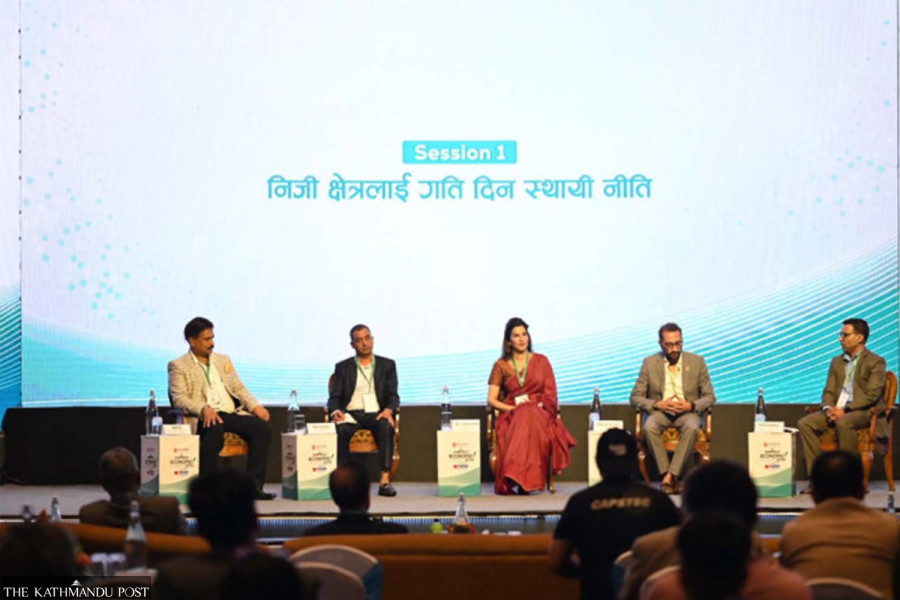
Say frequent policy changes, regulatory uncertainty and weak infrastructure are holding back investment and industrial growth in Nepal. Panellists pictured at the Kantipur Economic Summit in Kathmandu on Wednesday. Angad Dhakal/TKP
Business leaders speaking at the first session of the Kantipur Economic Summit 2026 on Wednesday called for stable policies, consistent regulations and closer cooperation between the government and private sector, saying frequent policy shifts and uncertainty were discouraging investment in Nepal.
Speaking at the session titled “Driving private sector growth: Policy, partnership and progress,” corporate executives said that Nepal’s economic ambitions could not be achieved without long-term policy consistency and a supportive business environment.
Ravi KC, vice-president for corporate affairs at Surya Nepal, criticised the jailing of businesspeople over tax-related issues, saying businesses operate to make profits and should not be treated as criminals.
“While authorities could investigate individuals suspected of funnelling money abroad without maintaining a business base in Nepal—citing concerns they might flee—he warned that detaining long-established industrialists spreads fear among entrepreneurs.”
“Someone who has spent three generations building industries and providing employment to thousands may not suffer financially from being jailed for a month or two, but it damages their social reputation, and creates an atmosphere of fear that saps an entrepreneur’s motivation,” he said. “Such actions only serve to discourage the business community.”
“No nation can achieve economic growth unless the government and the private sector work in partnership,” he said. “The government is merely a facilitator. All actual development work must be carried out by the private sector. Therefore, I believe detaining private sector entrepreneurs does more harm than good for the state.”
He further noted that such actions risk dampening the high energy and enthusiasm currently shown by the government. “It is not feasible for the state to run industries and businesses itself; this is a task for the people and entrepreneurs. The government must take the lead in this process as a guardian,” he added.
He said recent ordinances introduced by the government had raised hopes that some concerns of the private sector would be addressed, but stressed that policy stability remained essential.
Hitesh Golchha, director of Diwkar Golchha Organisation, said domestic industries had helped keep the country stable during crises such as the border blockade and the Covid pandemic.
He said Nepal’s industrial sector had struggled largely because of policy instability.
“Business demands policy stability. When you invest billions into large-scale industries, it takes four to five years just to get off the ground, stabilise operations, and establish a brand in the market,” Golchha said. “If the rules of the game change five times in those same five years, success becomes impossible. We need to know where our capital is safe so that businesses can actually survive and grow.”
He recalled that policies are often altered two or three times, even during the tenure of a single government. “When one individual commits a mistake, the state changes the entire law instead of just the policy; in such a scenario, good governance becomes the primary casualty,” he said. “We must dismantle the system where laws are rewritten simply to target individuals.”
Also speaking, Hem Raj Dhakal, co-founder and managing director of IME Group, said that Nepal has the potential to compete in the global market through an IT and knowledge-based economy.
Dhakal welcomed the government's current focus on the IT sector. “Given our youth workforce and English-speaking population, the timing is perfect for this industry,” he said. “Data from the last few years shows that Nepal is already exporting IT services worth approximately Rs20 billion annually.”
Dhakal complained that despite government praise for this rapidly expanding sector, frequent changes in administration lead to immediate policy shifts. “Taxes on IT exports have fluctuated from one percent to 10 percent and then five percent,” he said. “A stable policy will boost the confidence of the sector.”
Dhakal believes the IT sector’s contribution to Nepal’s GDP could exceed two percent. However, he pointed out that this requires essential infrastructure like robust connectivity. He said the government must take the initiative and invest in building and expanding digital infrastructure.
“While the private sector should lead, the government must provide the foundational infrastructure,” he said. “The state has invested heavily in basic structures in India. In Nepal, however, the private sector has had to carry the burden of investing in connectivity and payment gateways.”
Dhakal warned that rapid digitalisation in Nepal brings increased risks. “Cybersecurity and retaining skilled talent have become expensive and challenging issues,” he said. “The government needs to formulate clear policies regarding this.”
Ritu Singh Vaidya, president of Nepal Automobile Importers and Manufacturers Association and managing director of VOITH Group, said frequent policy changes with every change in government had become a major problem for businesses.
“There should be a national consensus on economic policy regardless of which political party comes to power,” she said. “Stable policies are necessary for economic progress.”
Vaidya also criticised the requirement to place maximum retail price labels on imported goods at customs points, calling the provision impractical.
“We are not opposing the system itself, but the process needs to be practical,” she said.
Importers have argued that unloading shipments and attaching labels to each unit at customs points increases costs and delays while creating logistical difficulties in customs clearance.
Yagya Banjade of Kantipur Daily moderated the session.




 19.12°C Kathmandu