



 18.11°C Kathmandu
Sun, Oct 25, 2026
Money
Private sector key to Nepal’s infrastructure push and job creation, says World Bank official
David Sislen says Nepal must change its perception of private enterprise and treat it as a driver of economic growth.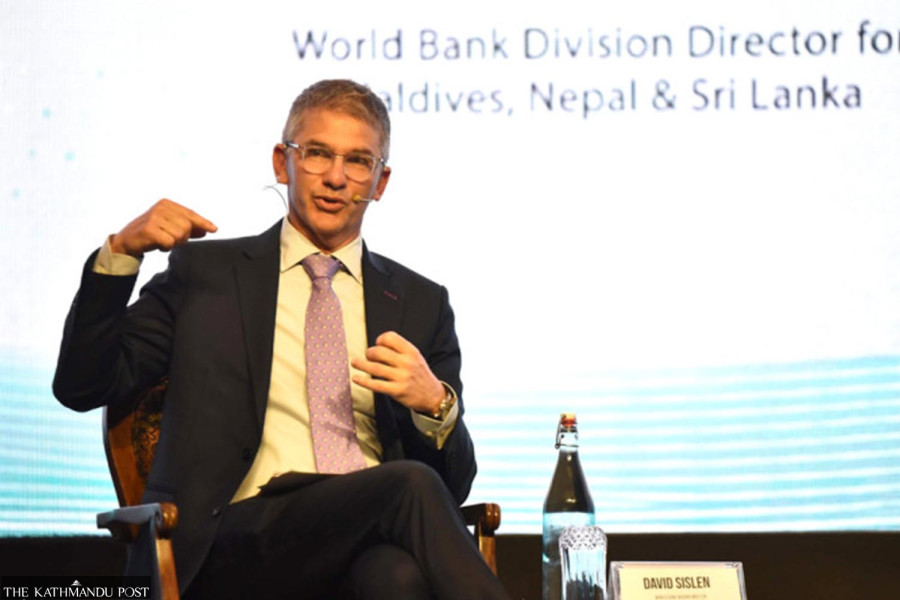
bookmark
Post Report
Published at : May 13, 2026
Updated at : May 13, 2026 18:18
Kathmandu
David Sislen, the World Bank division director for the Maldives, Nepal, and Sri Lanka, on Wednesday said Nepal must bring the private sector to the centre of its development strategy, particularly in infrastructure development and job creation.
Speaking at the opening fireside conversation of the Kantipur Economic Summit 2026 in Kathmandu, Sislen said relying solely on government investment would not be enough to meet Nepal’s infrastructure and economic ambitions.
He said Nepal needed to change the way it viewed private enterprise and treat it as an engine of economic growth. Referring to India’s economic rise, Sislen said the neighbouring country made significant progress after changing its perception towards the private sector.
“Even today, profit-making is often portrayed negatively on social media,” Sislen said. Sislen said. “The private sector should be regulated and managed properly, but the government must work in partnership with businesses.”
Sislen said Nepal was at a critical stage of economic transition and that the next 12 to 18 months would be decisive in shaping the country’s future direction.
Highlighting the country’s employment crisis, he said nearly 2,000 Nepalis leave the country every day in search of jobs abroad.
He said nearly 1.2 million Nepalis had left the country during the 21 months he has been in Nepal, warning that if the trend continues, the number of people leaving over the next four years would equal Kathmandu’s current population.
Sislen also raised concerns about the future of foreign employment at a time when artificial intelligence is disrupting jobs in global labour markets. He said the World Bank had placed employment generation at the centre of its agenda for Nepal.
According to Sislen, Nepal needed reforms in three key areas—infrastructure, policy, and finance—to address the employment crisis and support private-sector growth.
He said Nepal managed to spend only 59 percent of its capital budget last year, highlighting weak infrastructure execution capacity. He also described uncertainty in the country’s tax system as a major obstacle for businesses and investment.
He also said the new government appeared clear about where employment opportunities could be generated, adding that Nepal had the potential to become a powerhouse in agriculture.
According to Sislen, Nepal could also expand its service economy through sectors such as tourism and information technology.
“Kathmandu has possibilities that few cities in other continents have,” he said, expressing optimism about the city’s potential in the information technology sector.
The conversation was moderated by Dipta Shah, founder of 54i Ventures.




Most Read from Money

Why does an hour long flight to Dhangadhi cost more than a flight to New Delhi?

Nepal travel agents threaten to stop selling Thailand trips over visa rules
Malaysia rejects Nepal’s demand to open recruitment to all manpower agencies

No school, but a graduation cap for women dairy farmers
Nepal arrests four medical service providers as Malaysia recruitment row deepens
Editor's Picks




E-PAPER | October 25, 2026

×