SEE results expose Nepal’s deep divisions among provinces
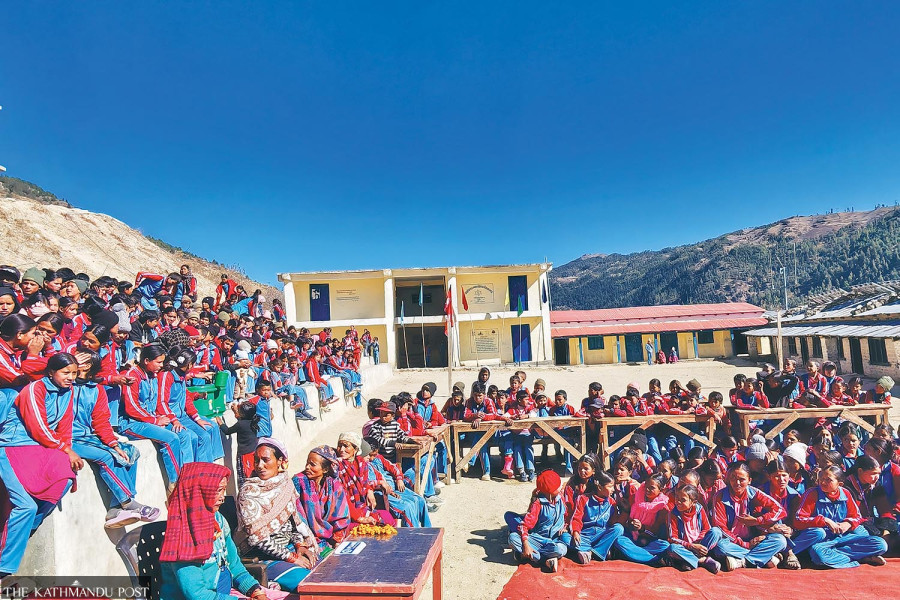
Students from Madhesh, Karnali and Sudurpashchim continue to underperform in national exams as structural weaknesses persist in public education.Students pictured at Panchadeval Secondary School in Kalikot, Karnali Province, in this recent photo. Tularam Pandey/TKP
The latest Secondary Education Examination (SEE) results have once again exposed deep divisions in Nepal’s education system, with students from geographically remote and economically weaker provinces continuing to perform below the national average.
According to results published by the National Examination Board (NEB) on Monday, Sudurpashchim Province recorded the weakest performance in this year’s SEE examinations. While the national pass rate stood at 66 percent, only 51 percent of students from Sudurpashchim qualified to study Grade 11.
Madhesh Province recorded a pass rate of 58.5 percent, Karnali Province 59 percent, and Lumbini Province 61 percent, all below the national average.
In contrast, provinces with relatively better literacy rates, stronger educational infrastructure and higher teacher availability continued to perform better. Koshi Province recorded a pass rate of 70.5 percent, Gandaki 73 percent and Bagmati 78 percent.
The pattern is not new.
For years, provinces such as Karnali, Madhesh, Sudurpashchim and Lumbini have consistently lagged behind national averages in both SEE and Grade 12 examinations, while Bagmati, Gandaki and Koshi have regularly posted better results.
Last year, when the national SEE pass rate stood at 62 percent, only 28 percent of students in Madhesh passed. Sudurpashchim recorded a pass rate of 55 percent and Lumbini 51 percent. Karnali, which performed relatively better last year with a 70 percent pass rate, has seen a significant decline this year.
A similar trend was visible in Grade 12 results.
While the national Grade 12 pass rate last year stood at 61 percent, only 50 percent of students passed in Karnali, 53.5 percent in Madhesh, 54 percent in Sudurpashchim and 55 percent in Lumbini. Bagmati, Gandaki and Koshi again outperformed the national average with pass rates of 70 percent, 64 percent and 60 percent respectively.
Education experts say the trend reflects broader structural inequalities tied to literacy, poverty, teacher shortages and weak learning environments.
Provinces with lower literacy rates have also shown weaker learning outcomes and examination performance. Madhesh has the country’s lowest literacy rate at around 68 percent. Literacy stands at 73 percent in Sudurpashchim, 76 percent in Karnali and 80 percent in Lumbini. In contrast, Bagmati and Gandaki provinces have literacy rates exceeding 83 percent.
Professor Ammaraj Joshi, former vice chancellor of the Sudurpaschim University, said parents’ educational background and economic condition directly affect students’ academic performance.
“In hill districts, there is a shortage of subject teachers and expert teachers,” Joshi said. “Schools lack adequate resources, while facilities remain concentrated in urban areas. The economic condition and low educational status of parents have weakened students’ learning environment.”
Joshi said structural weaknesses in the education systems of Sudurpashchim and Karnali have continued for years, and warned that results would not improve without broader reforms.
“Educational infrastructure is weak and teacher dedication has also declined,” he said. “The entire education system needs to be reconsidered. Teacher capacity must be strengthened.”
He added that declining engagement from stakeholders, including parents and communities, has further weakened community schools. According to him, reforms should focus on stronger school regulation and increased investment in public education.
Sudurpashchim has around 700,000 students enrolled in schools and around 17,000 teachers, including permanent, temporary and relief quota staff, working in community schools. However, ministry data show that community schools across the country face a shortage of more than 50,000 subject teachers.
The shortage is particularly severe in English, Mathematics and Science, subjects in which students fail most frequently in national examinations.
Despite repeated commitments by successive governments, no new permanent teacher quotas have been added in community schools since 2000. In Grades 11 and 12, there are no permanent teacher positions at all. As a result, schools continue to rely heavily on temporary, relief and contract teachers.
Prakash Chandra Khatri said the weakening teaching-learning culture in remote districts has significantly affected student outcomes.
“Sudurpashchim, Madhesh and Karnali all face similar problems,” Khatri said. “In Karnali, even getting textbooks on time is difficult. Educational materials are not properly used in classrooms.”
He said examination-focused learning and a growing culture of cheating have replaced meaningful education.
“There is a greater tendency towards passing exams than actual learning,” he said. “Coaching classes have become fashionable. Education has become exam-centric instead of learning-oriented, and this does not produce good results.”
According to Khatri, neither the government, teachers, parents nor students have given adequate attention to improving educational quality.
“Improvement is possible only if everyone works together,” he said. “If the goal remains limited to taking exams, passing and obtaining certificates, the problem will continue.”
Karnali currently has around 500,000 students enrolled at school level and approximately 12,500 teachers. However, schools continue to struggle to retain permanent teachers in remote areas.
Education experts say weak learning achievement is directly linked to poor examination results.
Jayaram Adhikari said examination performance cannot improve without learning achievement improving first.
“Learning achievement and examination evaluation are different things, but they are closely linked,” Adhikari said. “When students do not receive adequate support in learning, results naturally remain weak.”
He said the overall condition of learning achievement mirrors examination outcomes across provinces.
“Children need support,” he said. “Families, schools, teachers, communities and the state must together create a proper learning environment. Only then will results improve.”
High dropout rates have also emerged as a major concern.
According to the Ministry of Education’s Flash Report, 1,053,824 students enrolled in Grade 1 in 2016. However, only 430,667 students eventually appeared in this year’s SEE examination.
This means more than 623,000 students dropped out somewhere along the education cycle before reaching Grade 10.
Among those who appeared in SEE this year, 146,507 students failed.
Professor Basanta Kumar Karna said weak foundational education and social pressures continue to undermine learning outcomes in Madhesh Province.
“The biggest problem in Madhesh is weak basic-level teaching,” Karna said. “Many students are unable to properly read or write basic Nepali or English.”
He said poverty and low parental education also contribute to high dropout rates.
“Many students leave school midway,” he said. “Even among those who continue, many fail.”
Karna also alleged irregularities during this year’s SEE examinations in parts of Madhesh.
“This time, examinations were conducted against the code of conduct in many places,” he claimed. “There were incidents of cheating using mobile phones. In some centres, answer sheets were checked by teachers familiar with students without adequate preparation, which made results look better than last year.”
Madhesh has the highest number of school students in the country, with around 1.63 million students and only 17,544 teachers.
Karna argued that arbitrary recruitment practices have weakened teaching quality.
“Due to politically influenced appointments, quality teachers have not been recruited,” he said. “Temporary and contract teachers selected through favouritism often cannot teach effectively.”
He added that even students passing Grade 12 are frequently unprepared for university-level studies.
Experts say teacher distribution remains deeply unequal across provinces.
According to Ministry of Education statistics, Koshi Province has around 30,000 teachers for 1.08 million students, while Bagmati has around 31,000 teachers for 1.36 million students. Gandaki has over 22,000 teachers for around 510,000 students.
For decades, the government has repeatedly announced plans to redistribute teacher quotas to address regional imbalances, but implementation has remained stalled.
While presenting the government’s policies and programmes in the federal parliament on Monday, President Ramchandra Paudel once again stated that teacher positions would be redistributed.
Mahendra Parajuli, deputy director general at the Centre for Education and Human Resource Development, said the government has been studying provincial examination results and dropout patterns.
This year, the NEB arranged for answer sheets to be checked at examination centres themselves.
The board reported that 1,597 students secured a perfect 4.0 GPA in SEE this year, up from 971 students last year.
During the Covid-19 pandemic, when answer sheets were marked at home centres in 2020, nearly 9,000 students secured 4.0 GPA scores, raising widespread questions at the time about the credibility and standard of evaluation.




 14.4°C Kathmandu