Displaced squatters left in limbo as rehabilitation remains uncertain
Nearly 1,500 people remain in temporary shelters 39 days after evictions, with no clear timeline for resettlement. Displaced squatter families housed in a pavilion at the Radhaswami Satsang Centre in Kirtipur, Kathmandu in April. Post file photo
Thirty-nine days after the government began clearing settlements on occupied land, hundreds of displaced families continue to face uncertainty as the rehabilitation process remains slow, with no clear timeline for permanent resettlement.
According to the High-Powered Committee for Integrated Development of Bagmati Civilisation, 1,488 people from 388 households are currently staying in government-designated holding centres across Kathmandu, Bhaktapur and Kavrepalanchok districts. While food and shelter have been provided, many residents say they have received little information about when they will be permanently resettled.
Among them is 50-year-old Pramila Rai, who has been staying at the Radhaswami Ashram holding centre in Kirtipur since April 25. She said government officials recently collected personal details and helped residents open bank accounts, but no information has been given on when rehabilitation will begin.
“When we ask when we will be settled, nobody gives an answer,” Rai said.
Before clearing the settlements, the Kathmandu District Administration Office had said verified landless families would be provided housing within 10 to 15 days. A six-point notice issued on April 24 reiterated the same commitment. However, officials now say they are unable to provide a timeline.
Chief District Officer Eshwor Raj Poudel declined to comment on the delay, saying the process was still under review.
Speaking in Parliament on May 31, Prime Minister Balendra Shah defended the pace of the rehabilitation process, saying a problem that remained unresolved for 35 years could not be fixed in a short time.
“It will take as long as it takes. We cannot rush it,” Shah said.
For many families, the delay has deepened existing hardships. Rai said her 27-year-old daughter is suffering from severe liver complications following jaundice and requires long-term treatment. Unable to afford medication, she has been selling roasted corn near the holding centre to cover the costs.
“I borrowed Rs1,000 to start selling corn. Even then, it is very difficult to cover medicine costs,” she said, requesting assistance.
The government has set up seven holding centres. These currently house 294 people from 87 households in Machhapokhari, Balaju; 277 people from 65 households at Radhaswami Ashram, Kirtipur; 355 people from 99 households at the Nepal Electricity Authority training centre building in Kharipati; 115 people from 24 households at the Agricultural Development Bank training institute in Bode; 80 people from 21 households at the National Water Supply and Sanitation Training Centre in Nagarkot; 195 people from 45 households at the Nepal Red Cross Society facility in Banepa; and 172 people from 47 households at apartments in Ichangu Narayan.
Sociologist Khagendra Bista, associated with the Bagmati Civilisation committee, said some family members were staying elsewhere for work while only part of each household remained in the holding centres.
Residents say recent government activity has largely focused on data collection. A woman at the Nagarkot centre said officials recently helped residents open accounts at Prabhu Bank for planned housing allowance payments.
“Everyone in the settlement opened an account,” she said. “But nobody has told us when the money will actually arrive.”
On May 14, the government announced that verified landless families would receive Rs15,000 per month in rent support until permanent land ownership certificates are issued.
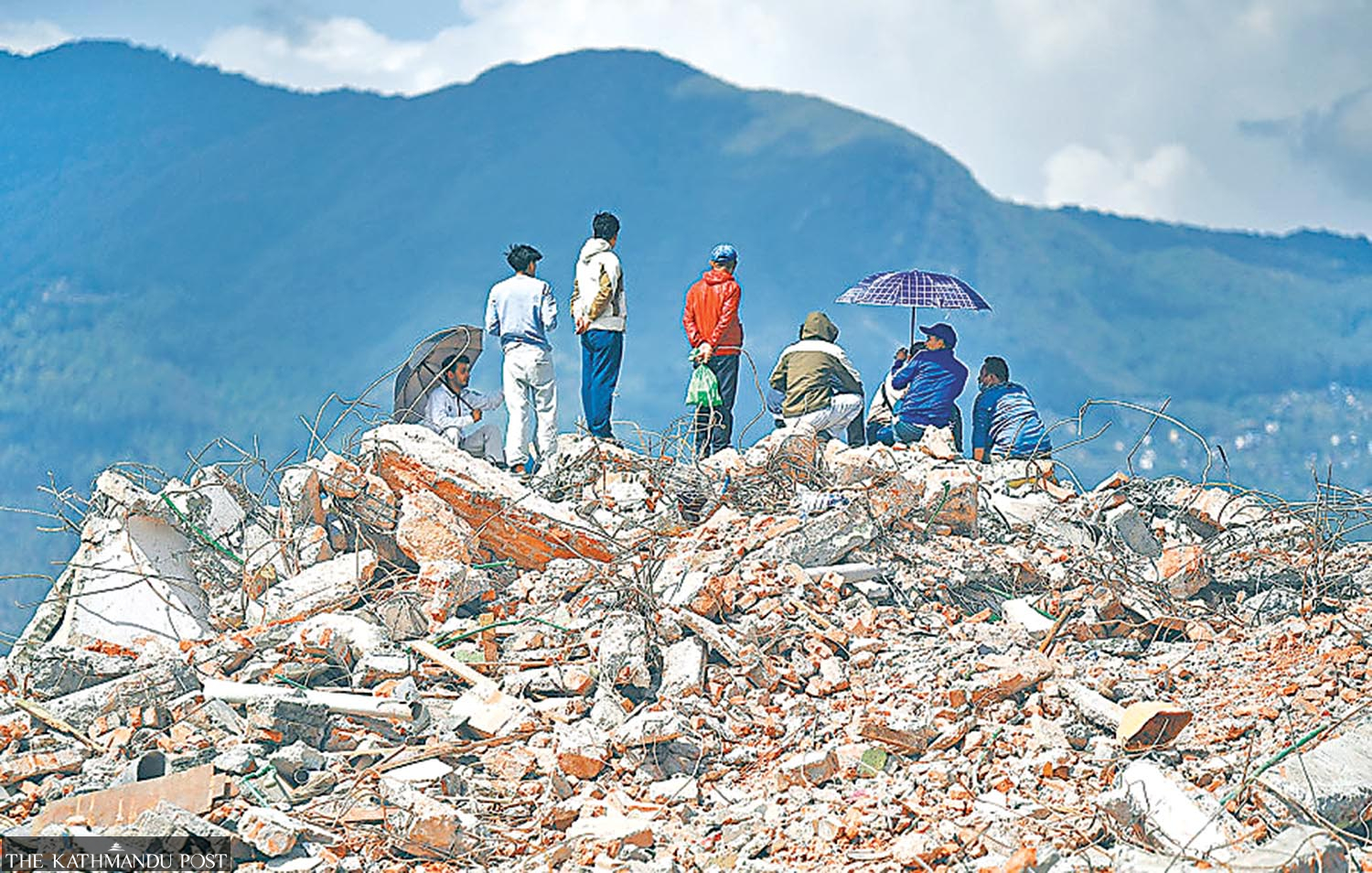
People seen on the demolition debris near the Dhobikhola corridor in Kapan, Kathmandu in April. Angad Dhakal/TKP
The woman said officials have collected detailed digital records, but residents are still unclear about the next steps.
“Even the officials who come here say they do not know what will happen next,” she said.
At the Nepal Red Cross centre in Banepa, 49-year-old Kumari Lama said she is increasingly worried about her children’s education.
“Officials collected names and asked whether our children would stay in hostels, but it has been more than two weeks, and nothing has happened,” she said. “My daughter has started saying she no longer wants to study.”
Others have raised concerns over a lack of work opportunities and poor living conditions.
Mithu Maya Magar, 67, staying at a guest house in Balaju, said residents were asked to fill out forms but had not received further updates.
“People who want to work have not found jobs. Nobody has come asking about employment. We are struggling. Food is another problem. They do not provide meat or fish,” she said.
Presenting the fiscal year 2026–27 budget on May 29, Finance Minister Swarnim Wagle pledged to complete the management of landless Dalits, squatters and informal settlers within the next fiscal year.
According to the Ministry of Infrastructure Development, authorities are preparing digital profiles of displaced families, including health, economic, demographic and biometric data. The information will be cross-checked with land records to identify genuinely landless households eligible for rehabilitation.
Bibek Bastola, personal secretary to Infrastructure Development Minister Sunil Lamsal, said identified families would receive Rs25,000 in relocation assistance and Rs15,000 per month in rent support for three months, directly deposited into bank accounts.
He said the ministry is also working on housing designs and land allocation plans.
Anand Singh Bhat, executive chair of the Bagmati Civilisation committee, said verification work is being carried out in coordination with land administration offices.
Officials are checking whether applicants or their relatives own land elsewhere and verifying citizenship and family records to determine eligibility.
Despite ongoing work, the government has not provided a firm timeline for rehabilitation.
Bhat said delays were mainly due to incomplete documentation and cases involving individuals without citizenship certificates, which require coordination with local authorities.
“The current rent support is only a temporary arrangement,” he said. “If the process is not completed within three months, discussions may be held on extending assistance or exploring alternatives. We estimate the work could be completed by mid-August.”




 14.4°C Kathmandu