Nepal has cooking gas, but no cylinders as half-fill keeps them at homes
Producers warn of idle gas stock and safety risks as consumers hoard cylinders and illegal refilling rises amid ongoing supply uncertainty. The Nepal Oil Corporation has increased the price of cooking gas to Rs2,160 for a full 14.2 kg cylinder. Under the current half-fill system, a 7.1 kg cylinder now costs Rs1,080. Post file photo
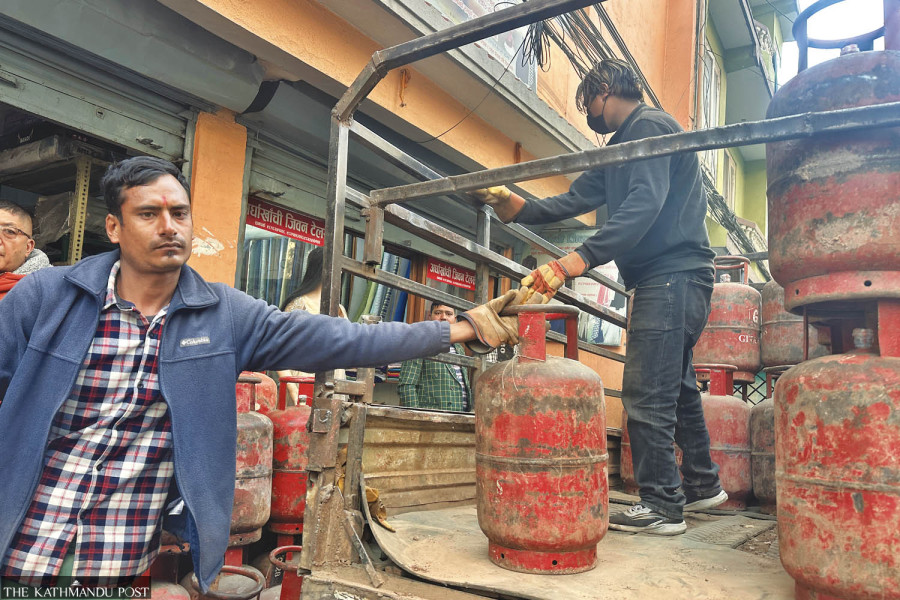
Liquefied petroleum gas (LPG) producers say they are unable to unload cooking gas from storage bullets as a shortage of cylinders has disrupted the normal supply cycle, with a majority of cylinders now held by consumers following the introduction of half-filled gas sales.
“We have not been able to unload the cooking gas from bullets due to a lack of cylinders. Most cylinders are being held by customers hoping that full cylinders will arrive, which has affected the normal flow of cooking gas in the market,” said Diwan Bahadur Chand, president of the Nepal LP Gas Association.
The situation has been further complicated by reports of unsafe practices emerging in the market. “We have heard that some restaurants and hotels in the Tarai region and even in Kathmandu Valley have started illegally refilling cylinders from one to another, which has created problems in the cylinders,” Chand said.
On March 12, the Nepal Oil Corporation decided to supply half-filled LPG cylinders to consumers in a bid to conserve energy, despite no significant disruption in imports. Since then, bottling plants have been distributing 7.1 kg of gas instead of the standard 14.2 kg per cylinder.
However, the policy has created operational challenges for commercial users. Restaurants and hotels say half-filled cylinders are insufficient for heavy-duty cooking.
“The half cooking gas cylinder does not create enough pressure while cooking in large pots. We have been using lukewarm water on the cylinder to maintain pressure,” said Arniko Rajbhandari, owner of ND’s Café.
Industry officials warn that such workarounds and illegal refilling practices are increasing safety risks. According to Chand, transferring gas from one cylinder to another can damage valves and lead to leakage, posing serious hazards to users.
The distribution imbalance has worsened significantly. Previously, LPG cylinders were evenly distributed across the supply chain, with roughly one-third at bottling plants, one-third in transit or with dealers, and one-third with consumers.
“Currently, around 66 percent of cylinders are with customers, while the rest are either in transit or with dealers,” Chand said, indicating a severe distortion in the supply cycle.
According to the Nepal Oil Corporation, more than 10 million LPG cylinders are in circulation nationwide. Of these, around 3 million are typically with consumers, 3 million at bottling plants for refilling and another 3 million within the distribution network. Refilling 3 million cylinders requires about 45,000 tonnes of LPG each month.
The supply pressure has coincided with a price hike. Effective from Friday, the corporation increased the price of cooking gas by Rs150 per cylinder, raising it to Rs2,160 for a full 14.2 kg cylinder. Under the current half-fill system, a 7.1 kg cylinder now costs Rs1,080.
Nepal Oil Corporation says it is incurring losses of more than Rs1,000 per cylinder despite the price adjustment.
Import data shows that Nepal brought in 411,081 tonnes of LPG worth Rs41.64 billion in the first 10 months of the current fiscal year until mid-April, according to the Department of Customs. This is slightly higher in volume compared to 410,593 tonnes imported during the same period last fiscal year, although the value stood higher at Rs46.58 billion previously.
Nepal sources its cooking gas from India, which itself is reeling under its worst gas crisis in decades with the government cutting supplies for industries to shield households from any shortages caused by shipment disruptions due to the US and Israel’s attacks on Iran since February 28.
Earlier, in the lead-up to the March 5 elections in Nepal, LPG shortages were felt particularly in Kathmandu. Bottlers then attributed the supply disruption to maintenance work at the Barauni refinery in India during November and December. The temporary shift to an alternative refinery had created logistical challenges and caused hassles in Kathmandu for some distributors.
Despite steady imports, the association says repeated requests to resume full-cylinder distribution have not been addressed. Producers have been in regular discussions with officials from the Nepal Oil Corporation and the Ministry of Industry, but no decision has been taken so far.
“The corporation is discussing with the board of directors whether to resume full-cylinder distribution. As the Middle East conflict remains uncertain and no one knows how long it will last, we are in a wait-and-watch situation amid supply uncertainty,” said Manoj Kumar Thakur, deputy director of the Oil Corporation.
Nepal’s monthly LPG demand currently stands at around 45,000 to 46,000 tonnes. However, officials say supply fluctuations are adding to the challenge.
“When the corporation imported up to 51,000 tonnes in earlier months, it became difficult to manage and distribute. We do not expect imports to exceed 35,000 tonnes in April,” Thakur said.
Consumers across Kathmandu Valley have been facing difficulties obtaining LPG cylinders since mid-January. The shortage has been attributed to disruptions linked to maintenance at the Barauni refinery in India, along with internal issues affecting distribution networks.
The crisis has disrupted daily life, forcing households to queue for hours and visit multiple outlets in search of refills, while businesses struggle to maintain operations.
With cylinders tied up in households, supply stuck in storage, and safety concerns rising due to improper handling, industry players warn that the situation could worsen unless the distribution model is revised and normal circulation restored.
Krishana Prasain is a business reporter for The Kathmandu Post covering markets. Before joining The Kathmandu Post in 2018, she spent 3 years in New Business Age magazine covering business.




 25.92°C Kathmandu