BYD’s robot-run factory in China builds an EV in under a minute
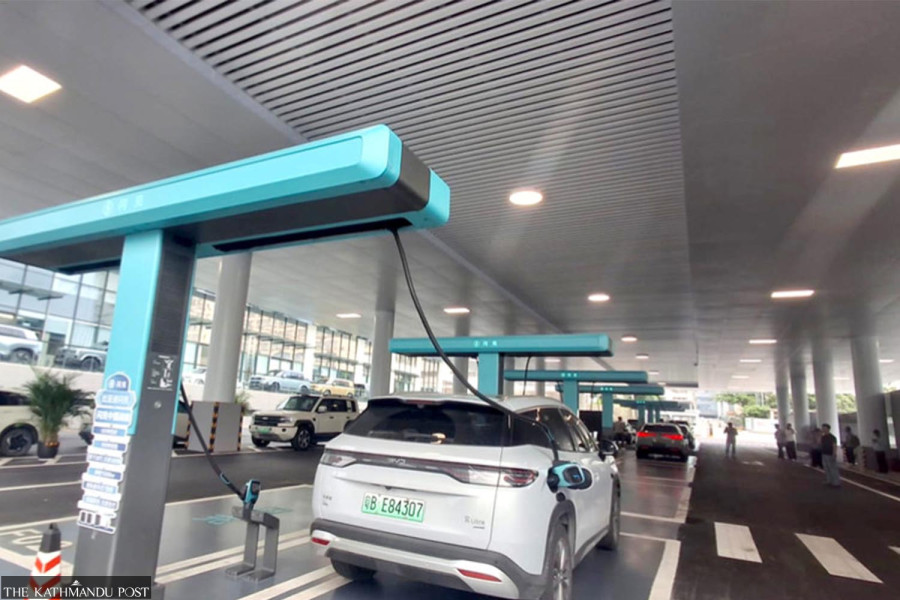
Chinese electric vehicle giant says its Zhengzhou plant operates with 98 percent automation as it rapidly expands production and charging infrastructure. BYD electric vehicles being charged at a flash-charging station in Shenzhen, China. Bimal Khatiwada/TKP
At Chinese electric vehicle giant BYD’s factory in Zhengzhou, a new electric car body rolls off the production line in less than a minute, powered largely by robots rather than human workers.
Since establishing operations in the Zhengzhou Airport Economy Zone in September 2021, BYD has built a vast manufacturing complex producing electric vehicles and key auto components, including batteries. Spread across 10.67 square kilometres, the facility manufactures both finished EVs and many of the critical components that go into them.
The factory carries out the major stages of vehicle production, including stamping, welding, painting and assembly. Beyond those core processes, BYD has also established additional plants at the site to produce motors, electronic control systems, power supplies, powertrains, air-conditioning systems, steering systems, trims, lights, frames, seats and other essential parts. Blade batteries, one of BYD’s signature battery technologies, are also manufactured there.
According to the company, Zhengzhou now has a complete industrial ecosystem required to build BYD vehicles from scratch to finish.
“The core competitive advantage of this factory is its 98 percent automation rate, which demonstrates world-leading intelligent manufacturing standards,” the company said in a press statement.
Inside the plant, robots vastly outnumber human workers. Automated machines handle welding, assemble vehicle parts and identify manufacturing defects.
During a recent visit to the factory, only a handful of workers could be seen on the production floor. BYD says 98 percent of its welding operations are carried out by around 1,500 robots operating at the site.
“A car body can be completed in less than a minute,” said Liu Xueliang, BYD's Asia Pacific General Manager, while briefing a delegation of Nepali journalists visiting the factory. He said the company has achieved rapid production gains in a short period through extensive use of robotics, which has played a major role in increasing manufacturing capacity.
Liu said more than 120,000 people work in BYD’s research and development divisions alone.
“Here, an electric vehicle is produced in less than a minute, and a battery cell is manufactured every three seconds,” he said.
In Shenzhen, company officials demonstrated BYD’s flash charging technology, which they said can charge a vehicle to 97 percent in about nine minutes, precisely eight minutes and 26 seconds.
According to the company, a nine-minute flash charge can power a vehicle for up to 988 kilometres. BYD is also rapidly expanding its flash-charging network across China. The company says 4,239 charging stations have already been built in different cities and locations, with plans to operate 20,000 stations nationwide by the end of 2026.
Liu said continuous technological innovation is the only way companies can create something meaningful for society.
“We have spent 20 years pursuing the technological vision we first proposed in 2004. By 2024, we achieved that goal,” Liu said. “We are a company that creates dreams, pursues them and turns them into reality.”
He said a few people showed interest in electric vehicles two decades ago.
“Think about it. Twenty years ago, who cared about electric vehicles?” Liu said. “We participated in the 2004 Beijing International Auto Show and displayed our first electric concept car there. That vehicle is now preserved in the Zhengzhou museum.”
Liu described Nepal as an important market for BYD.
“When I first visited Nepal about 10 years ago, my impression was that the country faced electricity shortages,” he said. “I questioned how Nepal could support the development of electric vehicles. But after discussions with government officials and local partners, I was impressed by the optimism surrounding Nepal’s future development.”
Despite Nepal’s limited infrastructure a decade ago and the challenges posed by the pandemic, Liu said BYD and Cimex successfully expanded the company’s market presence in the country.
“The dedication and work ethic of Nepali people matched our own commitment,” he said.




 19.79°C Kathmandu