Ruby Khan refuses to relent in the fight for Nirmala Kurmi’s justice
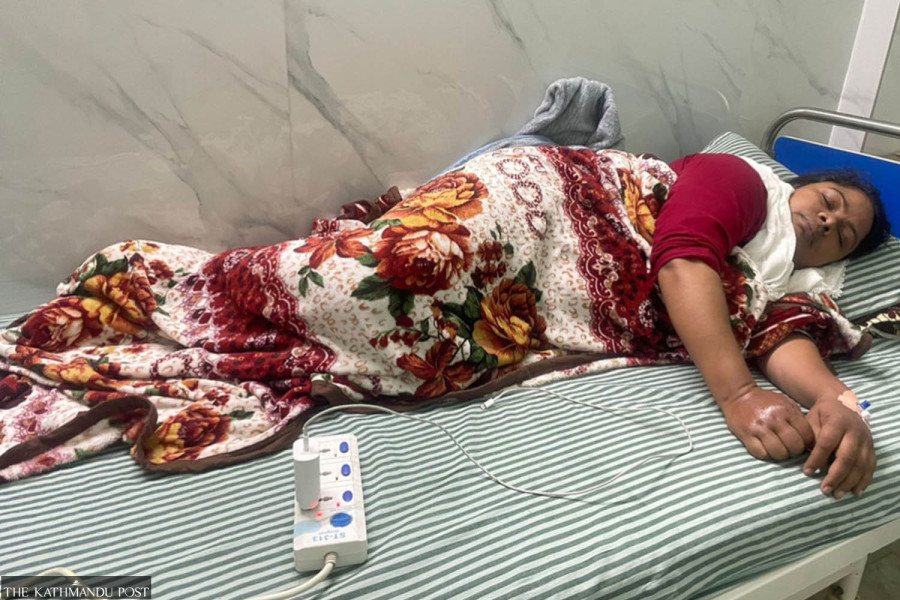
Rights activist alleges repeated detention and intimidation as police accuse her of using the case to influence legal proceedings. For the past 18 days, Khan has remained on a hunger strike while admitted to Nepalgunj Medical College in Banke. Rupa Gahatraj/TKP
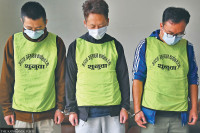
Around 5 pm. Armed police personnel moved in and detained a group led by rights activist Ruby Khan outside the District Administration Office in Banke.
It had only been three days since the group began a sit-in demanding justice in the suspicious disappearance case of Nirmala Kurmi.
Police officers immediately started forcing Khan and five other activists into a van. Khan and the others resisted, but could not stop the arrests.
The group was taken to the District Police Office in Banke. Initially, discussions were held about detaining all six activists. Khan insisted that if anyone had to remain in custody, it should be her alone because she was leading the protest.
About an hour later, the five other activists were released after signing papers agreeing not to return to the protest site. Khan, however, was handed what police described as an “urgent arrest warrant” inside the police office itself.
The warrant is a special provision under Nepal’s National Penal (Code) Act 2017 that allows police investigators to detain suspects if they are likely to flee or destroy evidence. But in Khan’s case, the provision was used against a woman leading a sit-in protest demanding justice. Police accused her of an offence against “public peace”.
Recalling the day of her detention on April 28, Khan said her first concern was for the other women activists.
“Some of them were ill. Some had children preparing for Grade 12 examinations,” she told Kantipur. “I requested them to let the others go.”
For Khan, speaking out against injustice has been a defining part of her life since her student years. This time too, she refused to stay silent. Inside police custody, she began a hunger strike.
“After spending such a long time on the streets, my body had already weakened. The next evening, around 8 pm, I became seriously unwell,” Khan said. “The police took me to Bheri Hospital.”
She said doctors immediately administered intravenous fluids after learning that she was fasting in custody. But her condition deteriorated further.
“Another doctor came later and added more medication,” she recalled. “As soon as the medicine was administered, I felt even worse.”
Khan said she refused to remain at the hospital and was later shifted to Sanjeevani Medical College while still under police supervision.
Even there, she refused food and continued the hunger strike.
Police later produced Khan before Banke Chief District Officer Dil Kumar Tamang, seeking an extension of her detention.
Tamang was not an unfamiliar figure to her. He had previously been part of government negotiation teams that signed agreements with Khan during earlier protests linked to the Nirmala Kurmi case.
In fact, the government had already reached five separate agreements with Khan and her movement over the years. Each time, the agreements went unimplemented. Each time, Khan returned to the streets. Each time, another agreement followed.
Khan said she believed that appearing before Tamang might finally lead to progress because he was already familiar with her demands.
Instead, with Tamang’s approval, she was formally registered as “Detainee Number 35”.
“We have been on the streets for so long, and you yourself had promised justice earlier,” Khan recalled telling the chief district officer.
According to Khan, Tamang responded dismissively: “Are you going to keep protesting in the name of Nirmala Kurmi forever?”
The Women’s Rights Forum later filed a petition at the Banke District Court challenging her detention. The court ordered the police to produce her.
“There were two public holidays, and I was supposed to be presented before the court on May 3,” Khan said. “They realised it would be embarrassing if I was released through a court order, so they released me on recognisance that same evening.”
But police reject Khan’s account.
Banke Police Chief Superintendent of Police Angur GC accused her of using the Nirmala Kurmi case to shield herself from detention and influence legal proceedings.
“Ruby Khan’s concern for Nirmala Kurmi is merely for appearances,” he told Kantipur. “She has used this issue to seek legal remedies favourable to herself.”
Khan rejects the allegation.
“How can I feel tired before justice is delivered?” she asked from her hospital bed.
The roots of the case stretch back more than two decades.
According to a government investigation committee, attempts to seize Nirmala Kurmi’s property began after the death of her husband, Mahalu Kurmi, in 2005. The family owned four bighas (one bigha is equivalent to 1.6735 acres) and 10 katthas (20 katthas equal one bigha) of land in the then Paraspur Village Development Committee-9 in Banke.
Then, within just 10 days in November 2009, her sons Ram Sagar and Suresh also died under mysterious circumstances.
An investigation report led by Hira Lal Regmi, joint secretary at the Ministry of Home Affairs, stated that after the deaths of her sons, citizenship and land ownership documents belonging to her husband and eldest son were taken away by a local man, Badshah Kurmi.
The report said protests and sit-ins later emerged, accusing Badshah of attempting to seize Nirmala’s land by taking control of her documents. Badshah, a former Nepali Congress lawmaker, is currently a provincial assembly member.
In a video recorded in 2009 by the Human Rights Forum, Banke, Nirmala herself described being assaulted over the property dispute.
“Badshah slapped me, while others beat me with bicycle chains,” she said in the recording while showing injuries on her legs. “At that time, they also took documents related to the deaths of my husband and sons.”
The investigation report stated that Badshah, Kuwar Babban Singh, Dhirendra Singh, Ammar Lal Kurmi, Indian national Munim Kurmi and others had forcibly seized the documents with the intention of taking over her property.
According to the report, the group threatened that the documents would never be returned and that Nirmala would not even be allowed to live in her own house.
The report concluded that Badshah’s role in the incident appeared suspicious.
As public pressure mounted, the administration eventually intervened. Badshah reportedly appeared at the District Administration Office, returned the documents and apologised.
But sometime after the documents were returned, Nirmala suddenly disappeared.
No formal complaint related to her disappearance was filed with police or any state authority. Instead, rights activists began pressing for an investigation.
An officer at the Central Investigation Bureau involved in the case said the process of transferring Nirmala’s land accelerated after her disappearance.
“The land registered under her husband and eldest son’s names appears to have first been transferred on June 22, 2012,” the officer said. “After being frozen for some time, the land’s ownership was transferred again, and further encroachment followed. Police have a detailed investigation report on this.”
The officer said investigators later travelled to India and found information suggesting that Nirmala had remarried there and later died.
Police have reportedly shown photographs they claim are from her second marriage. But activists, including Khan, refuse to accept the claim.
Since 2021, Khan has repeatedly staged protests demanding justice not only for Nirmala but also for Nakunni Dhobi, another woman from Banke whose death was linked to domestic violence.
When protests in Nepalgunj failed to draw attention from Singha Durbar, the country’s administrative centre, Khan and other activists travelled to Kathmandu in September 2021.
But immediately upon arriving in Kathmandu, police arrested Khan on bigamy charges and sent her back to Nepalgunj on October 9, 2021.
“That was where the police conspiracy against me began,” Khan said. “I had a personal family dispute, and they used it to frame me in a case that had already ended in divorce, in order to pressure me into abandoning the protests.”
The Supreme Court later ordered her release through a habeas corpus petition.
According to Khan, police warned her at the time that additional charges could follow if she refused to withdraw the movement.
“I told them, ‘I have done nothing wrong. Do whatever you want,’” she said.
When she was detained again this year, she said she repeated the same stance.
For the past 18 days, Khan has remained on a hunger strike from a hospital bed at Nepalgunj Medical College, Banke.
For now, her central demand is straightforward: that police and government prosecutors stop delaying the Nirmala Kurmi case and finally take it to court so justice can be decided there.




 13.46°C Kathmandu