Wildlife translocation falls short of conservation goals
Decades of efforts to establish new habitats for endangered species have produced uneven outcomes, raising concerns as authorities prepare to relocate blackbucks to Chitwan.File Photo.
From a conservation perspective, establishing populations of rare wildlife across multiple habitats is considered far more beneficial than confining them to a single location.
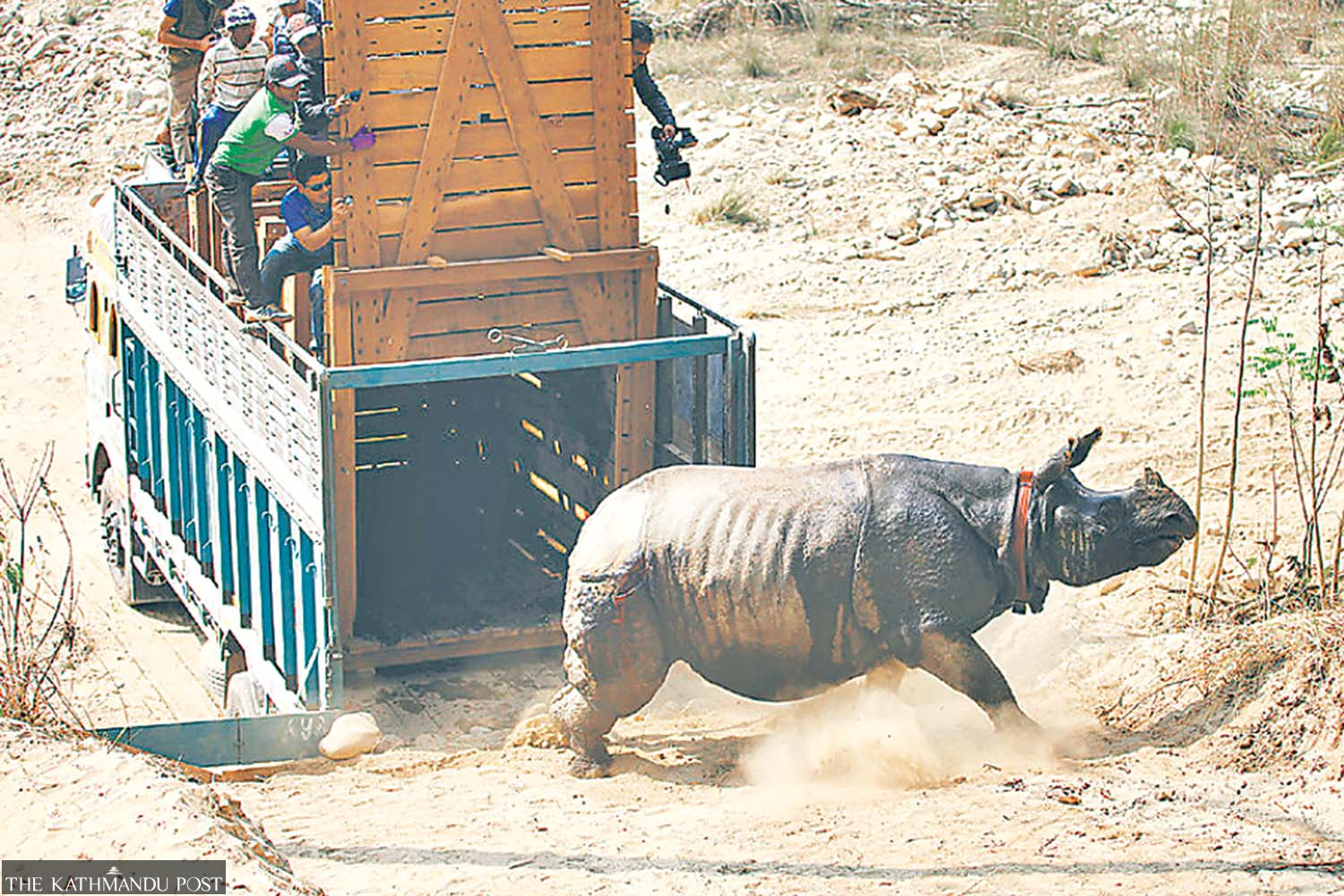
Nepal began translocating wild animals from areas with high population densities to similar habitats elsewhere four decades ago. Now, as preparations are underway to move blackbucks from Bardiya to Chitwan, questions are being raised about the success of past translocation efforts.
In February 2016, when the government decided to move a one-horned rhino from Chitwan National Park to Bardiya National Park, conservationists in Chitwan staged protests outside the District Administration Office. Demonstrators carried placards reading: “We sent 83 rhinos, now only 29 remain. Why are we sending them again?”
Despite the protests, the government proceeded with the programme.
According to Chitwan National Park, a total of 104 rhinos were translocated from Chitwan to Bardiya, Shuklaphanta and Koshi Tappu between 1986 and 2023. Avinash Thapa Magar, information officer at the park, said the largest number, 91 rhinos, were moved to Bardiya in nine phases between 1986 and 2017. Another 11 rhinos were translocated to Shuklaphanta in three phases between 2000 and 2018.
In 2023, two female rhinos were moved from Chitwan to Koshi Tappu for the first time. Both had been rescued and raised under human care and are currently being kept in a large enclosure. As a result, there is little prospect of population growth in Koshi for now.
The situation in Bardiya and Shuklaphanta, where male and female rhinos were relocated in balanced numbers, has also failed to meet expectations. According to the national rhino census released in April 2021, Nepal had 752 rhinos, of which 694 were in Chitwan, 38 in Bardiya, 17 in Shuklaphanta and three in adjoining Parsa National Park.
Despite the relocation of 91 rhinos from Chitwan to Bardiya, only 38 were recorded there during the census. Shuklaphanta has seen only marginal gains.
Like the rhinos moved out of Chitwan, other wildlife species have been brought into the park from elsewhere. But the outcomes for wild water buffaloes from Koshi Tappu and swamp deer from Shuklaphanta have been even more disappointing.
Chitwan failed to sustain the population of wild water buffaloes brought from Koshi, while the swamp deer project met a similar fate. Both species were kept in a large fenced enclosure in Padampur inside the national park.
The area became available after the settlement of Padampur was relocated outside the park boundaries. In January 2017, authorities began translocating wild water buffaloes from Koshi Tappu to a 30-hectare enclosure established there.
A total of 15 wild water buffaloes, including 12 from Koshi Tappu and three from the Central Zoo in Jawalakhel, were placed inside the enclosure. The animals even began breeding successfully.
However, the initial optimism among conservationists quickly faded. Floods breached the enclosure, while tigers and pythons also gained access. In August 2017, two buffaloes drowned during flooding. Three buffaloes brought from the zoo had already died before the floods occurred.
The surviving animals later fell ill, and the combined effects of flooding, predation and disease devastated the population.
“The fact that the translocated wild water buffaloes gave birth to seven calves proves that the relocation was initially suitable for them. However, they could not survive due to certain natural and managerial factors,” said Ram Chandra Kandel, a joint secretary at the Ministry of Forests and Environment who served as chief conservation officer of Chitwan National Park when the project was launched.
Kandel said the floods were a natural disaster, but management shortcomings worsened the situation. Authorities had planned to release the buffaloes into a natural habitat once their population reached 25, but the animals remained confined to the enclosure.
According to him, stronger monitoring and better nutritional management after the floods could have prevented the animals from becoming weak and vulnerable.
“Had they been released into the natural environment, it would have served as a valuable experiment. Fifteen were brought in. They never reached 25, and while waiting for the population to hit that target before release, crisis after crisis struck them,” Kandel said.
Tigers killed both calves and adult buffaloes, while a python swallowed one calf. The project effectively ended in July 2022 when a tiger entered the enclosure and killed the last three surviving buffaloes.
The issue was also highlighted in the Auditor General’s report. The 59th Annual Report of the Office of the Auditor General stated that translocation efforts must be systematic and sustainable, based on comprehensive study and research. The report suggested that the management of the endangered species translocation programme had been deeply flawed.
Swamp deer faced similar challenges. Seven swamp deer were brought from Shuklaphanta and kept in the same Padampur enclosure. Two died soon after arrival, while others were lost during the August 2017 floods.
Although it was feared that all had perished, one swamp deer was spotted in Kumroj Community Forest in May 2025, nearly eight years after the floods.
Nepal began translocating wild animals from areas with high population densities to similar habitats elsewhere four decades ago. Post file photo
These setbacks have prompted calls for greater caution as authorities prepare to relocate blackbucks.
“I am personally opposed to bringing animals and keeping them in enclosures for long periods, turning them into zoo exhibits for tourists,” said Kamal Jung Kunwar, former chief conservation officer of Chitwan National Park and author of the book ‘Four Years for Rhinos’.
“If translocation is carried out, the animals should eventually be released into their natural habitat. Enclosures should only be used temporarily while they adapt to the new environment.”
Kunwar said suitable habitat and strong security arrangements are the two most important requirements for successful translocation. He argued that inadequate security and poor habitat conditions explain why Bardiya currently hosts fewer rhinos than the number originally moved there.
“If the habitat is suitable, rhinos remain healthy and reproduce. At the same time, strong security is needed to prevent poaching. In the past, Bardiya suffered from weak protection,” he said.
According to Kunwar, rhinos require extensive grasslands, wallowing holes and marshy areas, all of which are abundant in Chitwan. Although Bardiya is crossed by the Karnali and Babai rivers, it lacks sufficient wallowing areas.
He suggested that future translocations could be more successful if habitats are improved and security strengthened. Community forests adjoining national parks should also be developed as wildlife habitats rather than confining animals solely within protected areas.
Habitat limitations have long affected the rhinos relocated to Bardiya National Park.
The first batch of 13 one-horned rhinos was moved from Chitwan to Bardiya four decades ago. Since 1986, a total of 88 rhinos, including 47 males and 41 females, have been translocated there in multiple phases.
Instead of growing, the population has declined over time.
According to park authorities, the first 13 rhinos were released in the Karnali river basin. Another 75 rhinos moved between 1988 and 2016 were released in the Babai Valley. The latest translocation took place in 2016, when five rhinos were introduced.
Ramesh Thapa, former chief conservation officer of Bardiya National Park, said many of the relocated animals struggled to survive.
“The rhinos brought here were often problematic, injured or orphaned,” he said. “As a result, the first 15 to 16 rhinos died naturally soon after arriving.”
Many of the remaining rhinos were later killed during the conflict years, when security posts protecting the park were withdrawn under emergency rule.
Poaching surged, and by around 2008 the rhino population in the area had nearly disappeared.
In response, three female and two male rhinos were released in 2016. Today, five rhinos remain in the Babai Valley. Although the adult breeding pair brought in 2016 later died naturally, successful breeding among the surviving animals has maintained the population at five.
Security posts have since been reinstated in the valley, while artificial provisions for food, water and wallowing sites have been created. Studies suggest that the Babai Valley could support between 25 and 50 rhinos.
The failure of the translocated population to expand has fuelled debate over whether Bardiya is genuinely suitable rhino habitat.
Ajit Tumbahangphe, Bardiya programme chief of the National Trust for Nature Conservation, said the Karnali riverbank area is largely rocky and barren, while the Babai Valley lacks sufficient wallowing holes and wetlands.
Although the valley has potential, its terrain is strewn with stones because it lies across the Chure and riverine belt, making movement difficult for rhinos.
The shortage of suitable habitat on the Nepali side has also led several rhinos to cross into India. While some return, many remain there permanently.
Saroj Mani Paudel, information officer at Bardiya National Park, said the 2022 census recorded 38 rhinos in the park, a figure that remains unchanged. Of them, 33 live in the Karnali basin and five in the Babai Valley.
The rhino population in Bardiya stood at 67 in 2005 but dropped to 22 by 2008. It later recovered to 29 in the 2015 census. Although rhino censuses are conducted every four years, none will be held this year.
Ashok Kumar Ram, chief conservation officer of Bardiya National Park, said the lack of population growth is largely due to unsuitable habitat conditions, including inadequate grasslands and wetlands.
Rhinos require wallowing sites and specific grasses, such as kans, that grow in riverine areas. Bardiya continues to face shortages of both.
Between January 1988 and April 2003, 70 rhinos, including 25 males and 45 females, were translocated to the Babai Valley alone. Yet by 2009, not a single rhino remained there.
An investigation conducted by the then Ministry of Forests and Soil Conservation and submitted on March 18, 2009, found that of the 83 rhinos translocated to Bardiya, including the Babai area, 36 had been killed by poachers and 24 had died of natural causes.




 14.58°C Kathmandu
1.jpg)