China leads, US follows—Everest emerges as frontier for high-altitude drone tech
After China’s high-altitude drone breakthrough, a US firm enters the fray with cargo drones and a climbing robot.A Chinese DJI drone flies over the Everest region in this undated photo. Post file photo
It was China that first tested its heavy-lift drone on Mount Everest and succeeded. Now, an American drone company is vying to replicate that achievement, signalling a new technological contest unfolding on the slopes of the world’s highest mountain.
But the American push goes beyond drones. In a development that has caught Nepali authorities off guard, the company has also proposed sending a robot to climb Everest. The plan has run into immediate uncertainty, as Nepal currently has no legal framework that allows a non-human entity to attempt an ascent of the peak.
On Friday, a test involving the Freefly Systems Alta X Gen 2, a US-made heavy-lift industrial drone, was abruptly halted at the Everest Base Camp after officials determined that the team had not secured the necessary permissions for a test flight.
“The Americans only showcased the drone at the Everest Base Camp, at 5,364 meters,” said two officials stationed at the base camp, requesting anonymity as they were not authorised to speak publicly.
The drone was formally inaugurated in a ceremony attended by Sergio Gor, US President Donald Trump’s Special Envoy for South and Central Asian Affairs, highlighting the geopolitical undertones of what might otherwise appear as a purely technological demonstration.
“As there was no permission for the cargo drone test, it was only showcased,” said Mingma Sherpa, chairman of Seven Summit Treks, Nepal’s largest expedition agency, which handled the American group’s logistics at the Everest Base Camp.
“The objective is to test the ability of American drones to transport cargo and garbage at the world’s highest peak in the future,” Sherpa said.
The American drone has a payload capacity of 15.88 kilograms at sea level, but its real capability in extreme high-altitude conditions remains unknown. “The actual performance in the high mountain region will be known once it is tested,” officials said.
Even before a formal test flight, the drone has already stirred controversy in Kathmandu. A government official familiar with the matter said the Ministry of Culture, Tourism and Civil Aviation had submitted recommendations to the Home Ministry around six weeks ago, flagging potential security concerns associated with the drone’s technical features.
The concerns include geo-mapping capabilities and other sensitive functionalities, particularly given Everest’s unique geopolitical location. The mountain straddles the international border between Nepal and China’s Tibet Autonomous Region, with the summit lying directly on the boundary shared by the two nations.
Authorities have urged caution, recommending detailed studies before granting permission for commercial drone operations on Everest.
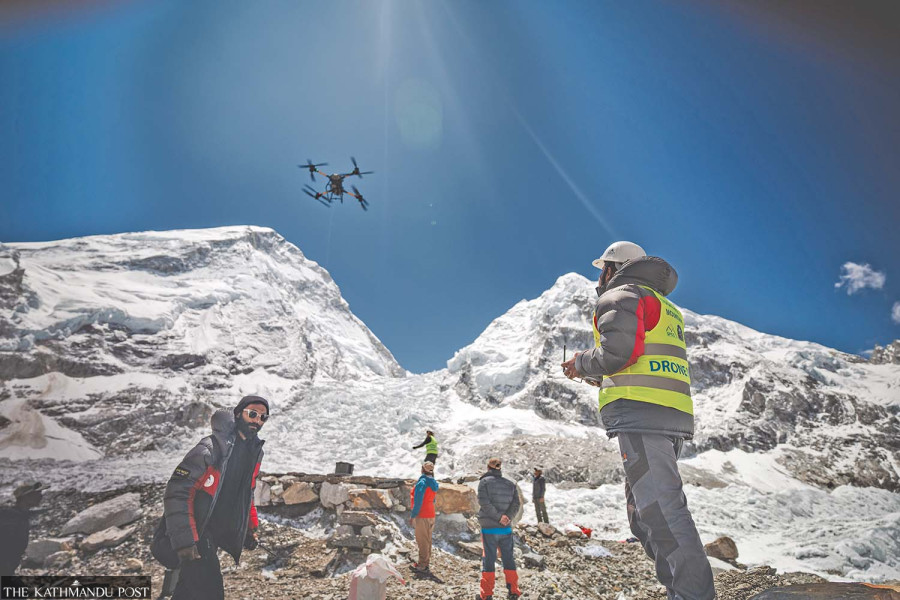
Nepal’s cautious stance contrasts with its earlier approval of Chinese drones. Last year, the government permitted heavy-lift drones manufactured by Chinese company DJI to operate commercially on Everest, marking a turning point in the use of unmanned aerial systems in high-altitude mountaineering logistics.
These drones, often described as sounding like a swarm of bees, were deployed extensively last year, with even more advanced versions introduced this climbing season.
A tripartite memorandum of understanding was signed between the Sagarmatha Pollution Control Committee, the Khumbu Pasang Lhamu Rural Municipality and Airlift Technology Pvt Ltd to use drone technology for waste management in the Khumbu region.
In April last year, DJI conducted what is considered the world’s first successful drone delivery test on Everest. The drone reached an altitude of 6,130 metres—Camp I—located above the treacherous Khumbu Icefall. It carried 15 kilograms of supplies per flight under extreme conditions, including temperatures of minus 25 degrees Celsius and winds reaching 45 kilometres per hour.
That altitude remains the highest documented drone delivery to date. Before Everest, the record stood at around 5,000 metres near Tawang in India’s Arunachal Pradesh.
Such a technology has been transformative. Tasks that traditionally required 6-7 hours of climbing by Sherpas carrying 12 kilograms of gear can now be completed by drones in about 10 minutes. In many cases, work that would have required at least 14 porters over six hours can now be handled by a single drone flight.
Following the initial tests, Airlift Technology deployed two heavy-lift drones that transported 2.5 tonnes of supplies, including 300 kilograms of garbage, in and out of the Khumbu Icefall.
Last spring, drones were used to transport nearly all the ladders and ropes needed to prepare Everest’s climbing route up to Camp I. Traditionally, this work is performed by the Icefall Doctors—a specialised group of Sherpas mobilised by the Sagarmatha Pollution Control Committee—who manually carry over 20 ladders and hundreds of kilograms of rope through one of the most dangerous sections of the mountain.
In 2025, drones lifted 444 kilograms of such equipment. They also transported 900 kilograms of expedition gear for commercial teams and delivered 150 oxygen cylinders for climbers, carrying six cylinders per flight.
All climbers attempting Everest must traverse the Khumbu Icefall, a constantly shifting river of ice roughly a kilometre long. The section is notorious for its danger, with towering ice blocks and unstable seracs posing a constant threat. Even experienced Sherpas often avoid moving through the icefall during daylight hours.
Climbers typically cross the icefall at night or in the early morning, using headlamps, when colder temperatures keep the ice more stable and reduce avalanche risks. As the sun rises and temperatures increase, the risk of collapsing ice and avalanches rises sharply.
Using drones will help us avoid the dangers in the Khumbu Icefall, operators say, pointing to the life-saving potential of reducing human exposure in hazardous zones.
This year’s climbing season has already faced delays after millions of tonnes of hanging seracs blocked Icefall Doctors from setting up the route, underscoring the increasing unpredictability of conditions on Everest.
Milan Pandey, co-founder of Airlift Technology, said drone-assisted operations have already begun this season. “We supplied four aluminium ladders and five rolls of rope via drone up to Camp I on Tuesday,” he said.
The company is currently using the DJI FlyCart 100, which can carry up to 100 kilograms at sea level and about 40 kilograms in high-altitude conditions. On Thursday, it also delivered oxygen cylinders to Camp I.
Meanwhile, the proposal to deploy a robot on Everest remains in limbo. Authorities say the application has been put on hold pending further study.
Mingma Sherpa confirmed that Seven Summit Treks has applied for permission. “It’s in process,” he said.
Himal Gautam, spokesperson for the Department of Tourism, said the absence of a legal framework for non-human climbers has created uncertainty. “As there is no law allowing non-human to climb Everest, we sought suggestions from the Tourism Ministry,” he said.
According to Gautam, the ministry has recommended a detailed review before any decision is made.
“The charge or fee, the purpose and other specifications of the robot will be studied before allowing it to climb Everest,” he said. “Right now, the permit is on hold.”
The debate comes at a time when Everest is facing mounting environmental pressures. The base camp has grown increasingly crowded and commercialised, contributing to a surge in waste. Nearly 60,000 people trek to Everest Base Camp annually.
According to the Sagarmatha Pollution Control Committee, 77.19 tonnes of waste was collected from the base camp alone during the spring 2024 climbing season. Including waste brought down from higher camps by expedition teams, the total reached 85 tonnes in spring 2025.
The waste included 27.99 tonnes of burnable material, 7.51 tonnes of recyclables, 27.53 tonnes of human waste and 14.15 tonnes of kitchen waste. The Nepali Army had also collected an additional 11 tonnes of garbage.
Operators argue that drones and (potentially) robots could play a crucial role in addressing this growing crisis. “When a machine can do the work of collecting garbage from treacherous points, it saves the lives of Sherpas,” they say.
As technology races ahead, Everest is fast becoming a testing ground not just for human endurance, but also for innovation. Yet Nepal’s regulatory framework is still catching up, leaving critical questions unanswered about how far machines should be allowed to go on the world’s highest peak.
Sangam Prasain is Business Editor at The Kathmandu Post, covering tourism, agriculture, mountaineering, aviation, infrastructure and other economic affairs. He joined The Kathmandu Post in October 2009.




 20.02°C Kathmandu