



 21.87°C Kathmandu

Sun, Oct 25, 2026
Money
Risk for human health as popular brands’ products test unsafe for consumption
Days after Current noodles, popular Dabur honey product flagged to be unsafe for consumption.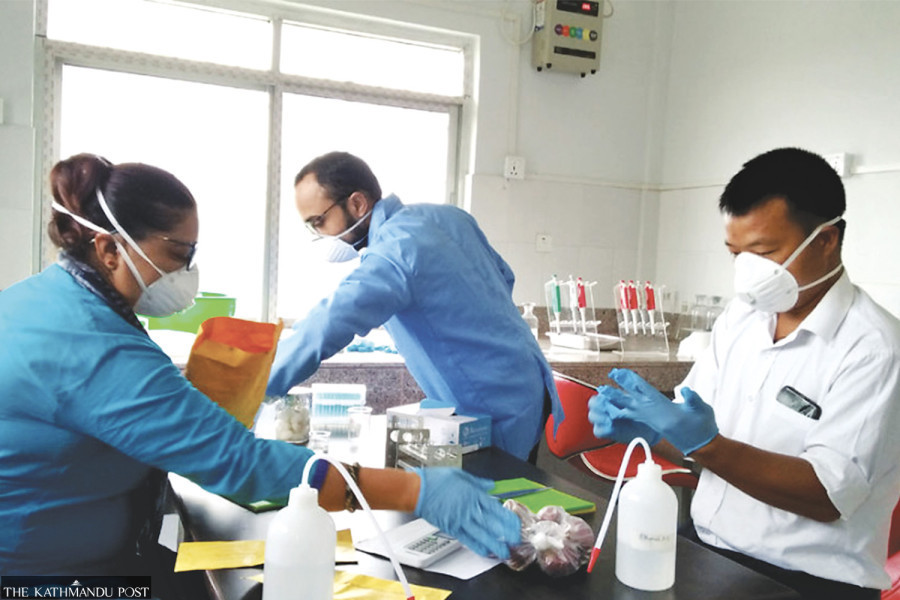
bookmark
Krishana Prasain
Published at : May 21, 2026
Updated at : May 21, 2026 21:17
Kathmandu
Nepal’s quality watchdog on Tuesday recalled a batch of Dabur Honey after laboratory tests found the product to be of low quality.
The Department of Food Technology and Quality Control recalled batch NB00477 of the honey produced by Dabur Nepal, Jitpur Samara.
According to the lab test report of the department, Dabur honey was found containing hydroxymethyal furfural (HMF) 50 milligrams, more than the food-standard 40 milligrams per kilogram. High level of HMF in honey indicates that the product has been overheated, stored improperly or is very old.
“Low quality food items refer to products that have higher or lower readings on the standard parameters set by the government,” said Bal Kumari Sharma, spokesperson for the Food Technology Department.
Substandard food items are those that fail to meet quality or safety standards, often due to reduced key ingredients, adulteration with inferior substances, or contamination with harmful bacteria, chemicals or toxins. While not always immediately fatal, such products can have serious long-term health impacts.
Professor Basanta Kumar Rai, chief of the Central Department of Food Technology, said that the parameters set by the government must be followed to ensure food quality and to not adversely impact human health.
“Anything below and above on composition, production process, packaging and labelling than the set standard can cause a negative health impact. It also suggests whether the food is pure or not,” he said.
Rai said that the market is full of low-quality ready-to-eat packaged food, asking the government to implement the food standards strictly.
In cases of substandard products, manufacturers can face up to six months’ imprisonment and a maximum fine of Rs300,000, according to the law.
Another sample test conducted on Nova ice cream also found total bacteria count, coliform count and Enterobacteriaceae count inappropriate for human consumption.
Last Friday, the department recalled the batch of CO2 of Nova ice cream produced by Fishtel Dairy, Pokhara Industrial Area, Pokhara.
“The ready-to-eat food should never contain any type of bacteria as it can cause immediate or long-term health problems to the consumer and sometimes even risk life,” said Sharma.
A sample test conducted on the Current and Lali brands of noodles produced by Yasodha Foods, Tilottama, Rupandehi had an acid value of the extracted fat short of the standard determined by the government.
The department last Thursday recalled batch 04A of Current noodles and batch 02A of Lali noodles.
Sharma said that extracted fact acid refers to the quality of oil while producing noodles in the factory. The extracted fat acid should not be not more than 1.0 milligram of potassium hydroxide per gram oil but the noodles were found having more than the government limits.
The Jack Nack Krakers biscuit brand produced by Asian Biscuit and Confectionery, Duhabi, Sunsari, was also recalled from the market after finding extracted fat acid value outside the standard determined by the government. The biscuits of batch 6 were recalled from the market.
Reports of adulteration of popular food brands worry consumers. Sashi Magar is one such person who feels sad and angry at the same time to hear news of substandard food.
“I am worried about my own health and that of my children. It feels nothing is safe to eat or drink and more than that it feels we are being cheated quality-wise, health-wise and price-wise,” said Magar, a housewife from Kapan.
Food department spokesperson Sharma said that the factory concerned needs to submit all the details, including the number of products of the problematic batch and the quantity of products recalled from the market to the department. The factory also needs to submit the certification of the product recall.
Consumer rights activists say that recalling a product from the market will not compel producers to improve their product unless they are made liable for neglecting human health in the rush for profits.
“Producers are increasingly becoming profit-oriented and do not have business ethics, resulting in product neglect. The regulatory body also does not take strict action on time. This risks human health,” said Bishnu Prasad Timilsina, general secretary of the Forum for Protection of Consumer Rights-Nepal.
“The lab tests conducted by the Food Technology Department are only a formality. For instance, some products of the problematic batch of honey might have already been consumed and many other batches might have come in the market,” he said.
Unless the potential health risk from the consumption of substandard or adulterated food and the profits raked in by the producers are analysed and an environment of compensating consumers is created, these types of unscrupulous market practices will repeat in the future, Timilsina said.
Krishana Prasain
Krishana Prasain is a business reporter for The Kathmandu Post covering markets. Before joining The Kathmandu Post in 2018, she spent 3 years in New Business Age magazine covering business.




Most Read from Money

Why does an hour long flight to Dhangadhi cost more than a flight to New Delhi?

Nepal travel agents threaten to stop selling Thailand trips over visa rules
Malaysia rejects Nepal’s demand to open recruitment to all manpower agencies

No school, but a graduation cap for women dairy farmers

Nepal arrests four medical service providers as Malaysia recruitment row deepens
Editor's Picks




E-PAPER | October 25, 2026

×