As the results for the snap polls for the House of Representatives continue to flood in from across the country, resoundingly in favour of an ‘alternative wave’ championed by the Rastriya Swantantra Party, the attention of the nation has turned to the difference between securing a majority and a two-thirds ‘supermajority’ in parliament.
Drawing on constitutional provisions, parliamentary practice and expert legal opinion, here is a look into how these numbers dictate the exercise of power and the governance of the state.
Parliamentary landscape
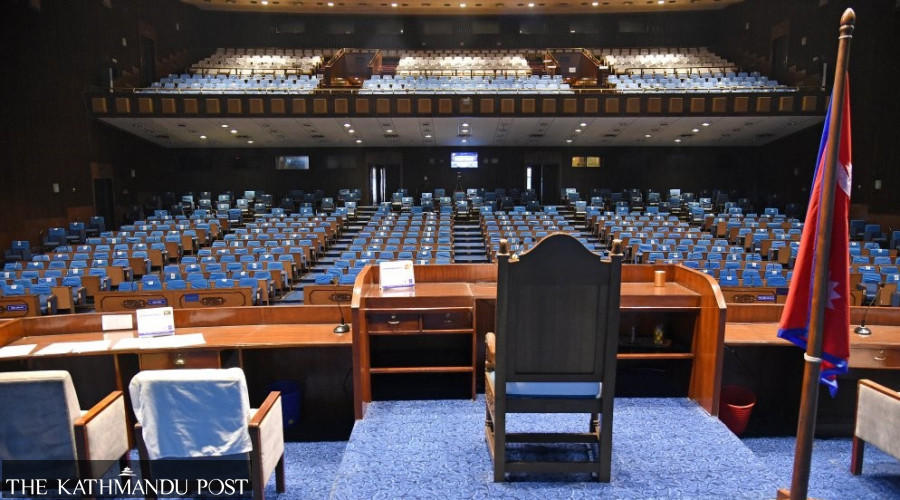
Nepal’s federal parliament is a bicameral legislature consisting of the House of Representatives (the lower house) and the National Assembly (the upper house). The House of Representatives (HoR) comprises 275 members: 165 elected through the first-past-the-post system and 110 via proportional representation. Under Article 83 of the constitution, the National Assembly (NA) consists of 59 members—eight elected from each province and three appointed by the President on the government's recommendation.
In terms of raw numbers, a simple majority in the HoR requires 138 seats, while a two-thirds majority stands at 184 seats. For the NA, a two-thirds majority is 40 members. When both houses meet in a joint session, a two-thirds majority requires 223 parliamentarians.
The power of two-thirds
Securing two-thirds of the HoR grants a party or coalition significant disciplinary and judicial powers. Under Article 91(6)(c), the House can remove the Speaker or Deputy Speaker for failing to conduct themselves in a manner appropriate to their office, provided two-thirds of the total membership supports the motion. The HoR alone can also impeach and remove high-ranking officials, including the chief justice, Supreme Court judges, members of the Judicial Council and heads of constitutional bodies, by a two-thirds vote.
Constitution expert Bhimarjun Acharya told the Post that if the party that secures a two-thirds majority in the HoR uses its strength in the lower house with diligence, it improves the chances of stability in the government and facilitates smooth lawmaking.
“While a two-thirds majority in the HoR does not hand a party absolute power over lawmaking, it can smooth the process of lawmaking by bypassing a time-consuming step of finding a majority in the lower house,” Acharya said.
However, for most significant state actions, the lower house cannot act in isolation. To impeach an executive, i.e. to remove the President or Vice President for serious violations of the constitution or law, a two-thirds majority in both houses of the federal parliament is required. For state emergencies and referendums, both the endorsement of emergency orders (Article 273) and the decision to hold a national referendum on matters of significant importance (Article 275) require a two-thirds majority of the total membership of both houses.
Furthermore, while ordinary international treaties regarding peace and natural resources that do not have a ‘serious impact’ on the nation can be passed by a simple majority in the HoR, treaties concerning national security, strategic relations, or state boundaries must be ratified by a two-thirds majority of both houses.
Acharya adds that a major drawback of a two-thirds majority single-party government is that it weakens the opposition. “It is a number game after all,” he said. “If most seats are secured by a single party, the opposition will be left with few seats, and in extreme cases, there is a possibility that there would be no opposition.”
Amending the constitution
A common misconception is that a two-thirds majority in the lower house grants a party the power to overhaul the constitution at will. Senior advocate Tika Ram Bhattarai notes, “A two-thirds majority in the HoR is not enough; two-thirds in the National Assembly is also required for constitutional amendments.”
Constitution expert Acharya echoed the same, but added, “Still, by having a required two-thirds majority in the lower house, constitution amendments can be fast-tracked.”
Even with a total parliamentary supermajority, Article 274(1) stipulates that certain core principles are unamendable: Nepal’s sovereignty, territorial integrity, independence and the sovereignty vested in the people. Other provisions may be amended, but only through a two-thirds vote in both houses.
Power of a simple majority
A simple majority of 138 seats in the HoR is sufficient to form a government, pass the federal budget, and sustain or defeat motions of confidence in the prime minister. While the NA plays a vital role in the legislative process, the HoR maintains the upper hand. Under Article 111, if the NA fails to return a bill within two months or rejects it, the HoR can bypass the upper house by passing the bill again with a simple majority of its total membership and sending it directly to the President for authentication.
Acharya told the Post that a simple majority can fast-track government formation, but its greatest advantage lies in the fact that it makes way for a strong opposition. “As compared to a two-thirds majority, a simple majority can still accommodate an opposition with a high number of seats in the HoR,” Acharya said. “This means that such a government will be held more accountable as compared to a two-thirds majority.”
Expert verdict
Constitutional experts agree that while a simple majority allows a party to govern, a two-thirds majority provides the stability of a strong government capable of long-term legislative shifts.
“If a party secures two-thirds in the HoR, it can form a government and pass its desired laws,” explains senior advocate Chandra Kanta Gyawali. However, he cautions, “For constitutional amendments, treaty ratifications, and impeachments, any governing party must still collaborate with other groups to secure the necessary numbers in the NA.”




 16.49°C Kathmandu