Lamichhane, Shah and Ghising pursue comprehensive deal
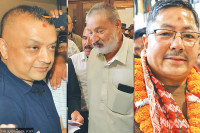
The trio sat down late Saturday after negotiations between RSP and Balendra Shah’s team could make no headway. Balendra Shah and Rabi Lamichhane Post Photos
Despite claims that the Rastriya Swatantra Party and Kathmandu mayor Balendra (Balen) Shah would together go to the March 5 elections, there was no agreement between the two sides until 11pm on Saturday.
Although an understanding was said to have been reached on Friday at the taskforce-level, awaiting formalisation on Saturday, talks could make no headway as both sides were firm on their respective positions.
In this state of deadlock, later in the day, Mayor Shah sat down with Kulman Ghising, the patron of the Ujyalo Party Nepal (UNP) and sitting minister for energy, water resources and irrigation, in order to forge an agreement that could unite “all alternate forces”. RSP chair Rabi Lamichhane later joined the meeting.
As the Post went to press, the trio were in intense discussions trying to hammer out a “comprehensive agreement” between the three sides, a source close to Mayor Shah said.
On Friday, from the RSP, Shishir Khanal, Asim Shah and Ramesh Mani Wagle were involved in talks with Mayor Shah’s team. Representing Shah were his personal secretary Bhoop Dev Shah and Sudip Dhakal, while his chief adviser, Kumar Ben, also participated in the negotiations.
Both sides broadly agreed on why talks failed to move forward, but each had its own interpretation. Those close to the Kathmandu mayor said the RSP wanted a prior agreement with him exclusively before reaching out to other alternative political forces, including the UNP. Shah’s camp, however, insisted that there should be simultaneous agreements with all alternative forces.
Apart from Ghising, at least two other sitting ministers are said to be considering contesting the March 5 elections announced by the interim government formed on the back of the Gen Z movement.
Against this backdrop, Mayor Shah’s camp argued that reaching separate agreements would send the wrong message, and that a comprehensive, collective understanding was necessary. “That is why our position has been to reach an agreement in toto,” a source close to Shah told the Post.
The same source said that leaders ranging from Janamat Party chair CK Raut to Resham Chaudhary, the chair of the Nagarik Unmukti Party, Nepal who took part in discussions with Mayor Shah on Wednesday, have in principle agreed to go to the elections under the same alliance.
Leaders such as Gyanendra Shahi of the Rastriya Prajatantra Party, along with several other figures, are also said to be positive about joining an alternative political platform.
“Our side was pushing for a one-off, collective agreement,” the source said. “But the RSP had a different approach.”
The RSP, for its part, argued that since the talks were held between the RSP and Mayor Shah’s group, any agreement should be confined to these two sides. Its leaders argued that it made little political sense to involve additional parties in an agreement when negotiations are taking place between only two stakeholders.
“Insisting on bringing in a third side at the stage of deal-finalisation is not politically viable and goes against the logic of the negotiations themselves,” said the RSP leader.
On Saturday morning, Shah reportedly gave Ghising a personal assurance that he has no intention of backing away from his commitment to bringing alternative political forces together.
However, the UNP leaders suggested that the assurance may only be limited to ensuring that Ghising will not be left standing alone should Shah and his supporters join the RSP.
A Mayor Shah supporter involved in the current negotiations also said that the discussion was focused on how alternative political forces could go ahead together, with the possibility of coordination among the RSP, the UNP and the Desh Bikash Party purportedly registered by the mayor’s team with the Election Commission.
Meanwhile, the UNP leaders said that the prospects of bringing alternative political forces together had diminished because of the RSP. Ghising himself also hinted at this at a public event on Saturday.
“Unity does not mean eliminating others,” Ghising said, addressing the inauguration ceremony of the UNP’s Nuwakot-Kathmandu Contact Forum in Kathmandu. “True unity recognises everyone’s existence and ensures dignity and respect for all.”
Ghising also briefed the UNP central committee on the RSP’s proposal on Saturday.
“Any cooperation has to be a win-win for all the sides involved,” central committee member Nirdesh Silwal told the Post after the party meeting.
The UNP also rejected a proposal that would have Rabi Lamichhane as the party chair, Kulman Ghising as a senior leader, and Shah as the future prime minister.
According to Silwal, the proposal was rejected because it would place the party’s name, election symbol, chairmanship and the prime ministerial candidate entirely with the RSP, leaving nothing under the UNP’s control.
During talks between the RSP and Shah’s group on Friday, there was some discussion on a proposal under which RSP chair Lamichhane would chair the unified party. The unified party would retain the name Rastriya Swatantra Party and the current election symbol, the bell. The proposal also envisaged Shah as a future prime minister while he also held the second-highest position in the party as co-chair.
According to an RSP leader, the possibility of Ghising being offered the vice-chair position was also discussed should he join the unified party. However, Ghising rejected the proposal at his party’s central committee meeting on Saturday, said a UNP member.
Earlier, the RSP and Ghising also discussed possible unity. But no agreement was reached, largely because the two sides failed to agree on leadership positions.
In those talks, held before Mayor Shah announced his political plans, Ghising had demanded a top position in the RSP. Ghising indicated that if his demand was accepted, he would be flexible on the party’s name and election symbol.
However, at the time, an RSP leader had told the Post that Ghising’s ‘questionable past’ made them hesitant to accept his leadership. Ghising, who long served as the head of the Nepal Electricity Authority, faces corruption charges.
RSP chair Lamichhane himself has cooperatives funds embezzlement cases sub judice in various courts and party leaders are already having a tough time defending him.
The RSP also cites its nationwide organisational structure to refuse to hand over the party’s core leadership to a person who lacks such an organisation.
In an apparent response, Ghising publicly said on Saturday that “while others may have organisational machinery, we have the people”.
According to RSP sources, the core issue was power-sharing arrangements. The leader also rejected claims that Shah had already been accepted as a prime ministerial candidate.
It’s a verbal proposal but it would be immature to claim that the RSP agreed to it entirely, claimed the leader. “We could be moving in that direction but there’s no deal [yet] saying ‘Shah as prime minister, Lamichhane as party chair’.”




 15.38°C Kathmandu