The ongoing war between Israel and the United States on one side and Iran on the other has put the lives of millions at risk, including at least 1.8 million Nepalis working in about a dozen Gulf countries.
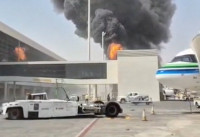
A Nepali national has died and at least 15 were injured in the UAE in attacks carried out by Iran.
It looks increasingly uncertain when the war will end. Concerns are being raised from all quarters about the Nepalis living in the Gulf and whether their evacuation is feasible.
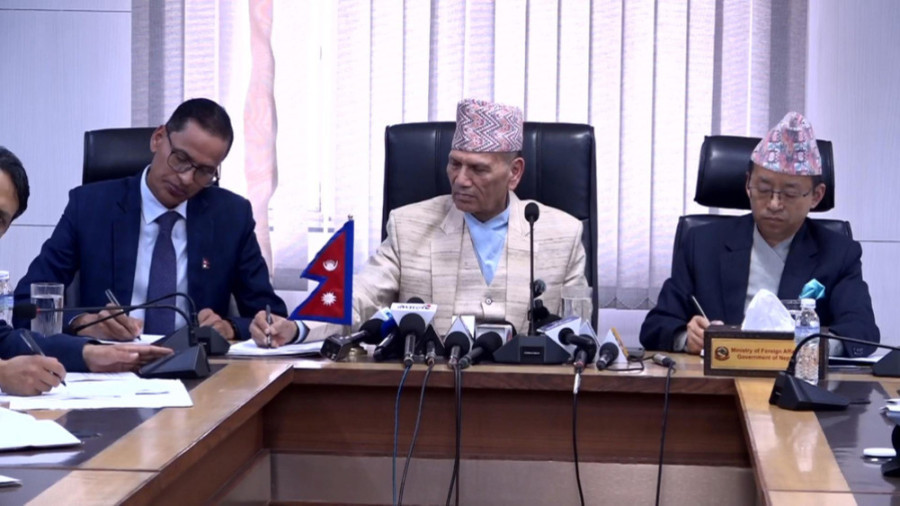
Amid this, Nepal’s Minister of Foreign Affairs Balananda Sharma held a press conference at the ministry on Wednesday to brief journalists about the government’s plan.
While 1.8 million Nepalis are registered migrant workers, a significant number of Nepalis are living in the Gulf informally. And the latter group of Nepalis do not figure in the government’s data.
According to Sharma, about a million more Nepalis are living in the Gulf informally. Sharma estimated that the number of Nepalis in the Gulf ranges from 2.5 million to 3 million.
Evacuating them would require a “national-level plan,” Sharma said.
Earlier this month, the Department of Consular Services introduced an online registration system to track Nepalis after the conflict escalated in West Asia. As many as 100,000 Nepalis have registered their names and addresses in the system so far.
Meanwhile, the government has suspended the attestation (verification) of demand letters for Middle Eastern countries, as per instructions from the emergency response team headed by the Foreign Secretary.
Foreign Minister Sharma said the ministry has already started homework on how to evacuate the Nepalis if necessary.
“The ministry has laid the groundwork for evacuation,” Sharma said. “We are preparing infrastructure to carry out this task. We have already set up a situation centre.”
The situation centre has established contact with all relevant stakeholders and is regularly updating the ministry about the situation, Sharma said.
“If rescue operations are needed, the centre will serve as a base,” he said. “It has established contact with all stakeholders. The ministry has already issued directions on how to coordinate, where the citizens are, and how to proceed.”
Sharma also mentioned that the work being carried out through the situation centre will make the rescue operations smoother as it develops.
The government has also formed an emergency response team headed by the foreign secretary to monitor, protect and evacuate the Nepalis from West Asia if the war escalates further.
“At least a network has been initiated,” Sharma added. “Our intention is to continue it. If it continues, it will also evolve. In the event of an emergency, the rescue operations will become much easier.”
He mentioned that it is not only the Nepali workers who would need rescue but also Nepali citizens heading to second countries who are stranded in transit in Middle Eastern countries. “They are suffering the most,” he said. “Those who have not yet reached their destination are the ones who currently need rescue.”
For now, arrangements for their accommodation and food have been made by the concerned missions and relevant airlines, Sharma added.
Furthermore, minister Sharma emphasised that the state must rescue Nepali citizens no matter how many of them are in conflict zones.
“Even if there are two million people, we cannot say we won't rescue them,” Sharma said. “We cannot leave our citizens stranded… we must carry out the rescue. Everyone must work together for this.”
Of the 15 Nepalis who have been injured so far due to the Iranian attack in the United Arab Emirates, 14 have returned to work after receiving treatment, according to the Ministry of Foreign Affairs.
One Nepali is still undergoing treatment, but their condition is stable.
Speaking at the press conference, joint secretary Ramji Khadka mentioned that there is an ongoing cycle of attacks and counterattacks between Israel, the United States and Iran.
Iran has been carrying out drone and missile attacks on American military bases in the Gulf and West Asian countries. The Nepali government and the Ministry of Foreign Affairs have said that they are seriously concerned about the security situation in the Middle East and the well-being of Nepali citizens there.
Foreign Secretary Amrit Bahadur Rai mentioned that the ministry is closely monitoring the developments in the region and that Nepalis in the area are currently safe.
Rai clarified that there is no immediate need to evacuate Nepali citizens from the region as the situation does not pose a significant risk to their safety. “The Ministry of Foreign Affairs maintains regular contact with its diplomatic missions in the region, checking in twice daily, in the morning and evening,” Rai said. The decisions made by the ‘Emergency Response Team’ established by the government are being continuously implemented through Nepali diplomatic missions in the region.
Rai mentioned that Nepali workers stranded in West Asia could be rescued by ships if necessary. “However, let’s hope that day will not come,” Rai said. “Gradually, the ongoing conflict will turn into peace.”
Rai added, “According to our analysis, there is no immediate threat that would endanger the lives of our citizens or require urgent evacuation. Therefore, I sincerely urge the families of Nepalis in Nepal and those residing in West Asia not to be disturbed or overly concerned.”
The Nepal government is also coordinating with labour-sending countries like India, Bangladesh, Pakistan, and Sri Lanka regarding the situation, Rai said, and Nepali ambassadors and consuls are in daily contact with these missions. Rai also said that the government is fully capable of protecting its citizens and would take necessary actions in the event of any critical situation.
“No one should be worried or disturbed,” Rai said. “This message should reach the parents, brothers, and sisters of the Nepali migrant workers in the Gulf and also the Nepalis living in West Asia.”




 15.68°C Kathmandu