Khanikhola farmers shift from maize and buckwheat to coffee cultivation
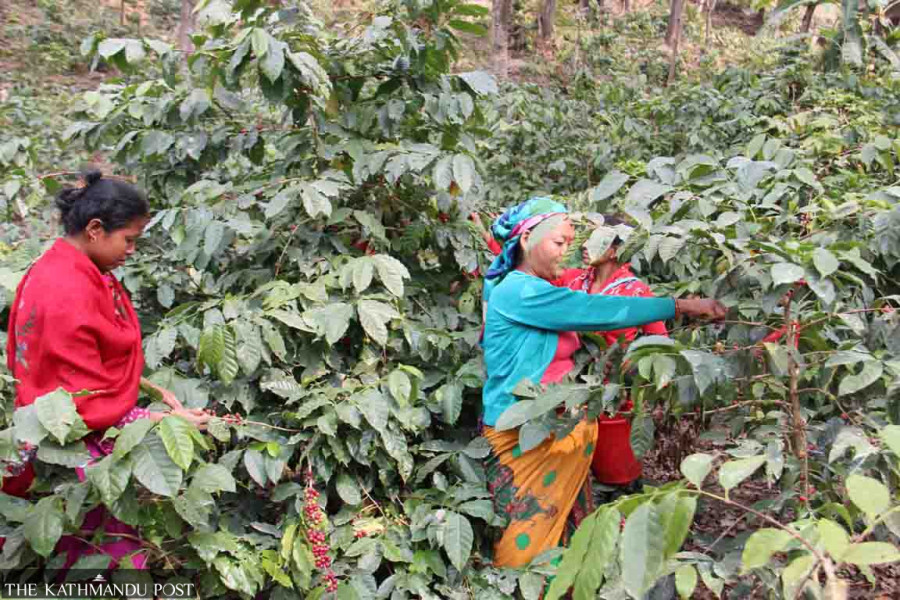
Coffee farming, once limited to a small area of Khanikhola, has now expanded across all wards of the rural municipality. Coffee farming, once limited to a small area of Khanikhola, has now expanded across all wards of the rural municipality. The local government has introduced support programmes to encourage production. Post File Photo
Farmers in Phalametar of Khanikhola Rural Municipality-2 in Kavrepalanchok are turning to coffee cultivation, replacing traditional crops such as maize, millet, mustard and buckwheat.
Fields that were earlier busy with seasonal maize farming are now dominated by coffee orchards. The hillsides are covered with green coffee shrubs, with new shoots growing steadily as farmers focus on weeding and plant care.
Until a few years ago, most households in the area depended on low-yield crops that barely covered basic expenses. Farmers say coffee has now changed that situation, becoming the main source of income for many families.
Tilak Bahadur Bal, 55, of Phalametar, said coffee farming has reduced the labour burden compared to traditional crops. “Earlier, maize farming required a lot of hard work throughout the season,” he said. “Coffee does not need that level of effort. We only need to remove weeds and apply pesticides when necessary.”
He said coffee has also brought significantly higher income. Bal began commercial coffee farming four years ago and has been selling produce for the past two years. “Last year, I earned around Rs800,000 to Rs900,000 from 500 plants,” he said. “We could never earn that much from maize, mustard or buckwheat.”
In Mahadevtar, Ran Bahadur Thokar was among the first to introduce coffee farming in 2015. At that time, cultivation was uncommon in the area, and many questioned whether the plants would survive.
Thokar initially planted 200 saplings on one ropani of land (1 ropani = 508.72 square metres). His farm has now expanded to around 1,000 coffee plants, which began producing after three years.
He said market conditions have improved significantly over time. Coffee was initially sold at around Rs250 per kg, but prices gradually increased from Rs560 to Rs640, then Rs900, and have now reached about Rs1,100 per kg.
Punya Kumari Khulal of Ramtar, who began coffee farming three years ago, said she decided to expand after seeing returns in the village. She sold 17 kg in her first year and 40 kg this season, earning Rs47,000. “It is still early, but the income is already better than maize, paddy and mustard,” she said.
She added that many of her plants are still maturing but expects higher yields in the coming years as production increases.
The growth of coffee farming has also supported local nurseries. Padam Bahadur Gole, who runs a nursery, said early days were difficult as demand was low.
“When I first raised 3,000 saplings, it was hard to sell them,” he said. “I used to carry them in a doko from village to village, and only a few people bought them.”
He said demand has now increased sharply. “Farmers now come directly to the nursery. Some take 300 to 400 saplings at a time. This year I sold about 14,000 saplings, and demand is still rising,” he said.
Abiral Lopchan, who has been farming coffee on five ropanis of land for the past five years, is preparing to expand his plantation to 10 ropanis. He also sells saplings alongside coffee production.
“Coffee brings many times more income than maize,” he said. “I earned about Rs200,000 last year and nearly Rs400,000 this year. The plants are still young, so production is low, but it will increase in the coming years.”
He said poor infrastructure remains a challenge for farmers. “Road access is limited, and transport is irregular. It becomes difficult to take products to market or supply saplings on time. Irrigation is also a problem,” he said.
Coffee farming, once limited to a small area of Khanikhola, has now expanded across all wards of the rural municipality. The local government has introduced support programmes to encourage production.
For the past three years, Khanikhola Rural Municipality has been running a production-based subsidy scheme titled “Subsidy to the Producer”, according to Chairperson Indra Bahadur Thing. Under the scheme, farmers receive Rs35 per kg of coffee produced.
Thing said the policy has encouraged wider participation in coffee farming. The municipality, in coordination with the Bagmati Provincial Government and the District Agriculture Development Office, has also been providing saplings, irrigation support, training, technology transfer and equipment.
“Out of 264 households in Phalametar, 263 have adopted coffee farming,” he said. “Because of suitable soil and climate, the area has been declared a full coffee pocket zone.”
He said around 200,000 saplings have been planted across the rural municipality’s seven wards. Once production fully begins next year, he estimated it could contribute Rs200 million to Rs300 million annually to the local economy.
According to the District Agriculture Development Office, Kavre, coffee cultivation and production have been steadily increasing in recent years. In fiscal year 2022–23, the district produced 43 metric tonnes from 292 hectares (1 hectare = 10,000 square metres). This increased to 74.4 metric tonnes from 342 hectares in 2023–24, and 76 metric tonnes from 358 hectares in 2024–25.
Office chief Kul Prasad Dawadi said Mahabharat and Khanikhola rural municipalities are the main coffee-producing areas in the district. He said a dedicated coffee promotion programme has been running in these areas with joint support from the provincial government, local units and agriculture offices.
Under the provincial government’s “One Ward, One Agricultural Product” programme, funding is shared between the province (60 percent), local units (20 percent) and farmers (20 percent). The support covers saplings, irrigation, training and farm equipment.
Dawadi said these measures have helped expand coffee farming and encouraged more farmers to shift towards commercial cultivation.




 13.64°C Kathmandu