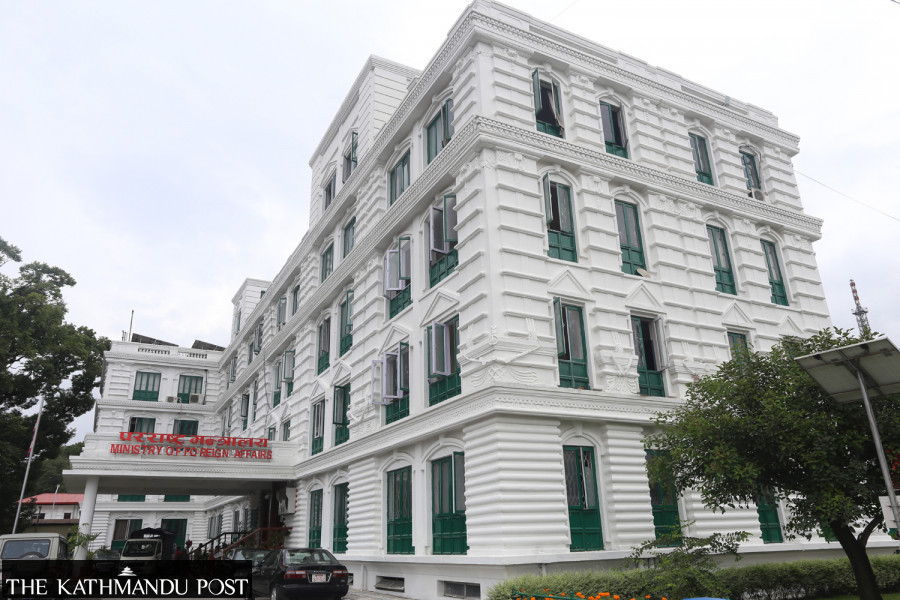
For the first time in Nepal’s history, the Ministry of Foreign Affairs on Thursday invited applications from eligible citizens for ambassador and permanent representative posts, and published a seven-page terms of reference (ToR) outlining the process.
The move comes amid an ongoing debate over whether ambassadorial appointments should be made through open competition or reserved for experts and experienced individuals.
In line with the new government’s stated emphasis on merit-based appointment and open competition for public positions, the foreign ministry has now opened ambassadorial posts for applicants. However, the ToR does not specify the countries to which successful candidates will be posted.
Exercising its authority under Section 45 of the Good Governance (Management and Operation) Act-2064, and in line with the Ambassador Appointment Guidelines-2075 (as amended in 2079 BS), the ministry has invited applications from qualified Nepali citizens. These provisions govern the appointment, responsibilities, and tenure of ambassadors, permanent representatives, and special envoys.
As per the ToR, the ambassadorial position is equivalent to Gazetted Special Class, with a tenure of four years. The deadline for applications has been set for June 5.
At present, 17 diplomatic missions are vacant, and by the end of August, another seven will become headless, bringing the total number of ambassadorial appointments required to 24. Foreign ministry officials said the final number will be determined after a review that may include the consolidation of some missions and the opening of new ones.
The ministry is considering closing embassies in Brazil, South Africa, Denmark and Myanmar, as well as consulates general in the US and China, though the exact numbers of the missions to be closed has yet to be finalised.
Traditionally, ambassadorial appointments have been split evenly between political nominees and career diplomats from the foreign service.
The positions for open competition include postings in India, China, US, UK, Australia, Israel, South Korea, Austria, Bahrain, Bangladesh, Malaysia, Oman and Saudi Arabia, among others, as well as international organisations. However, the ministry has since removed the page that earlier specified country-wise allocation for applicants.
The preferred qualification for applicants is a postgraduate degree (master's or higher) in international relations, political science, law, economics, public administration, or a related field, along with specialised training or certification in diplomacy, international trade, or multilateral negotiations. Academic publications, research work, or significant scholarly contributions in areas relevant to Nepal's foreign policy will be an added advantage.
Likewise applicants should have substantial experience in leadership positions within senior government, diplomatic, corporate, non-governmental organisations or public service organisations at the national or international level, and a proven track record in bilateral or multilateral negotiations, treaty-making, or international legal frameworks.
Prior posting or assignment in the proposed host country or region will be considered an advantage, reads the ToR. Experience in trade promotion, investment facilitation, or economic diplomacy, as well as familiarity with UN systems, international financial institutions, or regional bodies (SAARC, BIMSTEC, etc.), will also be desirable, according to the notice.
Applicants must be Nepali citizens aged at least 35 years; must not have been dismissed from government service or declared ineligible for future government employment; must not hold permanent or temporary residency or immigration benefits of any foreign country; and must not have been convicted of any offence involving corruption or moral turpitude.
They must also have experience in Nepal's foreign policy, international relations, or bilateral/multilateral diplomacy and be capable of representing Nepal. In addition they should possess knowledge and/or experience relevant to the key functions required in the country or organization of posting.
Likewise, applicants must have a good command of the English language (knowledge of the host country's official language will be an added advantage); must not have any conflict of interest or vested interest in the country of proposed posting; must not be currently employed by any NGO funded by international or foreign assistance; must be of high moral character and ethical standing.
They must not be on any blacklist maintained by the government of Nepal or other international bodies. If previously appointed to a salaried position by a foreign state, they must have completed at least 10 years since leaving that role.
There are differing views on selecting ambassadors through open competition. Former ambassador to Spain and Oman, Sarmila Parajuli Dhakal, said open competition is a positive step, but the key question is who will evaluate the candidates and how.
She said the selection must be carried out by a credible, independent and highly qualified panel, supported by strong background research and strict vetting. “Ultimately, the process must ensure that only those with proven competence, integrity, and deep commitment to Nepal’s national interest are chosen.”
She added that foreign ministry alone may not be sufficient to evaluate candidates, and if the system had been fully effective, past appointments would likely have reflected stronger merit-based selection for both career and political posts.
“This is why an independent and broader panel is needed, not limited to a single institution. The process should involve experienced diplomats, experts, and respected national figures to ensure a fair assessment of candidates. A clear line of accountability is therefore essential. Ultimately, ambassadors represent the government’s foreign policy, so the prime minister must have confidence in those tasked with implementing that vision. At the same time, the selection process should not become purely discretionary.”
The ToR states that the ambassador should protect the rights and welfare of Nepali nationals residing in, or transiting through, the host country; promote Nepal's development objectives, including foreign direct investment, official development assistance [ODA] and technical cooperation; enhance Nepal's international image and position on global issues including climate change, sustainable development, and human rights.
It further outlines the duties and responsibilities, including representing the government of Nepal in official dealings with the host government, diplomatic corps, and international community; conducting negotiations, engaging in diplomatic dialogue, and signing agreements and treaties as authorized by the government of Nepal; observing, analysing, and reporting on political, economic, social, and strategic developments in the host country that may affect Nepal's interests. It also includes advocating Nepal's positions in bilateral and multilateral forums and international organisations.
Likewise, the ambassadors are expected to promote economic and trade diplomacy by facilitating foreign direct investment from the host country; identifying trade, tourism, and business opportunities for Nepali enterprises; and coordinating with relevant authorities to mobilise Official Development Assistance (ODA), grants, and technical cooperation for Nepal's priority sectors.
The ambassador is expected to liaise with multilateral development banks, UN agencies, and other international financial institutions, as well as oversee consular affairs and engagement with the Nepali diaspora. This includes providing consular services including passport and visa facilitation, supporting notarial services, and assisting Nepalis in distress, including during emergencies, labour disputes, detention, or other crises.
They are also expected to mobilise the diaspora to strengthen ties with Nepal and contribute to its development, while coordinating with host country authorities on migration- and labour-related agreements where applicable.
The foreign ministry will prepare a preliminary list of candidates, and conduct an initial screening, and shortlist applicants based on merit, qualifications, and suitability for specific postings before forwarding the names for Cabinet decision.
As per the ToR, ambassadors will serve four years from the date of assuming office. However, the government of Nepal reserves the right to recall an ambassador before the completion of tenure if deemed necessary. There will not be re-appointment to the same post for a second consecutive term.
The ToR also states that the government reserves the right to modify, cancel, or extend the application process at any stage without assigning reasons, and that being shortlisted does not guarantee appointment.
“Final appointment is at the sole discretion of the government of Nepal, subject to agrément from the receiving state. Any canvassing or influencing of the selection process in any manner shall disqualify the applicant,” the ToR reads.
Meanwhile, former ambassador Dhakal said the best approach would be a hybrid system in which the prime minister sets the strategic direction and ensures trusted, capable individuals are appointed, while maintaining transparent standards of competence, integrity, and performance. Such a model, she said, would keep diplomacy both vision-driven and merit-based.
Anil Giri is a Chief Sub Editor covering diplomacy, international relations and national politics for The Kathmandu Post. Giri has been working as a journalist for more than two decades, contributing to numerous national and international media outlets.




 12.65°C Kathmandu