4-day holiday revives Nepal tourism as major destinations report surge in visitors
Hotel and resort owners report full occupancy at cool stations as people escape hot weather, albeit momentarily. Chitwan National Park, the country’s first protected area, remains one of Nepal’s premier wildlife destinations. Ramesh Kumar Paudel/TKP
A growing culture of travelling with friends during public holidays has provided a huge boost to the country’s tourism business.
Major tourist hubs across the country are witnessing an unprecedented surge in visitor numbers. A heavy influx of domestic tourists, combined with regional Indian tourists looking to escape the blistering summer heat, has filled hotels to capacity in Chitwan, Palpa, Pokhara, Lumbini and Bardiya.
Currently, cooler hill stations are seeing a much higher concentration of visitors compared to the plains of the Tarai. In Pokhara, the arrival of Indian visitors has completely revitalised the city during what is traditionally considered the off-season.
While the plains continue to swelter under soaring temperatures, hill destinations have emerged as preferred retreats for holidaymakers seeking cooler weather. For many visitors heading to the hills to escape the heat, finding a room at farmhouses, resorts and hotels has become increasingly difficult.
In hotter regions, even hotels have had to maintain occupancy levels by offering attractive discounts and organising entertainment programmes while hotels and resorts in the hill stations are almost full during weekends and extended public holidays.
According to tourism entrepreneurs, a combination of favourable weather, consecutive holidays and growing domestic travel culture has significantly increased visitor numbers.
On Thursday afternoon, Saroj Pant from Kathmandu was preparing for an elephant safari at Baghmara in Sauraha, Chitwan, together with his wife and two children. The family planned to continue to Pokhara on Friday and Jomsom, the district headquarters of Mustang, on Saturday.
“After getting four days off, we decided to travel. We wanted to escape the heat and enjoy a cooler climate. The timing was perfect,” said Pant. Thursday and Friday were public holidays for Bakr-Eid festival and Republic Day while Saturday and Sunday are weekend holidays.
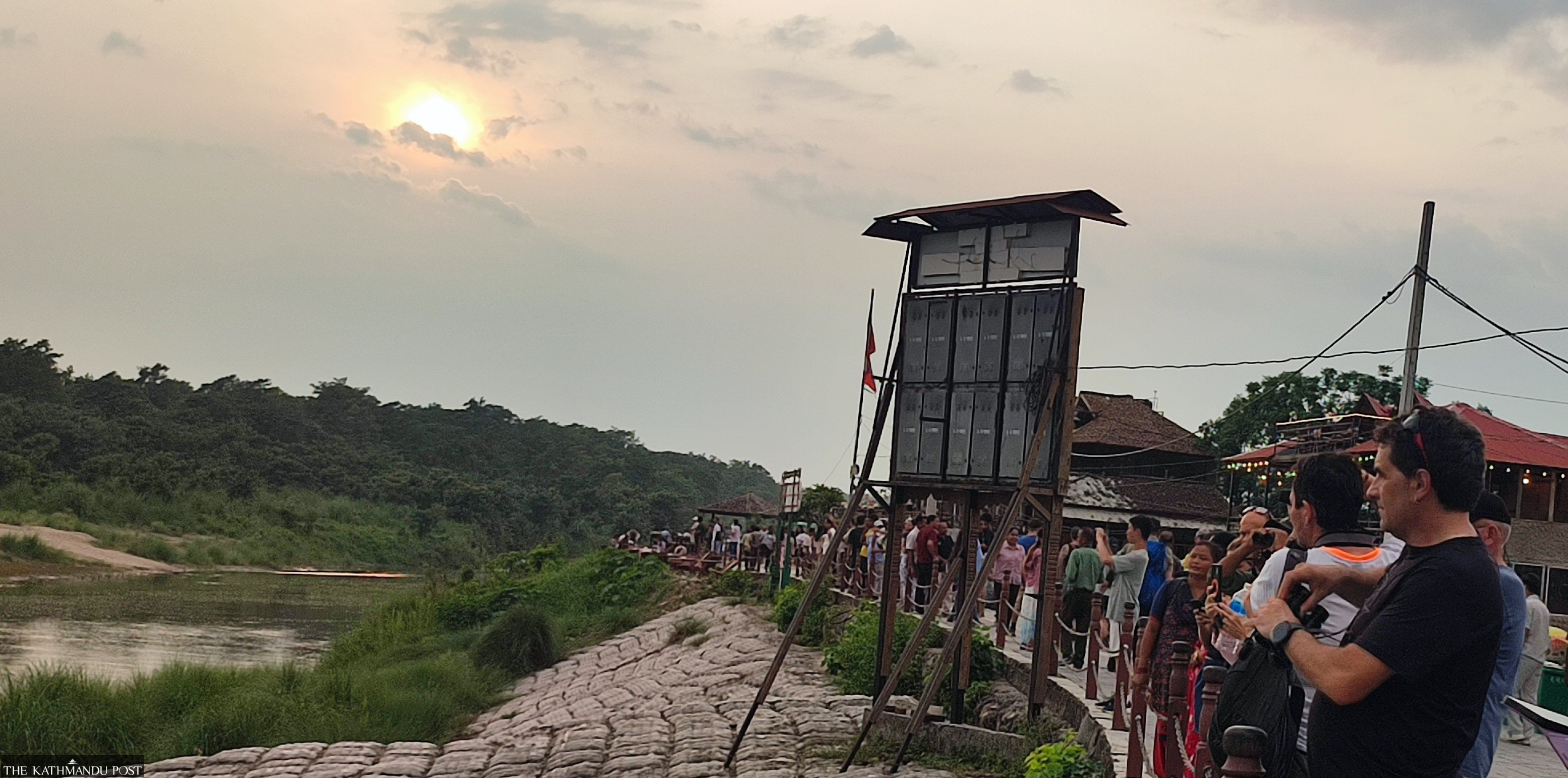
As the sun set along the Rapti river in Chitwan, the embankment overlooking the water filled with visitors. Domestic tourists admired the greenery surrounding the river and watched the sun disappear beyond the horizon. Buses bearing Indian registration plates arrived steadily, while foreign visitors returning from jungle safaris relaxed at hotels.
Hotel operators and tourism workers remained busy welcoming guests. Tourism entrepreneurs in Sauraha say visitor numbers generally decline after March and April. This year, however, arrivals remained strong throughout April and May, even as the monsoon season approaches.
Keshav Khanal, who has been involved in tourism in Sauraha for three decades and has operated Monalisa Hotel for the past 15 years, said the current season has exceeded expectations.
“Normally, Nepali tourists come during Dashain, Tihar and winter, while foreign tourists arrive in February and March,” said Khanal. “This year, business remained good even in April and May. We cannot really call it an off-season.”
His hotel, which accommodates around 100 guests, became fully booked as soon as the holiday period began. “About 70 percent of our guests are Nepali, around 20 percent are Chinese and the remaining are Indians,” said Khanal.
According to nature guide Asmita Godar, this is usually the period when Chinese and Indian tourists visit Chitwan. This year, however, domestic visitors have joined them in large numbers. “Many tourists are coming from Kathmandu and Pokhara,” she said.
Chitwan National Park, the country’s first protected area, remains one of Nepal’s premier wildlife destinations. Visitors enjoy jungle walks, jeep safaris and elephant safaris in community forests surrounding the protected area.
Tourists gather along the banks of the Rapti river in Sauraha during sunset on Thursday evening. Ramesh Kumar Paudel/TKP
According to park information officer Abinash Thapa Magar, a total of 29,740 visitors entered the park in the Nepali month of Baisakh (mid-April to mid-May). The figure compares favourably with 32,252 visitors recorded during Kartik (mid-October to mid-November), traditionally one of the busiest tourism months. Visitor numbers stood at 27,405 during mid-February to mid-March before declining slightly to 25,985 during mid-March to mid-April.
The park has 10 entry points, though around 90 percent of visitors enter through Sauraha.
Further west in Chitwan, Meghauli has also witnessed strong tourist activity. The area, particularly Golaghat, where the Rapti and Narayani rivers meet, has become increasingly popular among visitors seeking wildlife experiences and spectacular sunset views.
“Hotels fill up during holidays and weekends,” said Bishal Kumal, chairman of the Golaghat Tourism Entrepreneurs Committee in Chitwan. “We have not had to turn away guests, but rooms remain occupied almost continuously.”
Kumal said tourists arrive from cities including Butwal, Hetauda and Biratnagar. The growing popularity of Meghauli is linked to its scenic river landscapes, dense forests and opportunities to spot rhinos and, occasionally, tigers.
In Pokhara, boat operator Govinda Magar struggles to keep up with demand from visitors travelling to Tal Barahi Temple in the midst of the Phewa lake.
“This is usually the season for Indian tourists, but their numbers are higher than before,” he said. “Since Thursday, domestic tourists have also increased because of the long holiday.”
Rajesh Tripathi from Kanpur in Uttar Pradesh, India, arrived in Pokhara with his family two days ago. It was his third visit to the city. “Earlier I came with friends. This time I brought my family. The weather is extremely hot back home. Coming here provides relief, even if only for a few days,” he said. According to him, his children enjoyed a lot in Pokhara.
Santosh Mishra from Lucknow, who arrived with five friends on Friday, said Pokhara had lived up to the expectations created by social media. “It looks exactly as I imagined,” he said. “I still have many places to visit. I am also looking forward to experiencing the food and nightlife.”
Strong arrivals of Indian and domestic tourists have pushed hotel occupancy rates in Pokhara close to capacity. Hotels ranging from luxury establishments to mid-range tourist accommodations have reported exceptionally high bookings.
Laxman Subedi, president of Hotel Association Pokhara, said occupancy rates have reached around 90 percent. “This is naturally the season when Indian tourists arrive. The four-day holiday has added domestic travellers to the mix,” he said.
Subedi noted that foreign trekkers who arrived before the onset of the monsoon are also staying in Pokhara, making hotel rooms difficult to find. He attributed part of the increase in Indian visitors to promotional campaigns undertaken in recent years.
“We have actively promoted Pokhara in India and invited Indian tourists to visit Nepal. The results are now becoming visible,” said Subedi. He rejected the common perception that Indian tourists contribute little to the local economy because they bring their own food.
“Such visitors now account for less than 10 percent,” he said. “Indian tourists support hotels, restaurants and even casinos.” Extreme heat across northern India has driven more visitors towards Nepal this year.
Meanwhile, the Palpa district headquarters and hill town—Tansen—has also experienced an unusually busy tourism season. Hotels display ‘sold out’ notices on their websites, while resorts in and around the town have reported occupancy rates of up to 100 percent.
“After a long time, hotel entrepreneurs in Tansen are smiling,” said Laxman Basyal, president of the Hotel and Restaurant Entrepreneurs Association of Palpa.
Laxman Bashyal, president of the Hotel and Restaurant Association of Palpa, reported that business confidence has improved following a quiet winter season. “Tansen operators are experiencing a sustained recovery. Average occupancy across resorts and hotels has hovered around 80 percent over the past week, with several properties reporting 100 percent occupancy on peak days,” Bashyal said.
Bashyal, who runs the Annapurna Hotel, noted that 80 percent of his 40 rooms were reserved ahead of guest check-outs, forcing him to refer walk-in clients to alternative lodges. “Historically, May is a slow month for Palpa due to rising temperatures, but the market dynamics have shifted this year,” he reasoned. There are 120 registered hotels and restaurants in Palpa, with 15 premium properties affiliated directly with the central association, all reporting consistent footfall.
Local farmhouses and eco-resorts surrounding Tansen are also reporting high demand. “Our guest demographic is roughly 20 percent Indian nationals, while the remaining 80 percent consists of domestic visitors, including short-haul visitors from nearby urban hubs like Butwal and Bhairahawa,” said Ramesh Karki.
Bardiya National Park in western Tarai has also seen steady visitor traffic despite midday temperatures reaching 41 degrees Celsius. Travellers are focusing their activities on early morning and late afternoon jeep safaris, alongside visits to the rescue enclosure at the park headquarters, which houses rescued Bengal tigers and one-horned rhinos.
Ramji Babu Thapa, a local lodge operator, noted that corporate retreats and non-governmental organisation workshops scheduled around the holidays have helped maintain occupancy levels despite the summer heat.
According to park regulations, entry fees are structured at Rs100 for domestic citizens, Rs750 for SAARC nationals, and Rs1,500 for international visitors. Bardiya National Park, recognised for its tiger conservation efforts, is currently home to an estimated 125 tigers.
Saroj Mani Paudel, Senior Assistant Conservation Officer and Information Officer for Bardiya National Park, provided official attendance records indicating that 22,222 tourists visited the park between mid-July and mid- May. This total includes 15,140 domestic travellers, 889 SAARC nationals, and 6,193 international tourists.
In Rupandehi district, where temperatures are hovering around 40 degrees Celsius, local residents are migrating towards cooler destinations like Palpa, Arghakhanchi, and Pokhara. To check this seasonal outflow and retain regional travellers, luxury hotels in the plains have introduced targeted leisure packages centred around their swimming facilities and indoor entertainment.
Five-star properties in the region are actively marketing these packages to domestic travellers and cross-border Indian visitors from neighbouring Uttar Pradesh and Bihar. The Lumbini Heritage Home, a five-star property in Lumbini, introduced a discounted multi-day package starting Thursday to coincide with the long weekend.
The property’s weekend schedule includes poolside events on Saturday, followed by a live screening of the Indian Premier League cricket final paired with dining offers on Sunday.
The Hyatt Place in Butwal organised a specialised pool party on Saturday, targeting families and young adults. Nisha Thapa, associate director of sales at the hotel, described the event as a tactical summer promotion.
“This is an interactive pool event featuring performance artists and musicians travelling from India,” said Thapa.
(Madhav Aryal in Palpa, Kamal Panthi in Bardiya and Dipendra Baduwal in Bhairahawa contributed reporting)




 14.81°C Kathmandu
1.jpg)
.jpg)