Minister’s emergency airlift lays bare healthcare gaps in Sudurpaschim
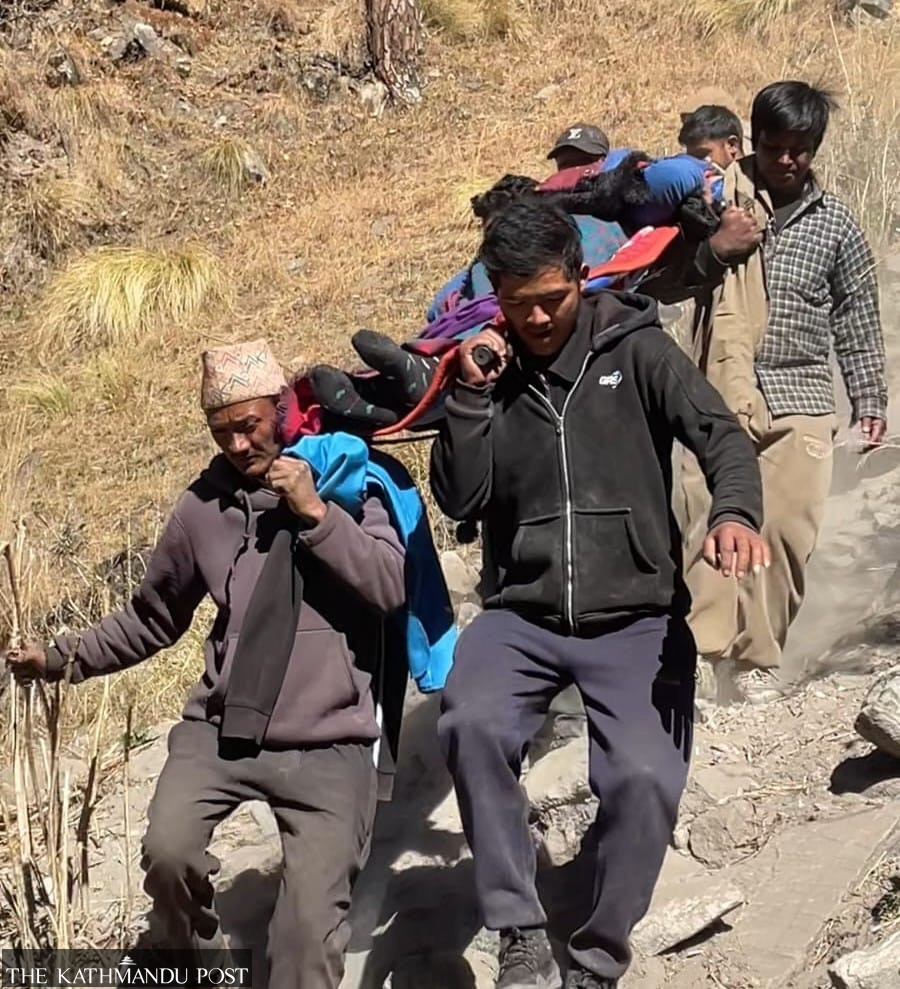
Lamsal was flown from Baitadi to Kathmandu after falling ill, highlighting a stark contrast with residents who struggle to find ambulances, basic medicines and specialist care. A patient is carried on a stretcher toward Chainpur, the headquarters of remote Bajhang district, after falling ill in Saipal Rural Municipality. Post file photo
Minister for Physical Infrastructure Development Sunil Lamsal was in Baitadi on Sunday during a field inspection of the province’s hill districts when he fell ill. Dr Pabin Upadhyay, who examined him at his hotel, said he had symptoms of a viral respiratory infection.
Lamsal was given medication in Baitadi but was later evacuated by army helicopter to Dhangadhi. After examination by military doctors, he was flown to Kathmandu aboard an army Skytruck and taken to Chhauni Hospital. He was discharged that night and prescribed antibiotics for five days, according to his personal secretary, Nirmal Gyawali.
Lamsal had fever, a sore throat and weakness, Gyawali said. Doctors in Dhangadhi also found that his breathing was irregular.
The evacuation drew criticism even from Lamsal’s own Rastriya Swatantra Party. Lawmaker Paras Mani Gelal told Parliament on Monday that ministers could obtain helicopters for minor illnesses while ordinary people could not find transport when they were dying.
“People are not going to be won over by ministers’ videos and publicity tours,” Gelal said. “They need to feel that the government is solving their problems, not simply visiting their homes.”
The episode also raised questions about healthcare in Baitadi itself.
The hospital has three MDGP doctors, an orthopaedic surgeon, a dental surgeon, two medical officers and high-dependency beds. It handles about 150 outpatients a day and has laboratory facilities for diagnostic tests.
Dr Chet Raj Joshi of the provincial Ministry of Social Development said healthcare in Sudurpaschim has improved significantly, although it remains inadequate.
However, for people living beyond the provincial capital, even basic healthcare remains difficult to obtain.
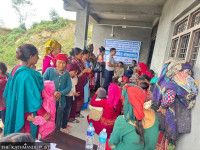
At a community health unit in Kholikot, in Bajura district’s Swamikartik Rural Municipality, paracetamol is often scarce. Birja BK, who runs the facility, said staff ration the medicine.
“If someone requires ten tablets, we can only give them five,” he said. “It’s the exact same story every day.”
Government rules require basic health facilities to provide 98 types of medicines free of charge. Kholikot usually has no more than 50 types available, BK said.
The shortage of medicines is compounded by the difficulty of reaching health facilities. The Bajura District Health Office says four women gave birth on the road during Shrawan, which falls roughly between mid-July and mid-August.
On July 20, 22-year-old Junu Rokaya of Gaumul Rural Municipality-2 went to a community health unit for maternity care. Health workers referred her elsewhere because they could not conduct the delivery. She was carried towards Ghatmuna on a stretcher, a journey of at least three hours on foot, but gave birth after about an hour at a place called Sim.
“There is no nearby health facility. There is no vehicle to take patients there. Carrying someone on a stretcher is extremely risky,” said Rama Thapa, an auxiliary nurse midwife.
In neighbouring Bajhang, 21-year-old Savita Bohara of Kedarsyun Rural Municipality-1 died last year after giving birth by the roadside. Her family had started taking her to a health facility, but could not get an ambulance in time. She gave birth about 10 minutes after leaving home, then lost consciousness.
“Her ambulance arrived only after she had died,” said her sister-in-law, Devkala Bohara. The nearest primary health centre could have been reached in about 30 minutes by ambulance or 90 minutes on foot, the family said.
Kuber Bahadur Shahi, a Dhangadhi-based health professional and civil society activist, questioned what kind of state allows women in labour to die because they cannot reach hospitals while a minister with a viral fever can be flown to Kathmandu.
“This is not merely misuse of state resources. It also reflects distrust and disregard for public and private hospitals, doctors and health workers in Sudurpaschim,” he said. Shahi questioned the medical grounds for the evacuation, who recommended it and how much it cost.
Provincial officials acknowledge that the health system remains under-resourced.
Dr Khagendra Bam, director of the Sudurpaschim Provincial Health Directorate, said the province lacks enough hospitals, staff and equipment. Dhangadhi has better-equipped hospitals, including government facilities with doctors trained to MD, DM and MCh levels. Specialist doctors sent on government scholarships are also working across the province.
The provincial government gives each district hospital Rs6 million a year to employ two specialist doctors.
But the province remains at the bottom of several health indicators.
The Nepal Health Fact Sheet 2025 says Nepal has 28 teaching hospitals. Sudurpaschim is the only province without a medical college or health sciences institute in operation.
The province has 109 sanctioned positions for specialist doctors across 13 hospitals, but only 20 are filled, according to Chetkant Bhusal, a public health administrator at the provincial Health Directorate. Of 79 sanctioned medical officer posts, only 37 are occupied.
Sudurpaschim has only one general hospital with more than 100 beds, compared with 25 in Bagmati, 15 in Madhesh, 12 in Lumbini, seven in Koshi and three each in Gandaki and Karnali.
For accident victims in Baitadi, Darchula, Bajhang, Bajura and the province’s other hill districts, Dhangadhi is often the only destination for critical treatment. Dr Gun Raj Awasthi, a former director of the provincial Health Directorate, said a trauma centre should be established somewhere accessible to all seven hill districts.
The government has established the Martyr Dasharath Chand University of Health Sciences in Geta, Kailali, but medical education has yet to begin. It has now decided to turn Geta Hospital into the university’s teaching hospital.
Private healthcare is also least developed in Sudurpaschim. Nepal had 2,451 privately operated health facilities in fiscal year 2024-25, according to the Health Fact Sheet. Sudurpaschim had only 69, the lowest of all provinces.
The health crisis extends beyond hospitals.
A provincial government survey found that one in four children in Sudurpaschim is stunted and one in six is wasted. Dhirendra Nath, a public health officer involved in the study, said the findings put child health in the province at an emergency level under World Health Organisation standards.
Some 31.45 percent of children had not eaten vegetables or fruit, the report found. Cow or buffalo milk was often introduced before six months, while four in 10 children consumed junk food. Wasting was particularly high in Kailali and Kanchanpur, while stunting in Bajura, Bajhang and Darchula was roughly twice the level recorded in the Tarai.
Sudurpaschim also has Nepal’s highest child mortality rates. The Nepal Multiple Indicator Survey 2024-25 puts infant mortality at 27 per 1,000 live births nationwide, compared with 38 in Sudurpaschim. The under-five mortality rate is 31 nationally and 48 in the province.
Government policy requires every local unit to have a basic hospital with five to 15 beds. Yet only 33 of Sudurpaschim’s 88 local units have such facilities.
“People in rural and remote areas are deprived of even minimum medical services,” said Ramesh Kunwar, head of the Kailali Health Office. Most provincial hospitals, he said, have only 15 beds.
Sudurpaschim has 18 hospitals with 25 to 50 beds, but the Health Fact Sheet identifies only four, Seti, Mahakali, Tikapur and Geta, as providing specialist services. The province has only one 100-bed hospital, at Dadeldhura, which the federal government classifies as a specialised hospital. Local resident Bhimdev Paneru said even that hospital is struggling to provide adequate services.
Government rules require facilities providing basic healthcare to receive 98 types of medicines free of charge. In practice, supplies do not reliably reach remote facilities.
“Not all facilities have been supplied with the required free medicines throughout the year,” said Jhanak Dhungana, head of the Provincial Health Supply Management Centre.
The contrast is stark. The state was able to mobilise a military helicopter, military doctors and an army Skytruck to move one sick minister from Baitadi to Kathmandu within hours. In the same province, women in labour can spend hours being carried to a health facility, while remote health posts ration paracetamol.
For many residents of Sudurpaschim, the problem is not simply a lack of advanced healthcare. It is the absence of a reliable system for delivering even basic care when they need it most.




 13.68°C Kathmandu