The trouble with sexuality education in Nepal is too much of it goes untaught
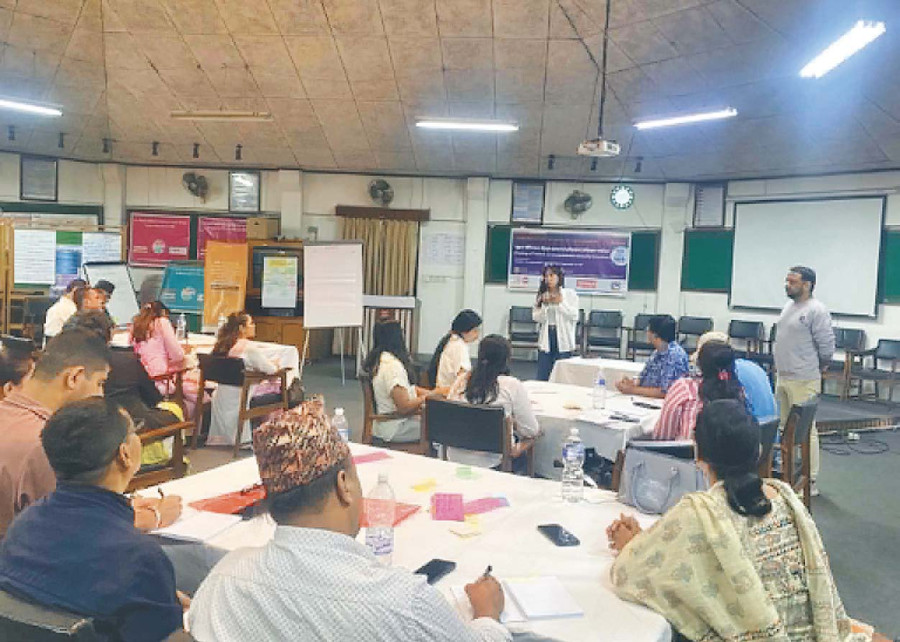
Despite being part of the curriculum through grade 8, Comprehensive Sexuality Education is often reduced to a few chapters, hampered by limited teacher training, and dropped from the compulsory curriculum just as adolescents enter their teenage years.Teachers attending a Training of Trainers programme on Comprehensive Sexuality Education. The training was conducted with the support of UNFPA and KOICA through FPAN. Photo : Courtesy of FPAN
Seema (name changed) was in grade 7 in Rithapata in Bhajang District, when her teacher first explained that human reproduction involved intercourse, embryos and how bodies work. She went home and asked her parents about it. Her father slapped her. Then he walked to the school and told the teachers they were teaching his daughter unnecessary things.
Sauriya Budhathoki, 17, a student at Divya High School in Kathmandu, had a different experience. She says she was lucky because of one teacher. A female English teacher at her school took it upon herself to go beyond the curriculum. “She told us that in her time, they weren’t taught these things so she wanted us to learn about it early,” Sauriya said. But the subject disappeared the following year. There was no Health, Population and Environment (HPE) in grade 9.
What the school didn’t teach her, her older sister did — partially. What she wishes had come earlier, and from school, is simple: “Periods and bodily changes, should have been explained to us much earlier, rather from grade 5 or 6.”
Two students, two different locations and entirely different education about their own bodies. The difference was not policy but luck: the particular teacher, the particular school and the particular year.
Seven years ago, Nepal’s education officials made a series of public commitments on Comprehensive Sexuality Education (CSE). Lekha Nath Poudel, then director general of the Curriculum Development Centre, said CSE would be introduced in phases from grade 1, while the Ministry of Education said a mandatory policy was forthcoming. At the time, international organisations including UNESCO, UNFPA and UN Women were also running a pilot programme in Bajura, Achham, Sunsari, Rautahat and Sarlahi districts.
Seven years later, the gap between those commitments and what students experience in classrooms remains wide. CSE content is incorporated into the curriculum through grade 8, but much of it appears only in one or two chapters and remains limited in scope, leaving students with only surface level understanding.
At grades 9 and 10, when adolescents are navigating puberty, relationships, Health, Physical Education remains an optional subject. Teachers and experts say CSE remains limited and heavily dependent on support from international organisations, while lessons are often skipped in classrooms.
The curriculum does cover these topics, on paper. For grades 1 to 3, age-appropriate topics like good touch and bad touch, family and personal hygiene are included in Hamro Serofero, the interdisciplinary subject that covers surroundings, social studies, and science. From grade 4, CSE is incorporated into Health, Physical Education and Creative Arts as a compulsory subject, with three credit hours per week. “Grade 6 has a dedicated unit on Sexual and Reproductive Health,” said Kamal Prasad Mishra, a curriculum officer at the CDC. “Grade 7 introduced LGBTQI+ content. Grade 8 covers puberty, menstruation and nocturnal emissions.”
At grades 9 and 10, where four credit hours are allocated, the subject becomes optional.
“The content exists just in definitions and delivery remains surface-level, a topic here and there, rarely enough to give students a real framework,”said Meena Sharma, chairperson of Institute of Human Rights Communication Nepal (IHRICON), a human rights organisation.
The decision to make Health optional at the secondary level was made by the National Curriculum Development and Evaluation Council, chaired by then federal education minister, partly because students were considered overloaded. The practical consequences play out not in policy documents but in staffing rosters. Because the subject is not compulsory, many schools have no dedicated teaching position for it.
Prabin Khadka, youth and CSE manager at the Family Planning Association of Nepal, said teachers of subjects such as mathematics or English are often asked to teach CSE despite lacking the necessary competence.
At Manakamana Secondary School in Harion, Sarlahi, Mina Dhungana Baral, a Social Studies teacher teaches HPE in grade 8 despite it not being her area of expertise. She has received no formal CSE training. “I think Science teachers would be better equipped to teach the technical details of reproductive health and gender identity than I am,” she said.
She has nevertheless found ways to teach the subject. Students are curious but often hesitant to ask questions. She said teachers have to find or create their own materials and need formal training on how to approach sensitive topics.
Her principal, NT Lama, said the school had received neither adequate materials nor training from the government. He has noticed students becoming visibly uncomfortable when lessons on consent or reproductive health come up.
“If we had been teaching them this content from a young age, they would not be reacting that way,” he said.
It is a problem the government says it is working to fix. Ram Chandra Dhakal of the Centre for Education and Human Resource Development (CEHRD), said his office runs a one-month certification programme for HPE teachers in grades 4 to 8 and a customised five-day programme. Ministry of Education spokesperson Shree Prasad Bhattarai said 1,500 teachers are benefiting from the latter.
A more targeted intervention came this year in the form of a Training of Trainers conducted in collaboration with FPAN and supported by UNFPA through KOICA, the Korean aid agency. Dhakal said CEHRD coordinated with Education Training Centres across all seven provinces to invite participants. Of the twenty-five teachers invited, 24 teachers came from across the country, which has around 26,000 community schools. And the training is not held annually, because it depends on funding.
What happens after teachers return to their classrooms is also unclear. Dhakal said monitoring falls to local governments. Mishra said the CDC is primarily occupied with curriculum development and lacks the resources for consistent field feedback.
The reasons teachers skip CSE lessons are not difficult to find. Khadka said hesitation is one of the most persistent barriers.
“Local teachers often find it difficult to teach these topics as students who are their relatives or neighbours are in the same class,” he said.
In provinces like Sudurpaschim, superstitions around menstruation make the subject harder still. Parents, he said, often believe CSE is only about sexual relationships and fear it will lead children towards “immoral behaviour”. “In reality, CSE covers gender-based violence prevention, communication skills and life skills.”
A 2025 Nepali study on CSE delivery in schools found the same pattern. Teachers often focused on abstinence rather than factual information. Students were left with questions because teachers were too uncomfortable to discuss the topic openly. Its title captured what students themselves reported: “The teacher himself feels shy, so how can we ask questions to him?”
Sharma, who has conducted fieldwork across Karnali, Madhesh and Sudurpaschim provinces, described what that hesitation looks like from the other side of the classroom. In Madhesh, she said, teachers often laugh the subject off. In Baitadi, she documented a case where a mathematics teacher would reach into female students’ pockets under the pretext of looking for chocolates or erasers. The students said nothing. They were weak in mathematics and afraid. “There was no complaint mechanism,” she said. “At the same time, they had no word for what actually happened to them. They were not aware of the concept of good touch or bad touch and consent.”
The consequences of that gap show up in the data. A recent report by the Centre for Research on Environment Health and Population Activities found that even as Nepal reduced adolescent pregnancy nationally, from 56 percent to 14 percent between 2001 and 2022, Madhesh and Karnali recorded the highest rates throughout the entire period. They are the same provinces where Sharma says CSE delivery is weakest.
The classrooms themselves compound the problem. In regions like Karnali and Sudurpaschim, significant age gaps exist within a single grade, a 13-year-old sitting beside an 18-year-old who has returned from working in India. Their needs, their exposure and their understanding of what CSE content means are entirely different. “Schools must create safe spaces,” Sharma said. “But they are not equipped to.”
With internet penetration in Nepal now above 80 percent, students are not waiting for the next class to find answers. “Curious minds need more than just lectures,” she said. “They need audio-visual methods to be impactful. Students often have half-knowledge and explore other options because HPE classes aren’t as regular as Math or Science.”
For many students, there is nowhere to turn when something goes wrong. According to Nepal Police data, an average of seven to eight rape cases are reported every day in the country, roughly 2,200 to 2,300 cases annually. In the fiscal year 2017-18, 64 percent of rape victims were girls below age 18. It was partly in response to this that Nepal Police launched the Community- Police Partnership programme in 2018. Abi Narayan Kafle, spokesperson for Nepal Police, confirmed the programme is still ongoing, with Police-School Liaison Committees established across the country. Through it, officers visit schools to teach students about sexual harassment, good touch and bad touch, and rape prevention. But the programme operates under the Ministry of Home Affairs, not the Ministry of Education and a police awareness programme, however well-intentioned, is not a substitute for a compulsory curriculum.
Mishra at CDC was direct about the limits of what his office can do. “It happens through stakeholder pressure: from students, teachers and society. It is a matter for the Ministry and political leadership.” He added: “I personally feel it would be good if HPE were compulsory for grades 9-10 as well. However, this won’t happen just because I say so.”
Sharma disagreed with that approach. “It is better to invest in health education early than to spend on health services later,” she said. “It should be made mandatory.”
Aarya Chand is a reporter at The Kathmandu Post covering social issues. Before moving to the social beat, Chand was an intern covering culture and lifestyle for the Post.




 26.02°C Kathmandu