Sugar stocks were said to be sufficient. Prices are now surging
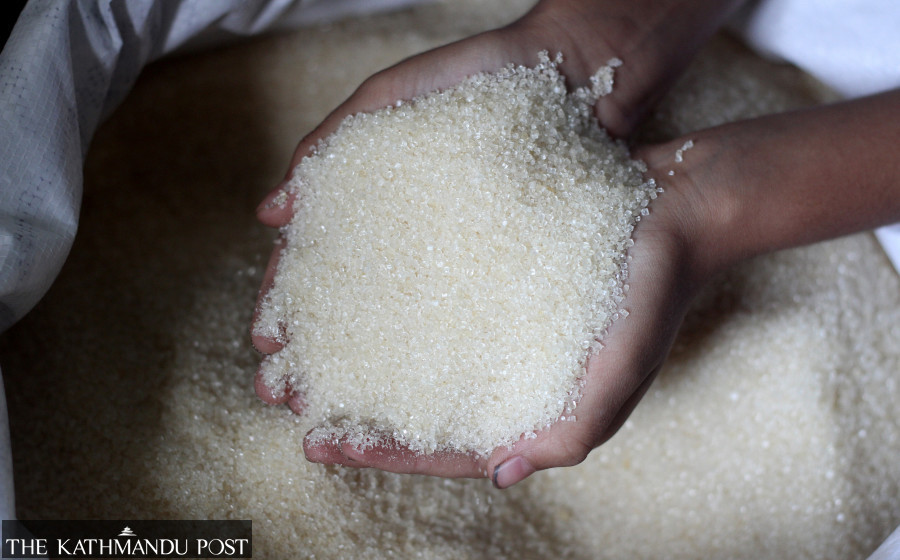
Nepal’s sugar stocks, once described as sufficient to meet demand for six months, are now under pressure as prices rise and the festive season approaches. Nepal’s monthly sugar demand ranges from 20,000 to 25,000 tonnes and rises to around 30,000 tonnes during major festivals such as Dashain, Tihar and Chhath. File Photo
Two months ago, after India imposed a ban on sugar exports, Nepali sugar producers assured the government that the country had enough stocks and that the restriction would not push up prices.
But as the autumn festive season approaches—the period when sugar consumption typically rises—the price of the sweetener has jumped to Rs125 per kg from Rs110 last week.
The increase comes at a time when households, sweet shops and food businesses are stocking up for Dashain, Tihar and Chhath festivals, when demand for sugar rises sharply.
Anil Kiratee, director of the Department of Commerce, Supplies and Consumer Protection, said recent inspections found retailers in different parts of the Kathmandu valley selling sugar at Rs125 per kg.
“We are inspecting sugar prices daily,” he said. “We checked retailers’ purchase bills in many places and found that they are selling sugar at the price at which they purchased it from wholesalers. There is no big difference between the retail and wholesale prices, which suggests that the price rise is driven by tighter supply.”
Kiratee said increasing supply was necessary to contain prices.
Sugar mills, meanwhile, have begun warning that supplies could tighten during the festive season, a reversal of their assurances two months ago that the country had sufficient stocks.
On May 13, India banned sugar exports, including shipments to Nepal, citing concerns that El Niño-related weather disruptions could reduce agricultural output and affect sugar production in the next season. The ban is scheduled to remain in effect until September 30, 2026, unless India issues another notice.
In June, government officials, sugar producers and traders had said existing domestic and imported stocks were sufficient to meet Nepal’s demand for at least six months.
The export ban also led to increased sugar smuggling through Nepal’s southern border. The Armed Police Force, which is responsible for border security, has so far seized 10 tonnes of smuggled sugar.
Attempts to create artificial shortages and push up prices during periods of restricted imports, however, are not new.
In September 2023, when India first suspended sugar exports to Nepal after poor rainfall reduced sugarcane yields, the price of sugar surged from around Rs88 per kg to as high as Rs160. The restriction was later extended beyond October 31, coinciding with Nepal’s peak festive season and triggering a sharp rise in prices.
At the time, sugar became scarce in the market and this prompted the government to impose a quota of 2 kg per person at state-owned depots. Black marketing flourished.
Consumer rights activists fear a similar situation could emerge this festive season.
Shashi Kant Agrawal, president of the Nepal Sugar Mills Association, said private sugar mills now have only around 7,000 tonnes in stock.
“Last week, we sold 15,000 tonnes of sugar to the Salt Trading Corporation and Food Management and Trading Company at Rs85 per kg, excluding VAT, transportation costs, dealer commissions and local commissions,” said Agrawal.
The low remaining stocks at private mills have raised concerns that prices could spiral if the market faces a severe shortage, according to market analysts.
The situation in India, Nepal’s main source of sugar imports, is also putting pressure on prices.
Retail sugar prices in India rose by around 16 percent between July 20 and August 20, according to Indian government data, while overall sugar prices have increased by nearly 40 percent over the past two months.
Indian media have reported lower sugarcane yields in Maharashtra, Karnataka and Uttar Pradesh, three of the country’s major sugar-producing states. Excess rainfall and waterlogging damaged sugarcane in parts of Maharashtra, while crops in some areas were also affected by diseases and pests, including red rot and top borer.
Lower cane yields have reduced the amount of sugar that can ultimately be produced, tightening the supply outlook.
In eight Indian states, including Uttarakhand, Punjab, Madhya Pradesh and Odisha, sugar prices have crossed INR65 per kg, or around Rs103. As of August 25, Odisha recorded the highest price at INR67.40 per kg, equivalent to about Rs107.82, up from INR55, or Rs87.98, a week earlier.
In Nepal, the consumer department said it has been collecting data on domestic sugar stocks to assess the supply situation.
The Nepal Sugar Mills Association said Nepal produced around 180,000 tonnes of sugar from last year’s harvest. Sugarcane harvesting in Nepal typically begins in mid-November, as winter sets in. This year sugar production is expected to rise to around 215,000 tonnes.
Nepali consumers have already begun worrying about the additional inflationary burden ahead of festivals.
In India, opposition leaders have blamed the diversion of sugarcane for ethanol production for the sharp rise in sugar prices, while farmers’ groups have argued that large traders are artificially pushing up prices ahead of the festive season, according to Indian media reports.
The Nepali government, however, has no concrete plan to import additional sugar to meet rising festive demand, although some sugar imported from India under an existing quota is arriving.
Nepal still has a quota of 10,000 tonnes remaining from the allocation approved by India in September last year.
Last year, Nepal had sought permission to import 60,000 tonnes of sugar to meet festive demand, but India approved only 25,000 tonnes through National Cooperative Exports Limited. Of the approved quota, Nepal has already imported 15,000 tonnes.
Madhav Mishra, information officer at the Food Management and Trading Company, said 1,000 tonnes of sugar would arrive in Nepalgunj on Tuesday. The price has yet to be fixed by the price-determination committee.
“We will calculate the cost. The price of sugar might go up by a few [rupees],” he said.
The state-owned company is currently selling sugar for Rs100 to Rs105 per kg through its outlets across the country.
However, the company has yet to begin preparations to meet the surge in festive demand. It plans to either import sugar from India or purchase it from the domestic market, although the quantity has not yet been decided.
According to the Salt Trading Corporation, Nepal’s monthly sugar demand ranges from 20,000 to 25,000 tonnes and rises to around 30,000 tonnes during major festivals such as Dashain, Tihar and Chhath.
Annual demand is estimated at around 300,000 tonnes, while domestic production falls short by roughly 100,000 tonnes, making imports necessary to meet consumption.
Nepal’s dependence on imports has grown in recent years. Sugar imports increased by 90 percent in the last fiscal year compared with 2024-25.
According to the Department of Customs, Nepal imported 51,485 tonnes of sugar worth Rs3.48 billion in the last fiscal year ended mid-July.
Krishana Prasain is a business reporter for The Kathmandu Post covering markets. Before joining The Kathmandu Post in 2018, she spent 3 years in New Business Age magazine covering business.




 15.32°C Kathmandu