On Wednesday afternoon, Daya Dudraj, a reporter for Kantipur Daily, a sister publication of the Post, was trying to document the plight of evicted landless squatters living under tarpaulin sheets in the rain, in the rehabilitation centre in Kirtipur, when a municipal police personnel grabbed him by the arm and issued a demand for the deletion of recorded footage. When he questioned the legal basis for such a restriction, the response was a refrain that has become the hallmark of the current administration: Orders from above. The encounter reached a pinnacle of absurdity when a police officer compared the possession of a press identification card to the possession of a firearm, asking if the presence of a gun meant it should be fired indiscriminately. Dudraj’s case is not an isolated one. TV journalists duo Sikha Shrestha and Shyam Shrestha were targeted by the police while covering the demolition of encroached structures at a squatter settlement along the Manohara riverbank. These two recent ordeals faced by journalists serve as a manifesto of this new era of suppression.
This atmosphere of intimidation is further amplified by a recent move by the Nepali Army. It recently issued a stern warning on what it labels as misleading content and fabricated narratives circulating on social and mass media. By announcing that it is actively monitoring such activities and threatening legal action under prevailing laws, the army has cast a wide net that threatens to ensnare legitimate investigative journalism. The military’s demand that the public rely solely on official press releases and verified accounts for information is an attempt to create a sanitised information ecosystem. Such rhetoric curtails the essential freedom to question institutional leadership and risks transforming the media into an echo chamber for official narratives.
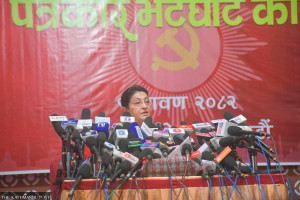
The suppression of information is being paired with an equally aggressive attempt to govern through shadows and secrets. The administration led by Balendra Shah has become defined by its distance from the fourth pillar of democracy, with the Prime Minister himself avoiding the press since his appointment. This silence from the top is mirrored by a legislative strategy that prioritises executive overreach over parliamentary debate. The government has doubled down on the use of ordinances to bypass the legislature, including on contentious moves to amend the Constitutional Council Act. These ordinances effectively weaken institutional checks and balances. Parallel to this political manoeuvring is a calculated economic assault on independent media. A recent government circular has mandated that all public advertisements and notices be funnelled exclusively through state-owned outlets. By depriving private outlets of vital advertising revenue under the guise of curbing market irregularities, the state is effectively starving the very voices that hold it accountable.
Nepal has maintained a unique position as the leader of media freedom within South Asia. Even with a recent decline in global rankings, the nation continues to boast the freest media environment in the region. However, this position is now under threat from the government’s recent actions.
The future of press freedom looks increasingly bleak. Journalists being physically harassed for filming public suffering, the military threatening those who deviate from official scripts, and the state using economic monopoly as a tool of censorship—these are all signs of democratic backsliding. The transition from a representative democracy to a regime that rules by ordinance and silence represents a betrayal of the transparency it once promised to the electorate. If ‘orders from above’ continue to supersede the constitutional rights of the people and the press, free speech in Nepal will come under grave threat.




 14.4°C Kathmandu