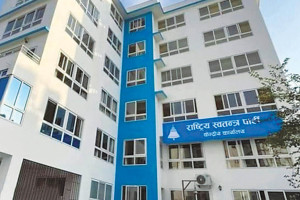
In just three and a half years, the Nepali Congress went down from 89 seats in the federal lower house in 2022 to 38 in 2026. If the faction of Purna Bahadur Khadka, former party president Sher Bahadur Deuba’s hand-picked vice-president, is to be believed, the one and only person responsible for this downfall of the party is Gagan Thapa. Supposedly, in the aftermath of the 2025 Gen Z movement, had Thapa not revolted and had he not convened a special general convention, the party would be in a much better shape right now. The special convention, called just a couple of months before the March 5 national elections, had picked Thapa as the new Congress president. Khadka’s faction protested, yet both the Election Commission and later the Supreme Court legitimised the gathering as well as Thapa’s status as the new party president. Following this, the Congress party went to election under Thapa. As the leader of the party’s electoral machine, Thapa no doubt has to shoulder the blame for the historic drubbing the Congress suffered. He had, after all, taken the risk of convening the convention before parliamentary polls that were only months away. Yet the contention of Khadka and his faction that the party would otherwise have fared better at the polls is dubious.
The hard reality is that the Gen Z uprising was a result of the failure of established political parties like the Nepali Congress and the CPN-UML, which had repeatedly been entrusted to govern the country but were found wanting each time. It was under the watch of the likes of Deuba and KP Oli that corruption and misgovernance flourished in the country. Under Deuba’s leadership, the party was involved in one after another dubious political deals, whose main purpose was to ensure that Deuba, the five-time prime minister, would get another chance as the country’s executive head. The old party leadership had failed to internalise the extent of its unpopularity. It was in this situation that Thapa dared to convene a special general convention. Arguably, without the convention, the party could have done worse in the polls. By adopting a strategy of non-cooperation, the Deuba-Khadka faction also actively cut the party’s votes, most notably in the Sudurpaschim province.
The Khadka faction now warns that a formal party split is imminent. But it is hard to see how a new outfit helmed by Khadka or any other member of his faction will be credible in the public eye. This is a group of leaders who still refuse to acknowledge that last year’s Gen Z movement represented a rupture in Nepali politics, that the country has been forever changed. That the reason the Congress was trounced electorally had less to do with an abrupt change in party leadership and more with the decades of corruption and misrule that the old party leadership perpetuated. Perhaps it’s not such a bad idea for a bunch of old leaders who still cling to the legacy of Deuba, someone who is now on the run from the Nepali law, to go their separate way and give the mother party a clean shot at rejuvenation.




 18.34°C Kathmandu