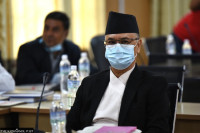
On Saturday, Prime Minister Balendra Shah posted a photo of himself eating a cube of cheese, alongside a plate of cheese cubes and a packet of yak cheese, on his social media accounts, captioned “Say Cheese. DDC ko Cheese”. He was promoting the cheese produced by the state-owned Dairy Development Corporation. The premier’s post alone did more to promote yak cheese than years of successive governments’ efforts. The demand for the cheese had been boosted by 30 percent the following day, as the public rushed to buy yak cheese to imitate Shah on social media. The product went out of stock at major supermarkets in the Kathmandu Valley, and the corporation even supplied additional quantities of the stuff. A single post from the country’s popular prime minister drove a cheese craze, offering hopes (if faint) of reform in Nepal’s dairy sector, which has long been under strain.
PM Shah’s move to promote domestic products is both welcome and refreshing. Yak cheese, with a slightly nutty and tangy taste, is an indigenous delicacy made from the milk of yaks in Nepal’s Himalayan region. But such delicacies are not popular among the wider public and are limited to Himalayan communities as a source of income. At a time when Nepal desperately needs stronger support for products like yak cheese, Shah’s endorsement of the product shouldn’t be dismissed as a publicity stunt. Still, a social media post is no magic wand to remove all the problems faced by the dairy sector, farmers and even the DDC.
The severity of the problems in the DDC warrants long-term solutions. The corporation has long been in the red. Demand for milk, butter, powdered milk and ghee plummeted as people’s purchasing power decreased. As a result, unsold dairy products remained unused in warehouses. Separately, only this year, the DDC cleared long-pending dues to farmers, covering all payments up to mid-January. As dairy farmers endured months-long payment delays, they struggled to earn a living, and often flooded roads with milk in protest. Even though demand for yak cheese is high in international markets, the lack of proper preservation systems hinders large-scale exports.
To boost exports of cheese and other dairy products from the DDC, investment in technology is vital. Then there are problems specific to yak cheese, such as declining numbers of yak farmers, limited pasture access, disease outbreaks, poor infrastructure and lack of veterinary services, among others. Nepal often faces an oversupply of milk during the flush period and a dip in production during lean months. So farmers could go unpaid yet again. Given this, the Shah-led government must devise plans to diversify surplus milk during flush periods to meet demand during lean periods, while also paying farmers on time. Most crucially, measures should be taken to boost dairy exports, including of yak cheese, to encourage farmers, industrialists and young entrepreneurs to enter the sector, and to sustain those already in it.
When Shah said, “Say cheese”, it helped to restore confidence in the struggling DDC to an extent. Whether his gesture will remain largely symbolic or if he and his government have broader reform measures in mind remains to be seen.




 23.24°C Kathmandu