



 14.81°C Kathmandu
Sat, Oct 24, 2026
Money
DDC clears dairy dues, private processors report no pending payments
State-owned corporation says Rs1.48 billion paid in first half as improved sales and lower output ease two-year cash crunch for farmers.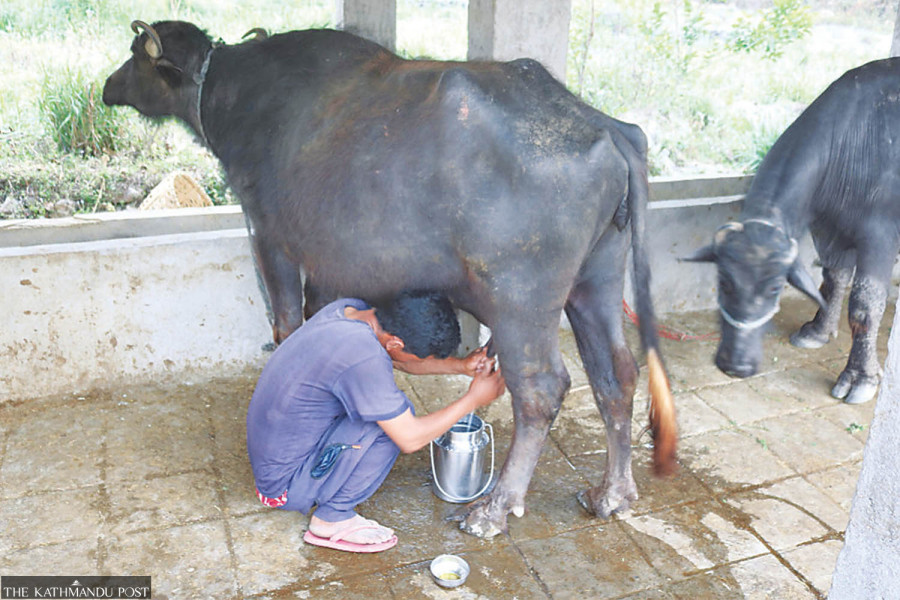
bookmark
Post Report
Published at : February 19, 2026
Updated at : February 20, 2026 06:54
Kathmandu
Dairy farmers who had endured months-long payment delays over the past two years are finally getting relief, as the state-owned Dairy Development Corporation (DDC) says it has cleared dues up to mid-January, while private processors report that they have no outstanding payments left.
DDC General Manager Sanjeev Jha said the corporation paid Rs1.48 billion to farmers in the first six months of the current fiscal year by mobilising internal resources. “We have cleared all payments up to mid-January,” he said. “Now around Rs320 million remains to be paid to farmers.”
The corporation narrowed its liabilities by selling accumulated stocks of butter and skimmed milk powder. For months, unsold inventory had strained the cash flow of both state-owned and private dairies, leaving farmers unpaid for as long as nine months.
The delays had severely affected rural households that depend on daily milk sales for their livelihoods. Many farmers use milk income to pay school fees, hospital bills and household expenses, while a portion goes towards purchasing animal feed and maintaining livestock.
Jha said the corporation aims to clear all remaining dues by March, as demand for dairy products typically rises with increasing temperatures. “We currently have no surplus stock of butter or skimmed milk powder,” he said. “Instead, we have started stocking these products for the coming summer season, when milk production declines.”
Nepal has two distinct milk production cycles: the flush season and the lean season. During the flush period, which runs from August to February, milk output surges, often leading to oversupply. In contrast, production drops sharply during the lean months of summer. The production ratio between lean and flush seasons is roughly 1:3, industry officials say.
Dairy producers estimate that the sector faces a 30 to 40 percent milk deficit during the lean season. Interestingly, despite the current flush season, milk production has declined this year compared to previous years. Producers say the reduced output has also helped prevent a build-up of fresh dues, as supply has not significantly exceeded demand.
Both state-owned and private dairies have long argued that the broader economic slowdown dampened consumer demand for dairy products, resulting in sluggish sales, blocked cash flow and mounting liabilities to farmers.
In an effort to ease its financial strain, the cash-strapped DDC signed an agreement in December 2024 to supply 1,000 kilograms of raw cheese or whey daily—derived from around 10,000 litres of milk—to Himalayan Dog Chew under the Manaram Group. However, the corporation said it has not supplied whey to the dog chew producer for the past five months.
“We have instead been converting that volume of milk into butter and skimmed milk powder, especially to prepare for the summer season,” Jha said.
Nepal has been exporting significant volumes of dog chew products, particularly to the United States and Canada, where demand for natural pet treats has been rising. Industry players say Nepali dog chew products are also gaining popularity in other international markets.
Currently, DDC collects between 95,000 and 100,000 litres of milk daily from farmers across the country, with procurement costing around Rs180 million. The collected milk is processed into pasteurised milk and other dairy products for domestic consumption.
Private sector operators say the payment situation has improved considerably. Prahlad Dahal, president of the Nepal Dairy Association, said that farmers are now receiving payments on time. “As milk production has declined, there is no problem in payment,” he said.
According to the association, the domestic market is currently receiving around 3.6 million litres of milk daily.
Despite the sector’s recent stabilisation, dairy producers have expressed concern that agriculture and dairy issues remain sidelined in national political discourse. With the country heading towards general elections, industry leaders say major political parties have failed to prioritise agriculture and livestock in their manifestos.
“It seems that the issues of agriculture and dairy farmers do not fall under the priority of political parties, old or new,” Dahal said. “This shows that farmers’ concerns are unlikely to be a priority for the upcoming government.”
For now, however, farmers are seeing a turnaround after nearly two years of uncertainty, as improved inventory management, seasonal demand shifts and reduced production help restore liquidity across the dairy sector.


Most Read from Money

Why does an hour long flight to Dhangadhi cost more than a flight to New Delhi?
Nepal travel agents threaten to stop selling Thailand trips over visa rules
Malaysia rejects Nepal’s demand to open recruitment to all manpower agencies

No school, but a graduation cap for women dairy farmers
Nepal arrests four medical service providers as Malaysia recruitment row deepens
Editor's Picks




E-PAPER | October 24, 2026

×