



 14.67°C Kathmandu

Sat, Oct 24, 2026
Money
Nepal braces for ripple effects of Gulf conflict
Kathmandu halts labour permits to key Gulf destinations as conflict threatens remittance lifeline and tourism sector.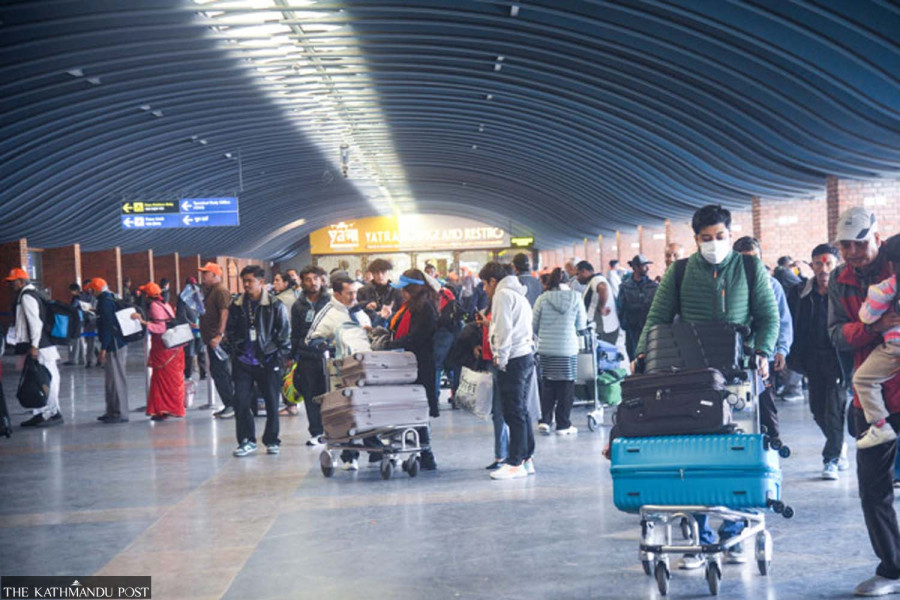
bookmark
Sangam Prasain & Krishana Prasain
Published at : March 2, 2026
Updated at : March 2, 2026 06:39
Kathmandu
Kiran Kumar Rana Magar, a construction worker in Abu Dhabi, did not sleep Saturday night after hearing missiles being dropped at different locations across the city.
“The situation here is tense, though no Nepali working in Abu Dhabi has been affected,” Magar told the Post from Abu Dhabi on Sunday morning. “Missiles were dropped in different places yesterday. There is a lot of fear.”
This was before the UAE Ministry of Defence reported the killing of a Nepali national in the country later in the day, along with a Bangladesh and and a Pakistan national.
“I am currently at work and the situation has not deteriorated much yet. But we don’t know what will happen next,” Magar said.
Prakash Dahal, who works at a bank in Abu Dhabi, said attacks are happening but that they remain safe.
“We heard the sound of a missile in Jumeirah. I got an alert at midnight saying to stay safe. I am now working from home,” Dahal told the Post. He said he and his friends are safe.
Dahal added that Dubai airport has been shut down and the situation seems far from normal.
Dilu Gurung, a medical worker in Doha, Qatar, said longer missile attacks were launched at midnight. “The Qatari government sent us an alert message 5-10 minutes prior to the attack.”
Gurung, who has been in Doha for the last 16 years, said shopping centres, supermarkets and medical stores remain open 24/7.
“The government has ensured the overall safety of people here. Everything is normal despite the attack.”
Escalating tensions in the Middle East following the war launched by the United States and Israel on Iran have quickly spread to Dubai, Bahrain, Jordan and Kuwait—where a majority of Nepali migrant workers are based—triggering global alarm.
Media reports said loud blasts were heard in Dubai and in Doha for a second consecutive day on Sunday, following Iran’s retaliatory strikes on neighbouring Gulf states in response to US and Israeli attacks on the Islamic Republic.
Iran had earlier warned it would target US bases in the region, but strikes have hit a range of other sites across Gulf cities.
Two people were injured in Dubai after shrapnel from intercepted drones fell on two houses, according to a Dubai Media Office statement.
Dubai’s international airport, the landmark Burj Al Arab hotel and the upscale man-made Palm Jumeirah island reportedly suffered damages.
Qatar’s interior ministry said it was responding to a limited fire in an industrial zone after debris fell from an intercepted missile.
An Israeli strike reportedly hit a girls’ elementary school in Minab, in Iran’s Hormozgan province, killing 108 people.
Mizan News Agency, the judiciary’s official outlet, reported the death toll from the attack on Shajareh Tayyebeh girls’ elementary school in Minab amid a massive US-Israeli offensive launched Saturday morning.
The last time the US and Iran exchanged attacks in June 2025, sparking a 12-day war, civilian casualties in Iran were also significant.
Remittance-dependent Nepal may now face a series of economic shocks, particularly in the labour market, experts warn.
Around 2,300 Nepali workers leave for foreign employment destinations each day.
Remittance inflows are a cornerstone of Nepal’s economy, consistently accounting for over 25 percent of gross domestic product, with records in fiscal year 2024-25 showing a 28.6 percent share.
This massive inflow, often exceeding agricultural output, drives household consumption, stabilises foreign exchange reserves and serves as a major poverty reduction tool.
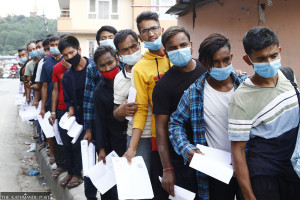
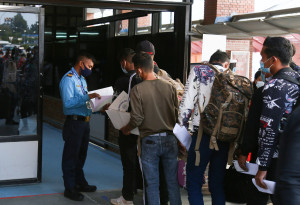
Most airlines connecting Middle East nations have cancelled flights, leaving hundreds of Nepalis stranded at Kathmandu airport.
Experts say a prolonged crisis in the Middle East, which employs nearly 80 percent of Nepal’s migrant workforce, could directly hit the country’s economy and urge preparations to absorb emerging geopolitical shocks.
In the last fiscal year, which ended in mid-July 2025, Nepal issued 839,266 labour permits—505,957 new and 333,309 renewals—of which Middle Eastern countries absorbed 80 percent.
According to Nepal Rastra Bank, the United Arab Emirates is the top destination, hosting 274,590 Nepali workers last fiscal year.
The UAE is followed by Qatar (140,792), Saudi Arabia (152,557), Kuwait (59,065), Bahrain (11,624), Oman (8,601), Cyprus (2,409), Jordan (2,052) and Israel (1,342).
Ganesh Gurung, a migration expert, said escalating tensions in the Middle East pose a serious threat to Nepal’s economy, which has been witnessing record remittance inflows exceeding Rs200 billion per month.
“The impact has already started as many workers who were bound to take flights have been stuck at the airport since yesterday,” he said. “This will also affect the psychology of workers in conflict-hit countries.”
Workers’ families in Nepal will also face psychological stress, he added.
“It will result in a decline in remittance flow as more workers cannot go while those already in war-affected countries might lose jobs,” Gurung said.
The surge in remittances coincides with heightened youth unrest at home. In early September last year, youth-led nationwide protests over corruption, governance failures, unemployment and police accountability disrupted businesses, caused losses to public and private property and dented investor confidence.
Economists say the protests reflect deep frustration among young people facing shrinking domestic job opportunities. Political instability, frequent government changes, stalled development projects and weak private-sector hiring have limited employment growth.
For many young Nepalis, migration has become the only viable escape from instability and economic stagnation.
The continued failure of agriculture, manufacturing and services to generate meaningful employment reinforces a cycle in which instability fuels unemployment, prompting more youth to leave. Remittances rise, but at the cost of a depleted workforce, weakened productivity and long-term economic vulnerability.
Nepal’s dependence on remittances has deepened to the point that it functions largely as a labour-exporting economy, with rural households particularly reliant on at least one family member’s income from abroad, according to central bank studies.
Political uncertainty, corruption and poor accountability remain core obstacles to economic transformation, pushing both skilled and unskilled youth overseas.
Following the escalation of the war on Saturday, Nepal on Sunday temporarily halted the issuance of labour permits for migrant workers, raising worries for the already strained economy.
“In light of the ongoing conflict, the minister-level meeting on Sunday decided to stop issuing labour permits to eight countries, including Saudi Arabia, the UAE, Qatar, Bahrain, Oman, Iraq, Yemen, Jordan, Lebanon, Turkey and Israel,” said Basant Bahadur Bohara, information officer at the Ministry of Labour, Employment and Social Security.
“A halt in issuance of labour permits has been ordered until further notice.”
In view of the evolving situation, the Embassy of Nepal in Abu Dhabi urged Nepali nationals in the UAE to avoid unnecessary travel, exercise caution and follow security advisories issued by local authorities and Nepal’s diplomatic missions.
Similarly, Nepali embassies in Doha and Riyadh have urged citizens to refrain from unnecessary travel.
A multi-stakeholder assessment meeting convened by Nepal’s chief secretary on Sunday decided to form an emergency rescue team under the coordination of the foreign secretary.
The government is also preparing to coordinate with international organisations for rescue and management, stating that necessary coordination will be made, particularly with the International Labour Organisation.
Economists warn that conflict in key oil-producing nations could push up global inflation.
With flight disruptions affecting carriers such as Qatar Airways and flydubai—major airlines bringing tourists to Nepal—travel trade entrepreneurs say the crisis may hit Nepal’s tourism industry at the peak of the season as well.
Sangam Prasain
Sangam Prasain is Business Editor at The Kathmandu Post, covering tourism, agriculture, mountaineering, aviation, infrastructure and other economic affairs. He joined The Kathmandu Post in October 2009.
Krishana Prasain
Krishana Prasain is a business reporter for The Kathmandu Post covering markets. Before joining The Kathmandu Post in 2018, she spent 3 years in New Business Age magazine covering business.




Most Read from Money

Why does an hour long flight to Dhangadhi cost more than a flight to New Delhi?
Nepal travel agents threaten to stop selling Thailand trips over visa rules
Malaysia rejects Nepal’s demand to open recruitment to all manpower agencies

No school, but a graduation cap for women dairy farmers
Nepal arrests four medical service providers as Malaysia recruitment row deepens
Editor's Picks




E-PAPER | October 24, 2026

×