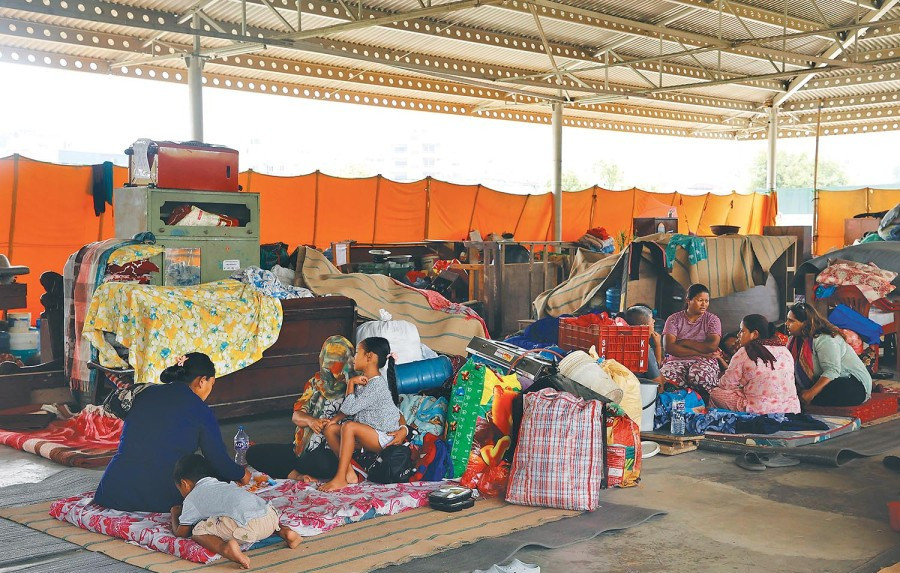
Over weeks after riverbank evictions, hundreds of families remain confined to temporary shelters without a clear resettlement plan from the government. Post File Photo
On April 25, Balendra Shah administration began demolishing squatter settlements along the riverbanks. The government argued that the move was necessary to relocate genuinely landless residents to permanent housing in safer areas, away from flood risks and poor living conditions. However, more than a month and a half later, no concrete steps have been taken to achieve this goal. Hundreds of displaced residents continue to remain in temporary shelters. While the government acted with urgency in carrying out the evictions, it has not prioritised long-term rehabilitation and resettlement of those affected. The delay is becoming increasingly difficult to justify, and meaningful action is already overdue.
Even today, 172 families evicted from the different river banks have been housed in seven shelters, not just in the Kathmandu Valley but also in Kavrepalchowk. The hasty and poorly planned nature of the eviction drive became evident once displaced families arrived at the designated holding centres. Many found that these facilities were inadequately prepared to accommodate vulnerable groups requiring special care, including pregnant women, new mothers, persons with disabilities, elderly citizens, children, and those suffering from illness. Basic necessities were often lacking. Some families struggled to access hot water, prepare formula milk for infants, or obtain food that was adequate in both quantity and quality. Although certain facilities and services have gradually improved over time, they remain far from sufficient.
The claim by the family of Bhesraj Darji, who died while undergoing treatment, that he did not get the necessary care at the shelter and that his health consequently deteriorated, raises serious concerns about the suitability of these centres for prolonged habitation. It underscores the risks of keeping displaced families in temporary facilities that were never designed to serve as long-term residences. So long as these centres remain under government management, the state bears full responsibility for ensuring that residents get adequate healthcare, nutritious food, education, and other essential services. Yet many of those displaced continue to face significant hardships. Some families evicted from Kathmandu, whose livelihoods depended on jobs located near their former homes, have been relocated to Kavre, forcing them to commute to Kathmandu daily for work. This arrangement has imposed additional financial and emotional burdens on already vulnerable households.
The situation is also concerning for school-going children. Many have been enrolled in schools near the temporary settlements, but the absence of a clear plan for permanent resettlement has left parents and students uncertain about their future. They fear that another relocation could disrupt their education in the middle of the academic year. Hundreds of children now find themselves worrying about circumstances beyond their control, when their focus should be on learning and development.
This uncertainty has only deepened concerns among residents who continue to wait for answers about their future. Even though district administration offices initially claimed that the process of permanent resettlement would begin within 15 days, there remains no clear timeline or roadmap from the government. In his first address to the House of Representatives on May 31, Prime Minister Balendra Shah remarked, “Let us not expect in 35 minutes what has not happened in 35 years. It will take some time.” While the statement acknowledges the complexity of the issue, it also reflects the government’s inability to clearly communicate what concrete steps are being taken toward permanent rehabilitation. More concerningly, the budget presented by the government failed to adequately address the long-term resettlement plan that such a large-scale eviction should have necessitated.
The displaced residents certainly did not expect such statements and unpreparedness from a prime minister who came to power with unprecedented public trust expressed in the March elections. Finding permanent residence for hundreds of people certainly takes time but it is the right of the displaced people to know what is being done to this effect. The government has no excuse to further delay taking concrete steps to ensure permanent shelters for the displaced. Temporary shelters are only for immediate relief, they cannot be the substitute for dignified living.




 14.69°C Kathmandu