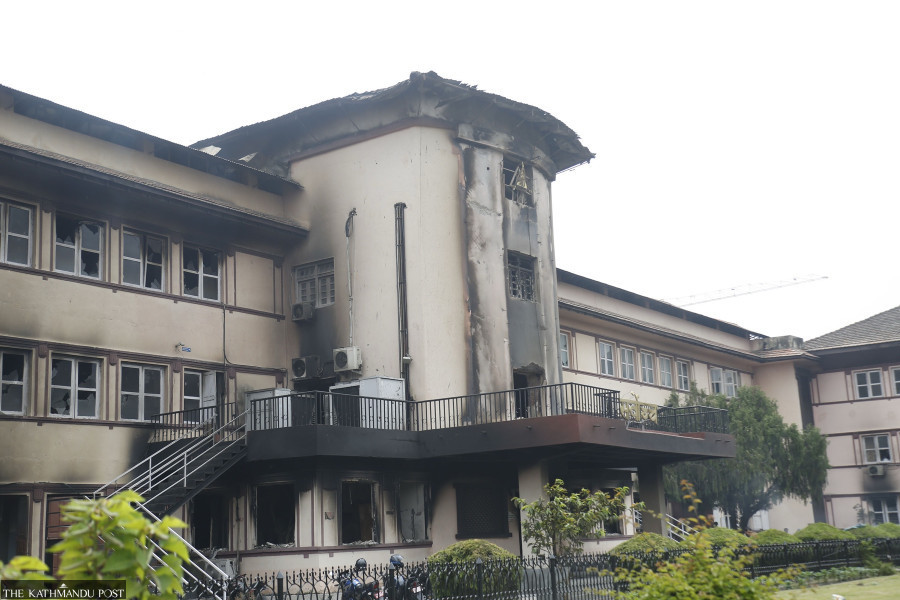
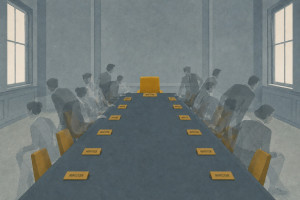
The fallout from the Gen Z protests of last September has reduced Nepal’s courtrooms to administrative and architectural ruin, exposing their fundamental fragility. The scale of the destruction during the protests is staggering, yet the subsequent standstill of the legal system suggests that the crisis is as much structural as it is physical. If the state is to restore the rule of law, it cannot do so simply by rebuilding the infrastructure. It must radically decentralise the seat of justice.
The statistics released for fiscal year 2025-26 represent an unprecedented collapse in judicial output. The national case clearance rate, which stood at 65.69 percent in the previous year, has plummeted to a mere 55 percent. Out of 357,023 pending cases across all tiers, only 196,474 were settled, leaving a backlog of 160,549 disputes unresolved. The Supreme Court, the ultimate arbiter of the law, recorded its lowest performance in history, disposing of only 29.46 percent of its caseload, plummeting 12.54 percentage points from the previous fiscal year. This failure is the result of a system that has been physically and technologically decapitated.
The physical carnage of the Gen Z protests is quantified in billions of rupees. Protesters targeted 23 court premises, leaving ten buildings completely destroyed and nine others partially ruined. The Supreme Court’s historical building, a symbol of the nation’s legal heritage, alone suffered damages worth Rs1.23 billion. Beyond the masonry, the loss of 936,000 legal files and documents represents an irreparable erasure of legal history. When the arson attacks consumed these papers, they effectively halted thousands of ongoing litigations, plunging the nation into a state where justice is not only delayed but, for many, entirely extinguished.
The technological fallout was equally catastrophic. The destruction of central servers during the riots caused a nationwide system failure that even untouched courts could not escape. The Patan High Court, for instance, saw its operations frozen for two months due to the loss of central databases, despite its physical premises remaining intact. Judicial activities across the country remained suspended for nearly four months. This reliance on a centralised digital and physical hub in the capital has proven to be a strategic vulnerability. While individual judges demonstrated remarkable resilience by maintaining high disposal rates through personal initiative, the system they serve remains fundamentally broken.
The current model of judicial centralisation is no longer tenable. To prevent a single point of failure from again crippling the entire judiciary, the state must look toward structural reforms that are not mentioned in the immediate reports but are necessitated by the current quagmire. A remedy lies in elevating the High Courts to the status of courts of record. At present, the Supreme Court is overwhelmed by a massive volume of routine appeals that could, and should, be finalised at lower levels. By making the High Courts a court of record, their judgments would carry a definitive authority, and their archives would serve as permanent, legally binding evidence. If each High Court were a self-contained repository of legal history, the destruction of a central server or a central building would no longer result in nationwide paralysis. This shift would naturally decrease the caseload of the Supreme Court, allowing it to focus exclusively on constitutional interpretation and matters of national importance. Another viable alternative is hiring ad hoc judges, similar to the new practice in India, to decrease the caseload on each judge.
The path to recovery requires more than just the Rs2.8 billion needed for physical reconstruction. The state must invest in distributed digital backups and empower lower courts to act as final arbiters in the majority of minor civil disputes. The rule of fire was able to halt the rule of law because the latter was concentrated in too few buildings and too few servers. To rebuild the Supreme Court without relaxing its burden is to invite the next catastrophe. The judiciary must be restructured so that even if the centre is struck, the scales of justice continue to balance in every province.




 19.57°C Kathmandu