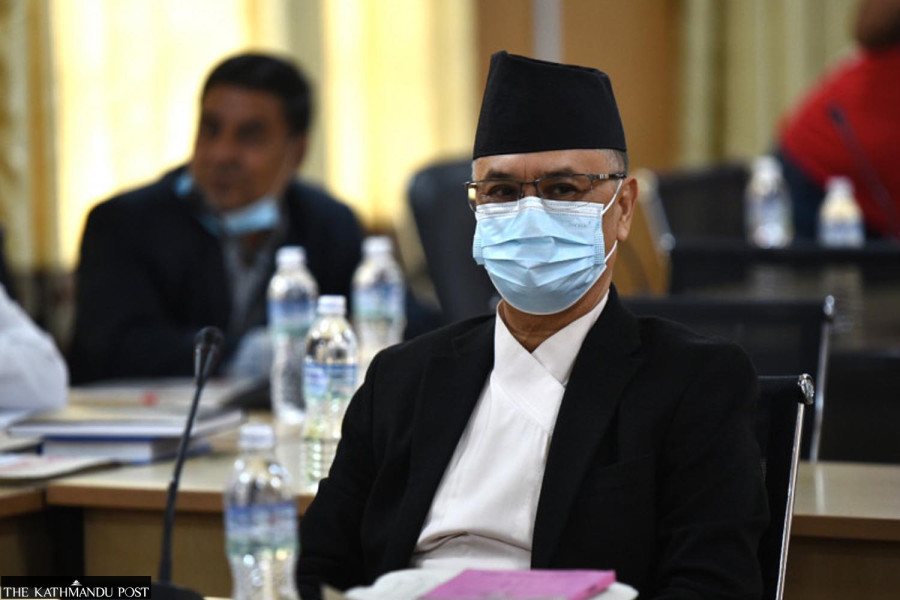
The state must immediately cease arbitrary detentions and restore strict adherence to due process. Former chief justice Cholendra Shumsher Rana Post File Photo
In the wee hours of Sunday, police officers reached the residence of former Chief Justice Cholendra SJB Rana and demanded that he accompany them. They showed no arrest warrant, named no formal charge and refused Rana’s request to revamp security at the residence. Officials even turned away a monitoring team from the National Human Rights Commission. The explanation for his detention changed over the course of the day: police first said he had been detained, then claimed he was placed in a safe house because of an unspecified security threat, before releasing him to relatives that afternoon.
This midnight intervention was no isolated anomaly. Just one week earlier, police detained political analyst Bharat Dahal from a tea shop in Morang. He was transported across provincial lines under a warrant issued in the capital. Authorities failed to publicly disclose any specific charge or statutory ground for his detention. Many read the arrest as a direct suppression of Dahal’s public critique regarding flaws in national governance.
On June 4, government secretary Krishna Hari Pushkar sent a text message to Prime Minister Balendra Shah on June 4 requesting consideration for ambassadorial appointments or the chief secretary post. Instead of handling the matter through civil service protocols, the Prime Minister’s Office instructed police leadership to intervene. Late that evening, an inspection team from the KVCIO arrived at Pushkar’s residence and brought him in for interrogation. Civil service regulations exist specifically to address such administrative matters without police coercion. But the PMO—and by extension, the state—took to intimidation tactics. Using criminal investigation units to interrogate a career bureaucrat over a private text sets a dangerous precedent of institutional intimidation.
This pattern has sometimes turned violent at the grassroots. On July 11, police at a Kirtipur holding centre for evicted squatter settlers detained three youth activists after they questioned flood relief management for evicted squatter families. Officers dragged one of the trio, Majid Ansari, into a police vehicle, physically assaulting him and inflicting facial bruises and body injuries that required a five-day stay at Tribhuvan University Teaching Hospital. Throughout his hospitalisation, police provided no arrest warrant, showed no detention papers, and repeatedly pressured him to sign legal papers framing the incident as his fault, while stationed inside his ward. Police spokespersons simultaneously claimed he was never under arrest, exposing a deliberate practice of informal custody designed to evade legal oversight.
These four recent cases expose how, across different levels of society, the state seemingly operates through a consistent tactic: vague or unstated grounds for arrest, absence of written warrants, contradictory public explanations, and obstruction of human rights oversight. Everyone faces the same reality. State authority is routinely overreached to intimidate critics, punish dissent, and penalise peaceful expression. This tactic inflicts severe damage on fundamental rights guaranteed to every citizen, creating an environment where no individual is secure from coercive state action.
When the Shah government came into power in late March, it shouldered the expectations of a generation expressed through the Gen Z protests of September 2025. That generation was fed up with the lack of transparency and accountability, and the utter disregard for the rule of law by previous governments. Now, the new government seems to be veering off its mandate and landing in the same cycle of problematic governance.
The state must immediately cease the arbitrary detentions and restore strict adherence to constitutional due process. Law enforcement agencies must be prohibited from depriving any individual of liberty without serving written warrants, stating clear statutory charges, and providing immediate access to legal counsel and human rights monitors. The fundamental rights to free expression and peaceful dissent must be protected from police interference. Nepal’s constitutional order cannot survive when law enforcement operates as an instrument of uncurbed executive power.




 23.73°C Kathmandu