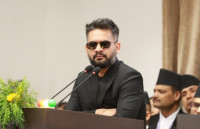
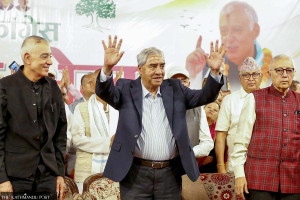
Prime Minister Balendra Shah has once again turned to Facebook—and once again late at night. At 9:11 on Sunday, he posted that Khula Manch had been improved so a new party could hold an event there and hurl insults, perhaps at the government. The target was clear: Nepali Congress members had gathered at the very venue for the first day of their 15th General Convention.
Within hours, politicians across the spectrum were borrowing Shah’s phrasing to tease their rivals, including Shah. In one sense, a prime minister’s remark that becomes a meme has done its job. It also speaks volumes about the state of public discourse in Nepal.
Since his mayorship days and prior, Shah made late-night social media posts a routine way of communicating. He has spoken once in Parliament and holds few meetings with domestic or foreign counterparts. In his six months in office, he has given two public speeches: one at his party’s general convention and another at a Constitution Day programme. His only address to the nation came on his Facebook handle, after communal violence engulfed Madhesh province.
This communication style appeals to the public for a reason. Nepalis have spent decades listening to politicians babble at length without saying much. Shah’s brevity, therefore, can feel like candour in contrast. Social media also gives leaders a direct line to citizens, bypassing party gatekeepers and editors. And no one expects Shah to give it up, especially when global leaders are using such platforms to amplify their stance.
But a Facebook post cannot do everything. It leaves no room for follow-up questions and requires no evidence for its claims. In addition, Shah’s language has sometimes been loose enough to invite scrutiny. When a leader’s statements go unchallenged in the forum where they are made, errors can harden into assertions. Statements that would have to be defended in Parliament can go unanswered. His jab at the Congress is a case in point. It scores a quick point, but explains little—and lowers the tone of an office that should set a higher standard.
When Gen Z protesters took to the streets in September 2025, they called for an accountable government. Accountability means answering difficult questions, including in settings a leader does not control. If the government relies on one-way communication, it risks treating public opinion as something to manage rather than listen to—and a well-timed post as a substitute for policy.
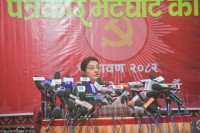
So what should change? First, Shah should attend Parliament regularly and answer questions directly, including from the opposition. His reluctance to use Parliament weakens the institution. Second, he should hold regular, scheduled press conferences and take questions from journalists with a range of views, not only those sympathetic to him. Third, he should meet more often with political leaders, diplomats and civil society representatives. Relations with India, China and Western countries cannot be managed through Facebook posts. Finally, his office should treat social media as a supplement, not a substitute, and publish the reasoning behind decisions in forms people can scrutinise: statements, data and documents.
Shah need not give up the plain speech that won him support. He needs to pair it with a willingness to explain himself. A prime minister’s words carry the weight of the state. They should be spoken where people can question and test them. Nepal elected a leader, not a commentator. It is time for him to govern like one.




 20.85°C Kathmandu