Audio attributed to fugitive GB Rai says he is ready to face authorities
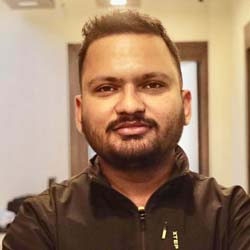
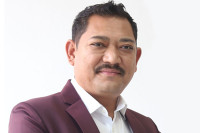
In an audio recording and statement published by Setopati, Rai says he is ready to cooperate with authorities and repay depositors, but police have yet to authenticate the material. File Photo
An audio recording and a statement attributed to GB Rai, a fugitive accused of cooperatives fraud and organised crime, have surfaced publicly, with Rai purportedly expressing a willingness to return to Nepal and pledging to repay depositors.
The digital news outlet Setopati published the audio on Saturday. In the recording, a man identified as Rai addresses shareholders, depositors, borrowers and the government, discussing cooperative institutions, companies and related matters. Police said they have yet to authenticate the recording and are preparing to examine its source and authenticity.
In the statement attributed to him, Rai says he had expected assistance and cooperation from the government at the time but the authorities encouraged depositors to file cases against him in various places.
“Different cases were filed under various charges,” the statement says. “The situation became so complicated that I began receiving death threats, forcing me to go underground. After that, efforts were made to locate me through international channels as well. Today, I want to ask one question: Is my arrest the solution to this entire problem?”
The statement adds Rai is willing to appear before the authorities if his arrest is considered the solution, but argues that doing so would not, by itself, return the billions of rupees owed to hundreds of thousands of savers.
“My appeal to the government is that it does not need to mobilise its resources jointly to search for me,” the statement reads. “I am committed to managing the depositors’ money within a specified period through various alternative measures.”
Rai has been accused of embezzling savings of thousands of people deposited in several cooperatives, including Suryadarshan in Pokhara, Sahara in Chitwan, Sano Paila in Birgunj, Supreme in Butwal, Rupandehi, Samanta in Nepalgunj and Swarnalaxmi in Kathmandu.
In the statement, Rai welcomes what he describes as the current government’s efforts to protect depositors’ savings and says he wants to cooperate with the authorities.
“As a first step, I have arranged some land and property through friends, relatives and well-wishers,” the statement says. “I will continue making every effort to protect everyone’s savings and fulfil my obligations, whether by using those assets or through other alternatives as necessary.”
Rai also addresses the transfer of cooperative funds to Gorkha Media Network, which operated the now-defunct Galaxy 4K Television. He says that, as the company’s chairman, he considers himself responsible for the money transferred from cooperatives to the media company.
“No other directors were involved in managing the financial resources,” the statement further reads. “If the names or documents of employees or other individuals were misused while records were being maintained, their names may have been used inadvertently. I do not think it is appropriate to unnecessarily implicate other people in this matter.”
The note also says Rai believes it would be inappropriate to link Rabi Lamichhane and Chhabilal Joshi to the matter.
Lamichhane, the chair of the Rastriya Swatantra Party (RSP), had been held in judicial custody as a defendant in cases involving alleged irregularities at four cooperatives, including Suryadarshan. He was released after the High Court ordered his release upon the deposit of bail equivalent to the amount claimed against him or the provision of a bank guarantee. He continues to appear in court in connection with cooperative-related cases. Joshi was also released after submitting a bank guarantee following Lamichhane’s release.
The claims in Rai’s statement have not been independently verified.
Police prepare to verify audio
Rai’s brother-in-law, Gyan Bahadur Bamjan, told Setopati that he believed the voice in the recording was Rai’s. However, the outlet has not confirmed the recording through forensic testing.
Kantipur spoke to three senior Nepal Police officials after the audio attributed to Rai was made public. They said preparations were under way to verify its authenticity and establish where the audio and statement originated.
“We learned that the audio had appeared in the media,” a police official said. “We are now trying to verify whether it is genuine.”
Bamjan also told Kantipur that the voice sounded like Rai’s, although he had not spoken to him for a long time. He said he became aware of the recording only after Setopati sent it to him.
“I listened to the audio. The voice is his,” Bamjan said. “But it had been a long time since I last spoke to him.”
Bamjan said he knew nothing about the press statement or how Rai might have communicated with the outlet. He recalled that their last conversation took place while he was in the United States.
“I had also been named as a defendant in a case involving a cooperative in Pokhara, so I returned to face it. At the time, I told him over the phone that I had come back to face the case and that he should do the same,” he said.
Bamjan recalled that when he urged Rai to return because many other cooperatives were also facing problems, Rai said he feared for his life.
Bamjan himself was accused in the Suryadarshan Savings and Credit Cooperative fraud case, in which Rai is the principal accused. A former chair of the cooperative, Bamjan appeared before the court and was released on a bail of Rs1 million.
The case filed in connection with Suryadarshan sought recovery of Rs1.514 billion from the accused.
Efforts to bring Rai back from Malaysia
Police had most recently written to the International Criminal Police Organisation (Interpol) nearly five months ago, seeking assistance in locating Rai. A Red notice was issued against him on February 8, 2024. According to the latest information available to Nepal Police, Rai has been living in Malaysia.
Investigators found that he had entered Malaysia through Kuala Lumpur International Airport about five months before the Red notice was issued.
Interpol’s National Central Bureau in Kuala Lumpur confirmed his entry into Malaysia but informed Nepal that legal procedures were available to facilitate his return. An officer who had previously worked at Nepal’s National Central Bureau and is now posted in a district told Kantipur that Malaysian authorities had advised Nepal to make a diplomatic request for his extradition.
“A written communication came from the National Central Bureau in Kuala Lumpur, asking that an extradition request be made through diplomatic channels,” the officer said. “After that, bringing Rai back became a matter for the government.”
When Rabi Lamichhane was deputy prime minister and home minister, he had also spoken to his Malaysian counterpart about Rai.
“Had this happened before discussions at the political level, there might have been a possibility of bringing him back informally as well,” the officer said. “But after the matter had been discussed at the highest political level, the response was that diplomatic efforts were required.”
Following the communication from Malaysia, police wrote to the Home Ministry on February 22, 2024, requesting assistance in securing Rai’s extradition. The request was subsequently forwarded to the Foreign Ministry, which began coordinating through diplomatic channels.
Police repeatedly emailed the National Central Bureau in Kuala Lumpur seeking information about Rai’s whereabouts, but received no response. They also coordinated with Interpol’s General Secretariat and held discussions involving officials in Kuala Lumpur, Kathmandu and Lyon, France.
Authorities later considered whether cancelling Rai’s passport could allow Malaysia to deport him to Nepal. Police were informed that he could be deported within 14 days if arrested, but the Department of Passports said it could not cancel his passport under the law.
On May 21, 2024, the Home Ministry sent a police superintendent and a police assistant sub-inspector to Malaysia to pursue his return through diplomatic channels.
The team spent 10 days in Malaysia. On returning, its members reported that they had held informal meetings with Malaysian police officials, who said high-level diplomatic engagement was necessary. When asked about Rai’s whereabouts, the Malaysian officials declined to provide details, saying the matter had already been discussed at the diplomatic level.
Efforts to locate him subsequently appeared to stall.
“There was another exchange of correspondence after the new government was formed, but no response came,” an official familiar with the matter said.
Police officials say the newly surfaced audio and statement have prompted an internal inquiry. They are also seeking to establish where the material originated.
Who is GB Rai?
Gitendra Babu (GB) Rai, originally from Sunkoshi Rural Municipality in Okhaldhunga district, began his business career in network marketing. The son of local communist leader Dipak Hari Rai, he studied up to the secondary level in his village before moving to Kathmandu.
According to family sources, Rai initially worked as an agent for Unity Life International before becoming involved in network marketing through Herbo International. He later expanded his business through companies such as Nature Herbs and Nest Nature Hub, which manufactured and sold products including toothpaste and shampoo. He developed business connections in Malaysia, Singapore and Dubai.
The government banned network marketing in 2011, affecting his business. He subsequently became active in the cooperative sector.
After establishing a connection with the family of Dambar Bahadur Bamjan, a former director of Gorkha Development Bank, Rai became involved with Suryadarshan Savings and Credit Cooperative. He later expanded his influence to cooperatives including Sano Paila and Swarnalaxmi.
A parliamentary inquiry into cooperative-related irregularities said Rai had expanded his business network by placing relatives and close associates in official positions at various cooperatives.
He also expanded into the media sector. Initially associated with AP1 Television and NagarikKhabar.com, he later became involved in operating Galaxy 4K Television through the Gorkha Media Network. Lamichhane, now the RSP chair, served as the television’s managing director, while former deputy inspector general of police Chhabilal Joshi was a director.
A parliamentary committee led by former CPN-UML lawmaker Surya Thapa found that Rs650 million had been transferred to Gorkha Media Network from five cooperatives in which Rai held directorships.
As allegations of misappropriation of cooperative funds came to light, Rai left Nepal and travelled through India to Malaysia, according to police.




 19°C Kathmandu