Judiciary left reeling from Gen Z protest impact as case clearance almost halved
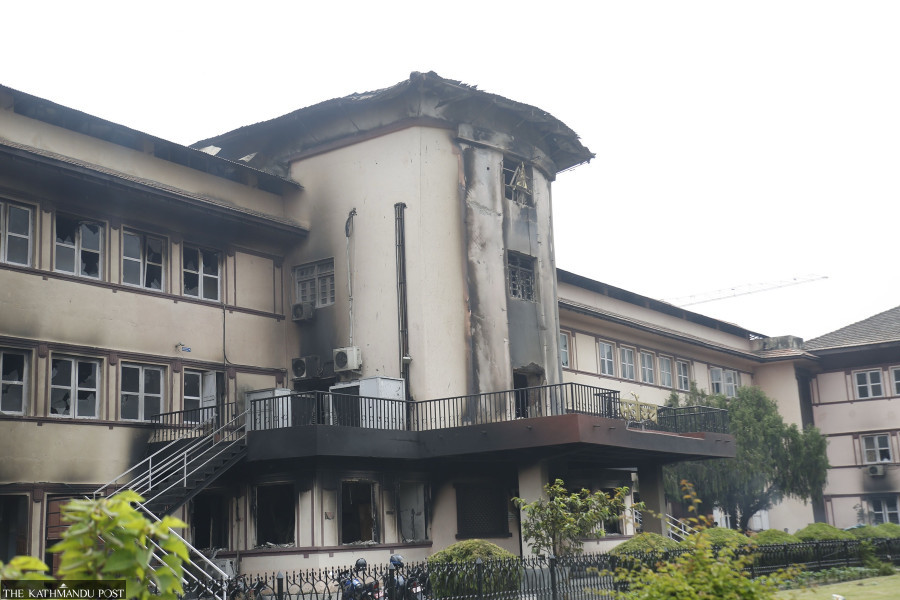
The Supreme Court records lowest performance, settling only 29.46 percent of its cases in 2025-26. The Supreme Court sustained the heaviest blow, with its main historical building heavily ruined, resulting in losses worth Rs1.23 billion. File Photo.
The Gen Z protests that swept across the country on September 8 and 9 last year have severely hit the country’s judicial system. With courts operating under significant limitations, the national case clearance rate plummeted to just 55 percent in the fiscal year 2025-2026.
According to the Supreme Court, out of the 357,023 pending cases lodged with various tiers across the country, only 196,474 were settled, leaving a backlog of 160,549 cases. This marks a sharp decline from the previous year’s overall clearance rate of 65.69 percent.
The Supreme Court recorded the lowest performance, settling only 29.46 percent of its cases in 2025-26, compared to 42 percent in 2024-25. High courts wrapped up 70.36 percent of their caseload against 74.61 percent previously, while district courts resolved 55.61 percent, down from 66.25 percent. Other tribunals managed to settle 41.67 percent, a major drop from last year's 56.34 percent.
Various reports show that the nationwide Gen Z protests caused an estimated total economic loss of Rs84.5 billion, with the judiciary bearing a heavy blow. Protesters destroyed or burnt approximately 936,000 legal case files and documents, crippling ongoing litigations.
The structural damage to the judiciary alone was estimated at Rs2.8 billion. A total of 23 court premises were struck, including the Supreme Court, the Special Court, seven high courts, and 14 district courts. Among them, 10 buildings were completely destroyed, nine suffered partial damage, and four sustained minor issues.
The Supreme Court sustained the heaviest blow, with its main historical building heavily ruined, resulting in losses worth Rs1.23 billion. Across the nation, infrastructure damage stood at Rs1.65 billion, vehicle losses amounted to Rs615.1 million, and office equipment damage totalled Rs538.5 million.
Supreme Court spokesperson Arjun Koirala stated that judicial activities remained virtually suspended for nearly four months after the movement. "The destruction of vital files and court property brought hearings to a standstill," said Koirala. "Severe damage to our central servers disrupted systems nationwide, preventing the judiciary from achieving its yearly targets."
Even courts that escaped direct vandalism suffered from the technological breakdown. Lal Bahadur Kunwar, acting Chief Judge of the Patan High Court, explained that the technical fallout halted their work for two months. "Although our buildings were not physically attacked, the loss of central databases and files from other courts left us unable to conduct full hearings," said Kunwar.
Special Court Chairman Sudarshan Dev Bhatta also linked the performance drop to the structural challenges. "The combination of the September riots, infrastructure loss, and scheduled judge transfers hindered our efficiency," said Bhatta. "It took substantial time to restore essential IT equipment and servers destroyed in the fire."
Bhatta added that thanks to collaborative recovery efforts, the Special Court was restored within four months, allowing them to initiate a targeted campaign to clear backlogs. The Special Court eventually settled 155 out of 261 cases, achieving a 59.38 percent resolution rate, with 106 cases remaining.
Top-performing judges by case disposal
Despite the operational challenges, several judges managed to achieve high performance numbers. In the High Court category, Judge Tek Narayan Kunwar recorded the highest number of settlements. Known for introducing digital initiatives and modern e-courts during his previous tenure at the Special Court in Kathmandu, Kunwar maintained his quick pace after his transfer to the Janakpur High Court.
Other top-performing High Court judges included Tikaram Acharya, Jagat Bahadur Thapa, Somkant Mainali, Narishwar Bhandari, Jagadish Ghimire, Gokarna Dangi, Krishna Prasad Subedi, Rajuram Silwal, and Kailash Prasad Subedi.
At the district level, Judge Rajendra Singh Bhandari of the Kanchanpur District Court led the list for the highest number of verdicts. He was followed by Madhav Prasad Ghimire, Hari Prasad Sharma Upadhyay, Kapil Mani Gautam, Bishnu Prasad Gautam, Roshan Gajurel, Manoj KC, Durga Bahadur Bhusal, Manoj Kumar Srivastava, and Bhuwan Singh Thapa.




 14.4°C Kathmandu