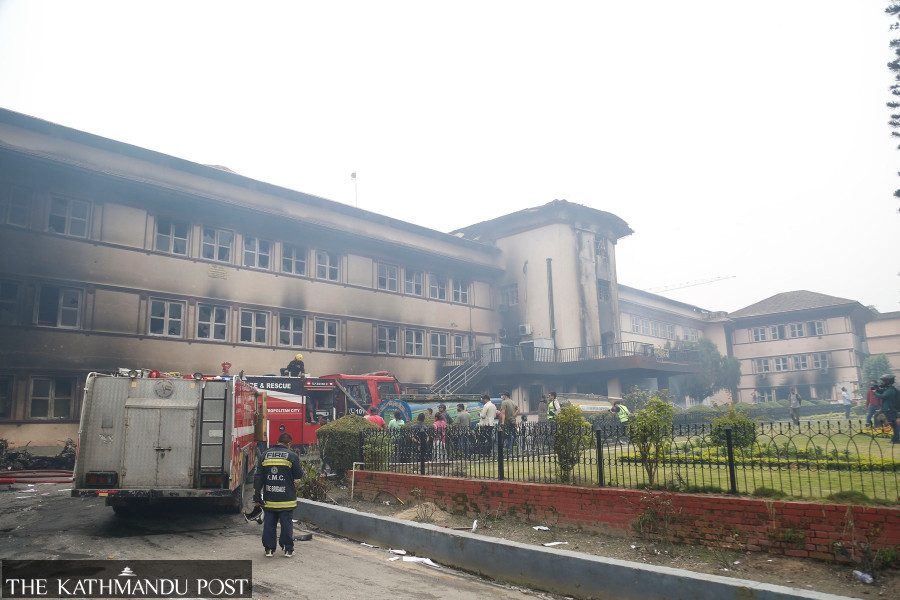
Over a month after the Supreme Court began recovering the case files destroyed during the deadly Gen Z movement, it has so far managed to restore under a quarter of the files lost.
After assessing that the majority of the case files of the top court and several of its subordinate courts were destroyed in the vandalism and arson of September 9, a full court on September 22 endorsed a directive listing out ways to recover them. A month later, on October 24, it issued a notice seeking cooperation from the parties to the cases, their lawyers, the Nepal Bar Association and its subordinate offices to help with the recovery.
“We have been able to recover just 4,400 case files [as of Thursday],” said Arjun Prasad Koirala, spokesperson for the court. “The recovery is going on as prescribed by the directive.”
He said all 28 sections of the court have set up dedicated desks for recovery.
The Directive on the Recovery and Authentication of Case Files Destroyed Due to Special Circumstances lists five ways to recover the destroyed files.
First, collecting copies of documents or records related to cases available with any court or institution. Second, gathering judgments and documents uploaded on the websites of the Supreme Court and other government bodies.
The third way is to collect documents that are in the possession of judges and staff obtained during court proceedings. While the fourth way entails gathering documents exchanged electronically between various courts, other government bodies, and judges or court officials. The fifth is collecting documents through other “appropriate means”.
Chief Justice Prakash Man Singh Raut had personally held meetings with the Nepal Bar Association and the Attorney General’s Office seeking their support for the recovery of the destroyed files.
On September 9, protesters set fire to and vandalised various courts, destroying about 933,000 case files. A total of 30,752 files from ongoing cases and 903,071 archived files were destroyed across all affected courts. The files of 20,034 of the 24,234 sub judice cases in the top court were lost. Only 2,509 writ-related files and 1,691 other-case files survived. As many as 197,000 files of the decided cases were also destroyed.
A week after the arson in its complex, the court began hearing habeas corpus petitions on September 14 from a tented structure on its premises. However, it took one more month to resume hearing other cases. Even today, the top court is not operating at full capacity. And most of the rulings, of late, are focussed on recovering the destroyed files. Conducting hearings with the original files is not possible.
“The court administration is putting all its efforts in order to recover the case files. It will continue to do so until all the files are recovered,” said Koirala. He, however, could not specify when all lost files will be recovered. “It is not an easy task. It might take months, we never know,” he said. The judiciary will be able to function in full-fledged manner only after all lost files are recovered.
In addition to the top court, 23 subordinate courts also suffered huge losses of property and documents after the youth-led protest turned violent on September 9, following the killings of 19 unarmed protesters by police on September 8.
As per the Supreme Court records, high courts and district courts lost close to 11,000 files of ongoing cases. The number of files of already decided cases stood at 706,071.
An assessment by the National Planning Commission shows that the country suffered losses worth Rs84.4577 billion during the protests. A total of 2,671 buildings sustained damage, with losses equivalent to Rs39.3175 billion. Likewise, 12,659 vehicles were damaged, resulting in losses equivalent to Rs12.9361 billion.
The government and public sector suffered the biggest losses, estimated at Rs44.9373 billion, according to the assessment. The private sector incurred losses of Rs 33.5487 billion, while damage to the community and other sectors stood at Rs 5.9717 billion.
Binod Ghimire covers parliamentary affairs and human rights for The Kathmandu Post. Since joining the Post in 2010, he has reported primarily on social issues, focusing on education and transitional justice.




 17.6°C Kathmandu