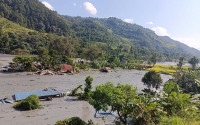
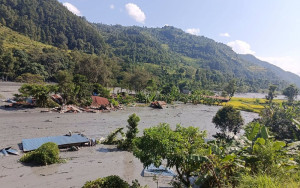
Nepal has not yet finished burying its dead from the Bhotekoshi disaster. The rescue teams are still out, the missing lists still open, and now a low-pressure system building over the Bay of Bengal is projected to bring heavy rain across the country from September 24 to 28. Meteorologists largely agree that enormous rain is coming. Where it will be heaviest, and on which of those five days, remains unsettled. Given how often heavy rain in this season has cost Nepal lives and property, that uncertainty is not a reason to relax.
Several forecast models point towards more than 400 millimetres of rain, with one outlier model suggesting a figure as high as 741 mm. To put it in context, the Department of Hydrology and Meteorology (DHM) itself classifies anything above 200mm in 24 hours as extremely heavy. The scale of rainfall forecast is closer to half of the monsoon’s worth compressed into five days. Some experts even forecast that central Nepal—where the flood in the Bhotekoshi-Trishuli river system left a trail of destruction last month—is one of the regions with heightened possibility of heavy rain. The risk, therefore, has already increased.
Heavy rain does not automatically become a disaster. Whether it does depends substantially on how well information reaches people beforehand and how seriously they act on it. That is why the three tiers of government, along with the media and relevant organisations, need to put this forecast in front of the public now—plainly, with the actual numbers, not dressed up to frighten and not played down to reassure.
Nepal has already faced this test twice in the past two years, and the results were far from encouraging. Heavy rainfall in 2024 overwhelmed rescue capacity even inside Kathmandu Valley. Surrounding districts took heavy damage from flooding and landslides in the same spell. The BP Highway, battered in that period, still has not been fully restored, and stretches of road elsewhere in the country are in no better shape.
None of the three tiers of government has yet shown it can mount an effective response once a flood or a landslide is already underway. Even modest interventions have struggled to hold. Preparedness efforts must be expedited in the days before the rain arrives, rather than counting on a response capacity that has already been tested and found short.
Much of this risk is also structural and will outlast this particular storm. Roads and settlements across Nepal sit close to riverbanks, without any real practice of distinguishing land fit for habitation from land that isn’t, or building accordingly. Fixing settlement patterns, construction standards and information systems is a longer project than five days allow. For now, government at every level needs a concrete plan for this specific window.
Information needs to reach the public before Thursday, not after. Arrangements for rescue, temporary shelter and relief distribution need to be in place in advance, even if they end up unused. A gap in response to a disaster the state saw coming days out is utter negligence.
Individual preparation matters too. Every household should weigh how exposed its home and workplace actually are. Where a residence sits near a riverbank, an unstable slope or low-lying ground, extra vigilance is warranted now. A safe route to higher ground should be worked out in advance, not improvised mid-flight. Deciding in advance what to carry, who carries what, and where to go will matter enormously.
The memory of Bhotekoshi has left people understandably frightened of what comes next. But fear weakens the capacity to cope with a disaster. Information, sound preparation and competent government are what actually reduce the damage. For now, that means everyone paying close attention to where they live, avoiding unnecessary travel, and the state ensuring that people and resources are kept ready to move the moment the situation turns complex.




 18.54°C Kathmandu