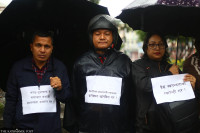
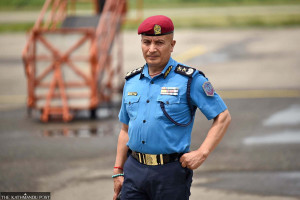
In a democracy, journalists are not supposed to become the story. Their job is to report facts and hold those in power accountable. They should be able to do their job without any fear. But on Friday, plainclothes police barged into several newsrooms in Kathmandu and took reporters into custody. The reporters became the news for doing their job.
This is a deeply problematic development—a warning that those in power may be losing patience with scrutiny. It raises serious questions about the government's commitment to press freedom. It amounts to an attempt to intimidate the media and prevent information unwelcome to those in power from reaching the public.
It is particularly troubling that a government formed on the back of the Gen Z movement, which championed transparency, good governance and democratic accountability, should resort to such conduct just seven months into its tenure. Such actions undermine the very democratic principles the government claims to uphold. It must apologise for Friday’s incident and guarantee that such intimidation will not be repeated.
Although the journalists arrested on Friday have since been released, the incident has sent a chilling message to the media. More concerning still is the government's failure to provide a convincing explanation. The prime minister’s secretariat has claimed that neither the prime minister nor his office was involved in or had prior knowledge of the arrests. If the prime minister was unaware of such a serious operation, it points to an alarming failure of executive oversight. The government must come up with a clarification.
Nepal’s constitution explicitly guarantees full press freedom. It also protects the right to communication as a fundamental right, prohibiting prior restrictions on the publication, broadcast or printing of news, editorials and other materials. It further bars the closure or seizure of media outlets, cancellation of their registration or confiscation of published material because of its content. These protections are not concessions from the government; they are constitutional guarantees. Any attempt to intimidate journalists or obstruct their work violates their spirit.
Nepal has seen it before. On January 19, 2005, when then King Gyanendra Shah seized direct power, military officers were sent into newsrooms to exercise editorial control. Journalists were intimidated, and independent reporting became increasingly difficult. Yet the press refused to surrender. Journalists exposed the monarchy’s authoritarian rule and made the restoration of democracy their mission. Gyanendra’s direct rule ended within 15 months, and the monarchy was eventually abolished. That history should serve as a warning, not an example for any government to emulate.
To be sure, the media is not without shortcomings. But flaws in journalism cannot justify arbitrary arrests or intimidation. Anyone dissatisfied with a published report can approach the Press Council Nepal. Law enforcement agencies must understand that intimidation is not a legitimate response to unfavourable reporting.
The ruling Rastriya Swatantra Party, too, must answer for the growing contradiction between its stated commitment to press freedom and its government’s conduct. Suspicious vehicles were earlier parked outside media houses without any satisfactory public explanation. Journalist Kishor Shrestha was arrested over a news report. Friday’s arrests add to this troubling pattern. The governing party cannot distance itself from the actions of its administration.
The government must explain Friday’s operation and take action against those responsible. A democratic government musttolerate scrutiny, however uncomfortable it may be. Otherwise, its commitment to democracy proves to be little more than empty rhetoric.




 16.86°C Kathmandu