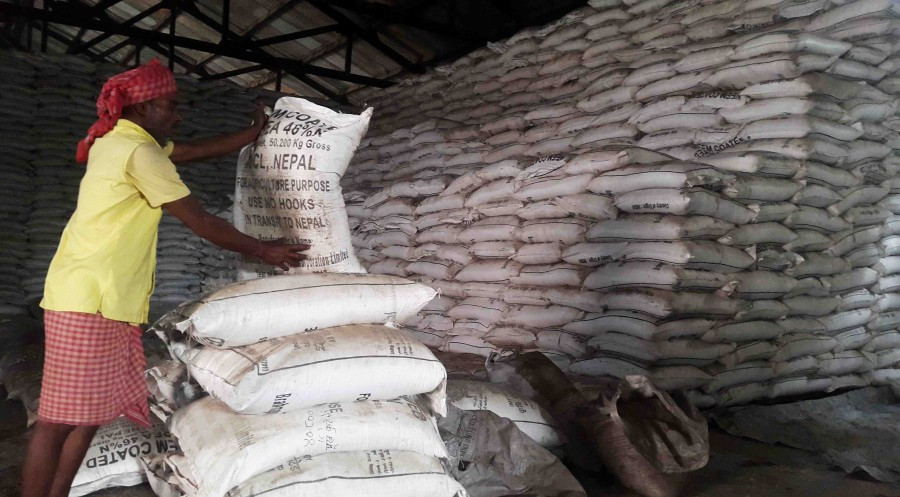
A shortage of chemical fertiliser during the peak farming season has been a perennial problem in Nepal. It recurred this year as well. The government has all the information regarding the quantity the country needs, the timing of the demand, and the investment required to make fertilisers available at subsidised prices. Yet, it persistently fails to ensure their timely availability. As a result, farmers, mainly from Tarai, have to rely on the Indian market, fraught with legal risks.
India provides fertilisers—mainly Di-Ammonium Phosphate (DAP), urea and potash—to its farmers at subsidised rates. Under India’s Fertiliser (Control) Order and the Essential Commodities Act, 1955, subsidised fertiliser distributed for agricultural use cannot legally be exported or transported outside the country without authorisation. The law enables authorities to confiscate both the fertiliser and the vehicle used for transportation, while offenders can face imprisonment and fines.
Indian security forces have often been flexible in allowing Nepali farmers to bring in a few sacks of fertiliser. However, rising prices and shortages triggered by global tensions have prompted the Indian states of Uttar Pradesh and Bihar to tighten enforcement against attempts to supply fertiliser to Nepal. As a result, they are even making arrests, as recently happened to Nagendra Prasad Singh, 60, and Suresh Prasad Singh, 55, of Sarlahi district. The siblings, who were arrested in Sonbarsa, Bihar, remained behind bars for three weeks before the Nepal government started diplomatic dealings for their release.
Although it came late, the Foreign Ministry’s diplomatic initiative, which is expected to secure the release of the Singh brothers in a few days, is a welcome move. But that is not enough. Taking this as a lesson, the government should now focus on ensuring that no other Nepali citizen has to face what the Singh brothers endured. For that, chemical fertiliser should be made readily available to the nearly 60 percent of the population engaged in agriculture. Only then can the country permanently end the compulsion to depend on supplies from across the border.
Paddy production is not just a localised issue for farmers like the Singh brothers but a national concern, as it is directly linked to the country’s Gross Domestic Product. Better harvests contribute to higher economic growth, and fertiliser is one of the key inputs for increasing agricultural productivity. Nepali farmers are already struggling with several challenges. Less than half of the country’s agricultural land has irrigation facilities, leaving the rest dependent on rainfall. Erratic rainfall patterns caused by climate change have further compounded the problem. Expanding irrigation infrastructure is costly and time-consuming; climatic conditions are beyond anyone’s control.
One thing that any responsible government can address, however, is the timely availability of chemical fertiliser. This is possible through timely planning by assessing what volume of each type of fertiliser is needed and when. Successive governments have promised such planning but failed to deliver. As the present government came to power only about four months ago, it may not be appropriate to pin the blame on it. However, it cannot be excused if the same problem persists in the next planting season. The government’s ability to ensure the timely supply of fertiliser should be the basis for judging its performance.




 15.28°C Kathmandu