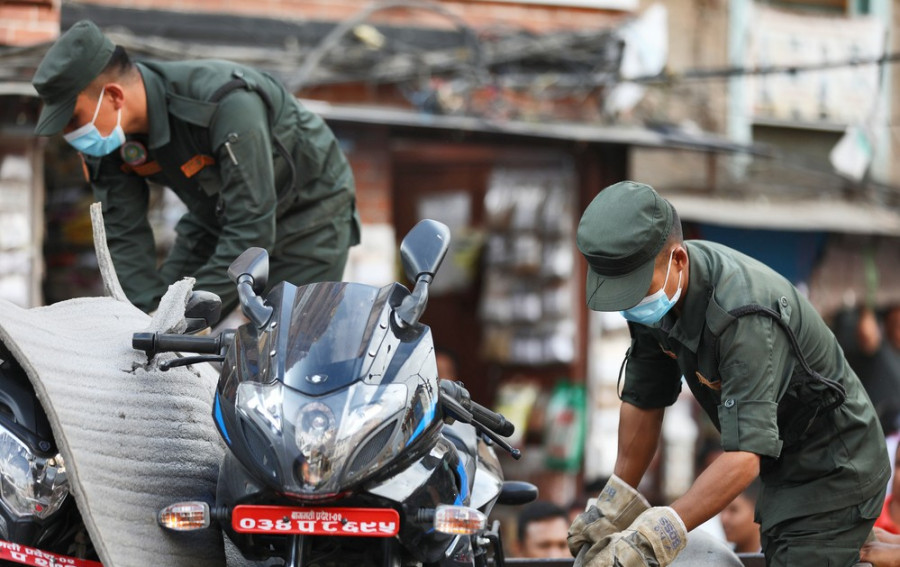
While the immediate catalyst for the tragic death of Ganesh Nepali, a twenty-five-year-old ride-hailing driver who set himself on fire in Kathmandu, was a thousand-rupee fine, the underlying cause was a systemic lack of legal recourse. His self-immolation was a final, desperate protest against a Kafkaesque legal environment where the word of a police officer is absolute, and the right to appeal is non-existent.
The current landscape of law enforcement in Nepal is increasingly defined by the arbitrary use of ‘indecent behaviour’ charges. As documented in a recent investigative report, the police have transformed this specific provision of the 2017 National Penal Code into a tool for the summary detention of anyone who dares to question authority. In a single year, 95 percent of those charged with ‘indecent behaviour’ were convicted. This staggering statistic indicates a judicial system that largely serves to rubber-stamp police actions.
The case of Majid Ansari, a Gen Z activist and law student, further illustrates this erosion of due process. Detained after a visit to displaced squatters, Ansari was held for days without a warrant. Despite his injuries, he was pressured to sign documents in a vacuum of legal clarity. This practice of ‘arrest first, justify later’ is facilitated by the routine misuse of ‘emergency arrest warrants’, which are deployed in every single case of ‘indecent behaviour’ regardless of whether a genuine emergency exists.
This systemic rot is sustained by a glaring legislative void. As lawmaker Sulav Kharel observed during a recent Law, Justice and Human Rights Committee meeting, Nepali citizens currently possess no dedicated legal space to challenge the fines or charges imposed by security forces. Whether it is a municipal police officer levying a fine for parking or a traffic personnel issuing a ticket, the decision remains beyond the reach of independent review. When there is no mechanism for an independent hearing, the law ceases to be a shield for the citizen and becomes a weapon for the state.
The consequences of this lack of appeal are often more punitive than the law itself. In many instances, individuals accused of ‘indecent behaviour’ spend more time in pre-trial detention than the maximum sentence eventually handed down by the courts. For the poor and those without legal representation—who comprise 94 percent of these defendants—the system offers no exit. The court’s tendency to interpret simple explanations as confessions further accelerates this descent into unfair justice.
The self-immolation of Ganesh Nepali was, as MP Kharel argued, partly a result of this claustrophobic legal reality. When the state provides no avenue for a citizen to say, “This is unfair,” it produces a state of learned helplessness where the only remaining response is self-destruction. The discrepancy in fines between different agencies—where municipal police charge double what traffic police do for the same offence—only adds to the sense of a capricious and predatory administration.
Restoring faith in the rule of law requires structural reform. First, the establishment of independent traffic and administrative courts is an urgent necessity. There must be a neutral venue where a citizen can contest a fine or a charge without fear of immediate detention. Second, the National Penal Code must be amended to strictly redefine ‘indecent behaviour’ and limit the maximum period of detention to prevent its use as a tool for arbitrary punishment.
Furthermore, the recommendations of the criminal justice reform task force, which have languished for two years, must be implemented immediately. This includes reducing the investigation period and ensuring that no judgment is delivered without the presence of legal counsel. The state must move away from a culture where police officers act simultaneously as complainants, investigators and witnesses.
True justice for the countless individuals caught in this cycle of arbitrary punishment will only be achieved when the law allows for dissent. A system that cannot be challenged is not a system of justice, but one of mere control. The government must act to create a space where the citizen’s voice carries as much weight as the officer’s badge.




 14.4°C Kathmandu