



 15.67°C Kathmandu

Sat, Oct 17, 2026
National
Indecent behaviour, indecent justice: How police misuse the law to arbitrarily detain citizens
Records show police routinely use the ‘indecent behaviour’ law to arrest individuals, often without evidence or access to legal counsel, leaving many to spend weeks in custody.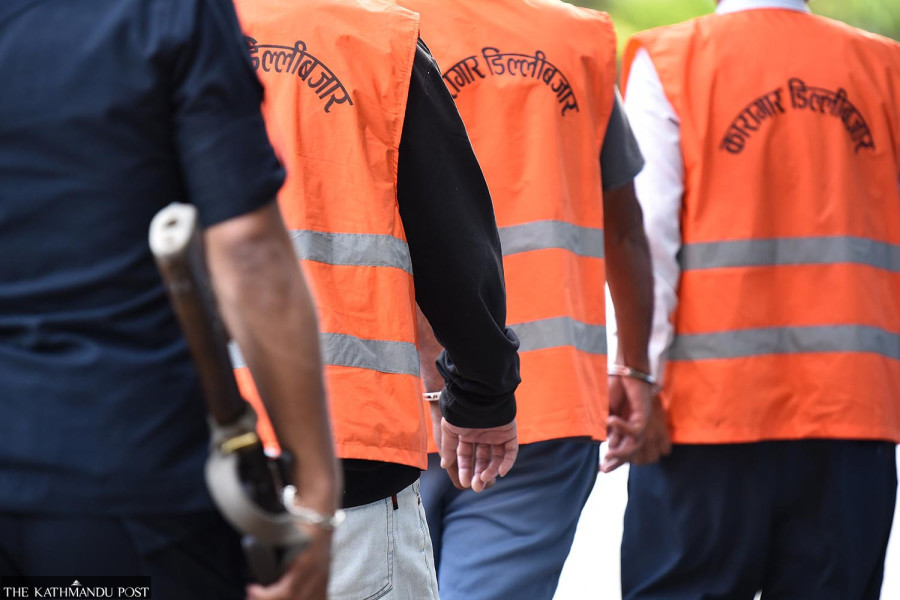
bookmark
Tufan Neupane
Published at : May 8, 2026
Updated at : May 8, 2026 21:56
Kathmandu
January 30, Friday. Safal Karki was walking home. It was around 5 pm. Suddenly, a police team accosted him.
According to the statements given to the Kathmandu District Court by Karki, 24, the police asked him to “go home.”
“I live nearby. I’m on my way,” replied Karki, a resident of Machhapokhari in Kathmandu. Unbeknownst to him, his routine walk home was about to turn into a nightmare.
A team from the Balaju Police Circle detained him. An “emergency arrest warrant” was issued. The police report said Karki was “found in suspicious circumstances and during questioning about drugs, he got into a dispute, used abusive words, and obstructed police work.”
He was charged with “indecent behaviour” towards the police. By the time the Kathmandu District Government Attorney’s Office filed the case seeking a maximum of one year in imprisonment, Karki had already spent 14 days in custody.
A close examination of the case file, police report, and court judgment shows no record that Karki had consumed, possessed, sold or transported drugs — neither that day nor previously. The documents do not even explain on what basis he was stopped and interrogated. Under the law, police must have probable cause — a reasonable ground for supposing that a charge is well-founded — for conducting a search or interrogation.
On February 13, on the 14th day of his arrest, Judge Thakur Prasad Kharel passed an order — 14 days in jail and Rs 200 (as contribution) to the Victim Relief Fund. What's surprising is the names of witnesses cited in the charge sheet differed from those mentioned in the judgment. Somewhere it was Ram Tamang, elsewhere Sudeep Acharya.
None of the witnesses appeared before the court. The reporting police officer did not testify. The court did not question the investigation. Instead, the court interpreted Karki’s statement — “I live nearby and I’m on the way” — as a confession.
A pattern emerges
Karki’s case is far from isolated.
An analysis by Kantipur of the 220 settled cases involving 358 individuals accused of “indecent behaviour” in Nepali calendar year 2082 BS — between April 14, 2025, and April 13, 2026 — shows a pattern. Nearly 95 percent of defendants were convicted.
Legal experts say courts often impose sentences that match the period already spent in detention, effectively validating pre-trial custody rather than independently assessing guilt and punishment. That’s exactly what happened with Karki.
A previous analysis of 788 arrests across Kathmandu Valley during a one-month period — from February 13 to March 14 — found that “emergency arrest warrants” were used in 100 percent of “indecent behaviour” cases. By contrast, such warrants were used in only 2 percent of banking offence cases and none in human trafficking cases.
The pattern puts the spotlight on the routine misuse of emergency powers for relatively minor charges. The analysis by Kantipur shows that the police have made laws on “indecent behaviour” a tool to detain citizens who question them, while the courts have largely served to formalise this process.
Section 118 of the National Penal Code 2017 defines “indecent behaviour” as harassment in public places or physical or verbal abuse against women, children or persons with disabilities. The explanatory notes of the National Judicial Academy state that “the purpose of the provision is to maintain dignity and ensure freedom of movement in public spaces.” This effectively means no room for a situation where the police themselves can initiate a case — as in the Karki case.
However, the cases reaching court often tell a different story.
A significant number of cases involve accusations against people for allegedly using abusive language or obstructing police work. Of the 220 cases analysed, 52 — nearly one in four — had the police themselves as complainants. The police often act simultaneously as complainant, investigator and witnesses.
The charge sheets in these cases are often drafted in a uniform language, with nearly identical wording: “[The accused] insulted police on duty with abusive words, issued threats, obstructed their work, and committed indecent behaviour.”
Police spokesperson Deputy Inspector General (DIG) Abi Narayan Kafle says the police detain individuals and file public offence (indecent behaviour) cases against those who “disturb” them when immediate action is required in maintaining law and order.
“Maintaining peace and security is the responsibility of the police. When we are on duty, anyone who tries to ‘disturb’ us must be brought under control immediately,” said Kafle. “As these cases are adjudicated by the chief district officer (CDO), it is easier for us to take immediate action.”
A joint secretary at the Office of the Attorney General, however, finds problems with the way cases are lodged.
“Questions arise when the police themselves file complaints,” the official said on condition of anonymity because he was not authorised to speak to the media. “We are examining how this law is being misused.”
A schoolteacher from Chabahil is a victim of the kind of system the official pointed at.
‘I nearly lost my sanity in detention’
The schoolteacher, Maharjan, who Kantipur is identifying with last name only, taught at the same school as his wife. A family renting a flat in his house had been locked in a long-running dispute with him over unpaid rent.
At around 12:15 pm on October 3, 2022, the family accused Maharjan of sexually harassing their daughter.
When police arrived at his home at around 9:00 pm, Maharjan was unaware of the allegation. His wife recalled that the police took him away without explaining the reason, leave alone a warrant.
Maharjan said he was at school at the time of the incident he was being accused of committing. “Digital attendance records and CCTV footage can verify this,” he said.
He was detained.
Instead of pursuing the sexual harassment allegation, the original charge over which he was picked up from his home, police filed an “indecent behaviour” case. The charge — obstructing women and children on a public road and arguing with officers.
His lawyer, Pranil Pradhan, said the indecent behaviour charge was invoked because the police did not have any evidence to support the sexual harassment allegation.
The sexual harassment complaint was later escalated to a rape charge and filed at the Kathmandu District Court, while the indecent behaviour case was registered at the District Administration Office. The administration office found him guilty and fined him Rs 8,000.
Maharjan appealed. The District Court later acquitted him, stating that the incident did not justify punishment under indecent behaviour provisions. He was also acquitted of the rape charge by both the district and high courts. He had already spent 26 days in custody.
Despite being cleared, the consequences were lasting. Maharjan left his job and now teaches at another school. He has two young daughters.
“Thinking about that time still triggers panic,” said Maharjan. “I nearly lost my sanity in detention. Only the hope that the truth would prevail kept me going. Otherwise, I would have slipped into depression.”
The reason he refused to provide his first name is the fear of social stigma.
“Who is going to give me back the 26 days I spent in detention?” he asked.
‘Not guilty,’ freed — after days in custody
Four young women working in a dance bar were arrested on February 21, 2025. At around 7pm, Dina Tamang was walking, munching chatpate, a roadside spicy snack. Manisha Rana Magar was in Gongabu. Maya Dhakal was sitting near Gate No. 1 of the New Bus Park. Sapana Thakuri was returning from her sister’s house on a Pathao ride. The police detained all four.
The police report states that, acting on a complaint from the Buddha Marga Tol Bikash Samiti (local residents’ committee) in Gongabu, police questioned the women on suspicion of theft, robbery, and “immoral activities.”
“They responded with abusive language and behaved indecently,” the report adds.
The court sought a bail of Rs 5,000 from each of them. After posting bail, they were released on the same day. The court then ordered the recording of witness statements. However, the police who had prepared the report accusing them of indecent behaviour did not appear in court. Despite repeated orders, the police failed to show up.
All four gave similar statements before the court, denying that they had used abusive language or engaged in any dispute with the police.
“Police detained me when I was walking, eating chatpate,” Dina Tamang told the court. “I was just sitting when police picked me up,” said Maya Dhakal. “Police arrested me even before I could get off the Pathao ride,” said Sapana Thakuri.
The court observed: “There was no evidence of theft and looting, nor was there any complaint. It’s natural to counter or even argue when interrogated without any basis. Just because someone argued with police does not constitute – and cannot be construed as – indecent behaviour.”
By the time they were acquitted and freed, each had spent 18 days in detention.
Among the cases involving 358 defendants analysed, only 19 were acquitted. Yet those acquitted spent an average of 25 days in detention — longer than the average 20-day sentence given to those convicted.
Data also shows that nearly half of those convicted had already spent more time in detention than the sentence eventually imposed. On average, they spent 11 extra days in custody beyond what the court ordered.
For some – like in the case of Maharjan or the four women – the detention lasted days. But for many, such detentions stretch for months.
The experience of Chhiring Sherpa from Solukhumbu is harrowing.
Sherpa, a daily wage worker, was picked up in July 2025 while walking along Thapathali road. Police described him as “suspicious” and accused him of arguing with officers and disturbing public peace.
Sherpa denied the allegations, saying he was simply looking for scrap materials.
He was asked to post a bail of Rs 10,000 but he did not have money. He was sent to prison, pending trial.
Four months later, the court sentenced him to 30 days’ imprisonment and fined him Rs 1,000. By then, he had already spent 122 days in custody — 92 days more than his sentence.
A vague offence with old roots
“Indecent behaviour” is a new offence introduced in the 2017 Penal Code. However, legal experts trace the roots of such practices to older laws used during the Panchayat era.
King Mahendra had introduced the “Some Public (Offence and Punishment) Act” in 1970. Section 2 of the Act defined as an offence any act that obstructed a public servant while discharging official duties.
Under that law, framed in the name of maintaining “peace and order,” police could initiate action against individuals accused of obstructing their work. With the introduction of the Penal Code, the Act was repealed.
However, a similar practice continues through the use of laws related to “indecent behaviour.”
Section 101 of the Penal Code also provides for a prison sentence of up to three years if the person in question “resists” arrest. However, to invoke this provision, police must establish that an arrest warrant was issued in accordance with the law and that the accused “physically” resisted it.
According to legal experts, it is difficult for police to produce such evidence because the “obstruction of investigation” cited in police reports often does not occur in practice. Moreover, when cases are filed under “indecent behaviour,” the burden of proving such resistance is assumed not to lie with the police, though in principle it does. Security officials, however, bring the charge armed with nothing more than a report.
Similarly, Section 85 of the Code provides for a jail term of up to one year for obstructing a public servant while discharging official duties. Police can also proceed under this provision.
Under the Penal Code, offences listed in Schedules 1 and 2 are investigated by the police and prosecuted in court by government attorneys, while cases under Schedule 3 must be directly filed in court by the aggrieved authority or individual. Offences under Section 85 fall under Schedule 3, meaning if police wish to act against someone for obstructing their work, the concerned officer must directly approach the court. To avoid this legal route, police often file charges under “indecent behaviour” in cases where obstruction of duty is alleged.
Police spokesperson Kafle said police follow the practice of taking cases to court through government attorneys and do not directly approach the court.
“Since Schedule 3 cases require us to go to court directly, we instead proceed under indecent behaviour and go through the government attorney,” he said. “However, we do so only in cases involving obstruction of police, unruly behaviour, harassment of women, children, or persons with disabilities, and disruption of public order.”
In many such cases initiated on the basis of police reports, accused persons have spent more time in detention than the punishment eventually imposed by the court. On average, those accused in police-initiated cases have spent about eight more days in custody than the sentence later imposed.
There are also cases where individuals were found guilty in the final verdict but were ultimately only fined a small amount, with no jail term imposed. By then, however, they had already spent weeks in detention.
Detained, ignored, forgotten
Of the 358 cases, court records show that 34 individuals were fined only. However, all of them had already spent several weeks in police custody. On average, they spent 14 days in detention. Among them, Saroj Tamang, 19, of Budhanilkantha-10, and his friend Shubham Adhikari, 20, spent the longest time in police custody — 25 and 23 days respectively.
Responding to concerns about the risks posed by current police practices in indecent behaviour cases, Home Ministry spokesperson Ananda Kafle said the ministry has been instructing security agencies to implement laws in their intended spirit during regional security meetings involving police and chief district officers.
“We have been directing them to work according to legal procedures,” he said.
Asked whether there were any specific instructions regarding “indecent behaviour” cases beyond general directives on law enforcement, spokesperson Kafle said: “There are none.”
A report submitted in June 2024 by a criminal justice reform task force formed by the Office of the Attorney General has already acknowledged the problem at the official level. It states that the investigation and detention period for offences such as indecent behaviour should be reduced to a maximum of 15 days, down from the current 25 days. It also recommends redefining "indecent behaviour" and limiting its use.
Somanath Bhandari, who is currently the chief of the Kathmandu District Government Attorney’s Office and served as member-secretary of the task force, said the recommendations were made in light of concerns over violations of individual liberty.
“We made those suggestions with the understanding that incidents involving infringement of personal liberty were occurring, and to bring objective reforms,” he said.
Bhandari added that the problem stems from the failure of the police, government attorneys, and even judges to fully internalise the spirit of the new laws.
“New laws have introduced new concepts. But there has not been a corresponding behavioural reform among implementing officials,” he said. "That is why the problem persists."
Nearly two years have passed since the report was submitted, but it has never been discussed in Parliament. The law remains unchanged. And those who suffer the most are the individuals who cannot even afford a lawyer to defend themselves in court.
Counsel denied, judgment delivered
A 95 percent conviction rate in "indecent behaviour" cases naturally raises questions over whether police investigations and prosecution by government attorneys are that effective, and whether the evidence collected is truly irrefutable.
Analysis of verdicts suggests the answer lies largely in the accused's inability to mount a defence in court.
Of the cases reviewed from last year, only 23 individuals — just 6 percent — were able to hire private lawyers. In other words, 94 out of every 100 individuals accused of "indecent behaviour" could not afford legal representation. Among the rest, only 17 received services of state-appointed lawyers, meaning access to free legal aid for those unable to hire counsel due to financial constraints stood at just 5 percent. For 241 others, court records do not indicate whether they had any legal defence at all.
In such cases, if the accused admits involvement, courts can deliver a final judgment on the same day during the bail hearing itself. Those unable to afford lawyers are often left without even the opportunity to request state-provided legal aid. A review of judgments shows that courts have proceeded to final judgment on the same day, citing an admission of guilt or the absence of witnesses, without ensuring effective legal representation. Yet the Constitution guarantees every accused person the right to consult a lawyer from the moment of arrest. District judges, however, are delivering final judgments in cases where such access is absent.
A further issue lies in how courts interpret an accused person’s statement. Take the case of Safal Karki, who said, “I had told police that I live nearby, and I'm on my way; during which, a minor argument broke out.” The court interpreted this as “an admission of guilt.”
Rajkumar Majhi is another "victim" of such interpretation by the court.
At around five in the morning on February 9, he was set to take a bus to Jadibuti from Balkumari. He had just started a new job of manning a ticket counter. When he was about to board the bus, he had an exchange of words with police in civvies. He, along with his friend Shyam Rai, was taken to a nearby police station.
In his statement, Majhi said, "I have not committed any indecent behaviour towards anyone."
However, the police report claimed that he was detained at the Sinamangal bus stop on suspicion of “creating a staged crowd by jostling female and elderly passengers with intent to pickpocket.” It also described them as repeat offenders, stating they had been previously arrested in various criminal cases. Such claims strengthen the case against the accused, as repeat offenders are liable to a one-and-a-half-times harsher punishment.
Before the court, Majhi said: "The police report is false. After push and shoves and exchange of words, the police took us in saying they wanted to question us. We did not engage in any activity intended to create a crowd or commit pickpocketing."
"I was taken from the Balkumari bus station; I had not even gone to Sinamangal. I have not behaved indecently with anyone,” he added.
In his statement, Majhi did acknowledge pushing and grappling but denied all other allegations. The court, however, interpreted the same statement as an “admission of guilt” and delivered judgment the same day.
Under the Criminal Procedure Code, a confession allows the court to deliver judgment without examining additional evidence. This effectively means one does not get the opportunity to hire a lawyer or access state-provided legal aid.
Here’s how it plays out: legal assistance is only offered during the court hearing, regardless of whether the accused wants it or not. If the accused asks for legal help, the court arranges a lawyer for the next hearings. However, when the court interprets the accused’s testimony as an “admission of guilt,” it delivers the judgement on the same day. As a result, the judgment is made without the accused having legal representation.
In Majhi’s case, the police also sought additional punishment by portraying him as a repeat offender based on previous cases.
However, a review of records by Kantipur found several inconsistencies in this claim. The charge sheet cited a rape case (No. 073-CR-1416), in which Majhi was said to have been sentenced to three-and-a-half years by the Kathmandu District Court. But court records show the accused in that case was Bishnu Khatri, who was in fact acquitted, and had no connection to this particular "indecent behaviour" case.
Records from the Kathmandu District Court further show that a theft case — not rape — was filed against Majhi in 2018. Although he was initially convicted by the district court, he was later acquitted by the High Court in 2021, a crucial piece of information omitted in the charge sheet. With no established prior conviction, the case should not have been treated as a repeat offence and should have automatically fallen under the CDO’s jurisdiction.
On February 25, Judge Ishwari Prasad Bhandari passed the judgment. He did not classify Majhi as a repeat offender, yet ordered 10 days of imprisonment. The pattern repeated: Majhi had already spent six more days in custody than he was sentenced to. Concurrently, it raises another question: why did the bench pass the judgment? If the bench observed that Majhi was not a repeat offender, the case should have been sent to the CDO – the agency with jurisdiction to hear the case.
A system that fails people
Three issues emerge concurrently from this case. First, saying “there was a scuffle” is not an admission of guilt, yet the court interpreted it as such. Second, that interpretation enabled the same-day judgment, effectively closing the door to legal representation. Third, the police attempted to use a previously acquitted case to establish repeat-offender status.
Although the court ultimately rejected that claim, Majhi had already been detained and tried. That conviction, in turn, risks being used against him in any future cases as a repeat offence.
For first-time offenders, an "indecent behaviour" conviction carries a maximum penalty of one year in prison, a fine of up to Rs 10,000, or both. However, if an accused has already been convicted in a prior case, they are considered a “repeat offender,” and the punishment may be increased by 1.5 times. This provision on repeat offenders also determines the case's jurisdiction.
Under Article 152 of the Constitution, cases that may result in a sentence of more than one year fall under the jurisdiction of the court, while those carrying lesser penalties are handled by chief district officers. As a result, cases involving first-time offenders are typically sent to CDOs, while those involving repeat offenders are heard by the district court.
An analysis by Kantipur of "indecent behaviour" cases filed in the Kathmandu District Court shows that most of the accused had prior convictions.
The analysis also reveals a clear link between legal representation and conviction rates. Those who hired private lawyers had a conviction rate of around 83 percent, about 13 percentage points lower than the overall conviction rate. In contrast, cases decided on the same day of bail hearings — without legal consultation — had a conviction rate of 98 percent. Among those represented by state-appointed lawyers in the past year, the conviction rate was 100 percent, meaning none secured an acquittal.
This raises a key question: is this the failure of an individual lawyer, or a structural problem in Nepal’s criminal justice system? For Karki, Maharjan, Sherpa, and many others, the system that should safeguard their freedom has become its greatest threat.
Advocate Harka Bahadur Rawal says the police have been widely abusing the law related to "indecent behaviour."
"This is an atrocity meted out by the state forces against vulnerable citizens," said Rawal, a member of the criminal justice reform taskforce led by the Attorney General. "Charges are being pressed against those who should not be charged with any offence. Many people are being subjected to unnecessary suffering.”
According to Rawal, such acts constitute a human rights violation and should be understood as a police attack on fundamental rights.
“Unless such police officers are held accountable,” he said, “it will be difficult to curb this misuse of the law.”
Tufan Neupane
Neupane reports affairs related to law, judiciary, human rights, transitional justice and wildlife crime.




Most Read from National

Flood sweeps away houses, bridges in Gorkha

Torrent of black mud and rocks engulfs settlements along Budhigandaki

From blankets to handmade dolls, two foreign women bring comfort to flood survivors
British Gurkha veterans issue ultimatum to Nepal government over long-standing grievances

Budhi Gandaki flood washes away three bridges in Gorkha
Editor's Picks

Constitutional Bench caught in seniority, ‘pick and choose’ dispute

A Dom boy’s long road to becoming a doctor
From blankets to handmade dolls, two foreign women bring comfort to flood survivors

News Analysis: When institutional defence exposes institutional fault lines

It’s a bird … it’s a plane … it’s the Indian ambassador’s farewell tweets
E-PAPER | October 17, 2026

×