



 15.67°C Kathmandu

Sat, Oct 17, 2026
National
How Nepal Police is misusing urgent warrant of arrest
Kantipur’s analysis of arrest procedures of 788 suspects in the Valley in a month shows urgent warrants were used in 80 percent of all arrests.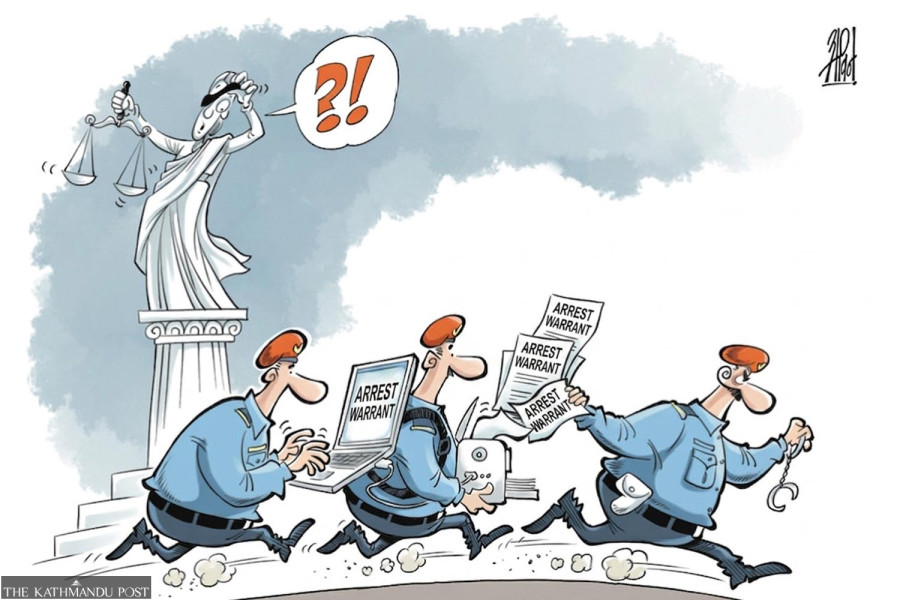
bookmark![]()
Tufan Neupane
Published at : April 12, 2026
Updated at : April 12, 2026 08:42
Kathmandu
On the evening of February 11, police officers from the District Police Range in Kathmandu apprehended a young girl from Lainchaur in Kathmandu. She was 15 years and six months old.
Crucially, the law enforcement officers had no prior authorisation from any judicial authority to take the minor into custody. Instead of seeking a court order, Police Sub-Inspector Kamal Thapa Chhetri issued an ‘urgent warrant of arrest’ on the spot. “You are being arrested immediately in connection with a polygamy offence,” the arrest warrant read.
Under existing legal provisions, children below 16 are ineligible to even open a bank account on their own accord. The accused girl possessed no citizenship certificate. She was legally barred from travelling abroad without the explicit permission and accompaniment of her guardians. But for Nepal Police, she was a dangerous suspect who ostensibly had the capability to flee the jurisdiction or systematically destroy evidence.
Section 9(6) of the National Criminal Procedure (Code) Act 2017 grants law enforcement personnel the extraordinary authority to arrest individuals without prior judicial permission. However, this immense power is strictly tethered to two foundational preconditions—it can only be exercised if there is a concrete, solid basis to believe that the accused will abscond, or if there is an imminent threat that they will destroy vital evidence.
In regular circumstances, police are mandated to first present their preliminary evidence to the court and obtain an arrest warrant. This legal provision, which officially came into effect on August 17, 2018, was designed to be a robust legal safeguard.
According to legal experts and human rights advocates, it was implemented to protect ordinary citizens from arbitrary, unchecked arrests by the state apparatus. And it was to be invoked in the rarest of circumstances, never to be used as a standard, everyday operating procedure.
Yet, the girl’s arrest in Lainchaur was by no means an exception.
To understand the prevailing trends of police arrests, Kantipur conducted an analysis of the arrest procedures of 788 suspects across 490 cases filed by the Government Attorney Offices in Kathmandu, Lalitpur, and Bhaktapur—throughout the Nepali month of Falgun (mid-February to mid-March).

The results are startling—an overwhelming 80 percent of all arrests executed within the Valley were carried out using urgent warrants. This shows a grim reality where four out of every five suspects were forcefully taken into police custody without prior judicial oversight. A staggering 98 percent of the arrested minors were detained using this emergency provision.
The systemic normalisation of this aggressive police practice largely operated in the shadows, escaping mainstream public scrutiny until the morning of March 28 when former Prime Minister KP Sharma Oli and former Home Minister Ramesh Lekhak were abruptly arrested from their respective private residences in Bhaktapur with urgent arrest warrants, deliberately bypassing the standard procedure of obtaining prior court approval.
Following a swift legal challenge, the Supreme Court intervened, issuing a decisive judicial order for them to be investigated without being subjected to physical detention. Consequently, both leaders were released on April 9. But there were questions. For instance, was there a realistic probability that they would flee the country or destroy evidence?
This legal question raised in the wake of the arrests of Oli and Lekhak was not asked when the 15-year-old girl was detained. Furthermore, nobody in the political establishment or the broader civil society raised similar questions on behalf of the 628 ordinary citizens who were similarly arrested through urgent warrants across the Kathmandu Valley in the single month.
“The police are walking down a deeply flawed path where they simply throw an individual into custody the moment an First Information Report (FIR) is filed, and only subsequently go to the court to casually announce the detention,” says advocate Subash Acharya, an expert on Nepali criminal law. “The existing legal framework dictates that such a procedural inversion must never occur.”
An inversion of legal practice
An analysis of the 490 cases registered at the courts by the government attorney offices in three districts revealed that over 80 percent (628 individuals) of the 788 defendants were detained using urgent arrest warrants. This rate stood at a staggering 100 percent for cases involving drug offences and “indecent behaviour”, and up to 97 percent for the theft of motorcycles, mobile phones and gas stoves.
The 15-year-old girl from Lainchaur is not the only minor to be detained via such an urgent arrest warrant. Of the 44 minors arrested across the three districts during the month, only one was detained following a court-issued warrant. They were arrested for minor offences such as petty theft, causing injury in accidents and marijuana consumption.
In stark contrast, urgent warrants were issued in merely two percent of banking offence cases, primarily bounced cheques, and 13 percent of money laundering cases. In human trafficking cases, the provision was not used even once. Meanwhile, out of 17 defendants accused of rape, three were arrested using regular warrants.
Financial offence suspects—who hold substantial funds in bank accounts, have foreign connections, and have the capacity to destroy digital evidence—or suspects in sexual offences and human trafficking who could intimidate victims, are typically arrested using regular court warrants. Conversely, suspects in cases like indecent behaviour, marijuana use, or petty theft are summarily subjected to urgent warrants.
This glaring disparity raises the question of what basis the police use to determine who gets an urgent warrant and who is afforded the wait for a court order.
This trend of excessive reliance on urgent warrants is not confined to the Kathmandu Valley. A research report titled ‘Legal Provisions and Practices Regarding Arrests’, published recently by the National Judicial Academy Nepal, comes to similar conclusions based on data from Mugu, Bhojpur, Surkhet, Kathmandu, and Dhanusha districts—nearly 70 percent of all arrests are based on urgent warrants. The report concludes that the use of the urgent warrant, which should be applied in special circumstances, is being used as a substitute for the regular provision of arrest with prior court permission.
“We decided to investigate this issue given the growing perception that urgent warrants were being widely misused,” says Sanjiv Rai, research coordinator and director of the academy. “Initially, we thought factors like geography, access to transport, and the state of police manpower would make a difference. However, whether it was the Kathmandu Valley, the mountains, the hills, or the inner Madhesh districts, we found it being used almost uniformly everywhere.”
Janak Prasad Ghimire, the Chief Government Attorney of Lalitpur, acknowledges the reality. “Currently, there are more urgent warrants than regular ones,” Ghimire said. “An urgent warrant should only be issued if the suspect is going to flee, destroy evidence, or if the crime is ongoing. But here, the police do not even state what the circumstances were. They just grab them and bring them in.”
Criminal law expert Rajit Bhakta Pradhananga has a similar view. “In cases of indecent behaviour, our practice has become such that if the police cannot immediately prosecute a case, but feel the need to take certain individuals into custody, they instantly issue an urgent arrest warrant and apprehend them,” he said.
Who are targets of urgent warrants?
Consider the circumstances of the minor girl arrested for polygamy. Darshana Hamal filed a formal complaint against her husband Nirak Shahi and the minor on February 6. Following the complaint, the Women, Children and Senior Citizens Service Centre verbally instructed Police Inspector Saraswati Karki to locate them. On February 11, Karki’s team finally apprehended the suspects in Lainchaur.
Despite having five days to conduct a search, the police did not consider it necessary to seek prior judicial permission. The court initially remanded them for four days, during which their official statements were swiftly concluded. However, claiming an urgent need to question other individuals, the police secured an additional 10 days remand.
The Kathmandu District Court turned a blind eye to this procedural overreach. Furthermore, the charge sheet filed at the Bhaktapur Juvenile Court on February 27 reveals careless police behavior—the legally protected identity remained unredacted in multiple places.
Similarly, in Lalitpur, sculptors Raju Sunar and Dhane Tamang were arrested at the Gwarko bus stop on January 7. Accused of walking suspiciously near passengers’ belongings and subsequently threatening plainclothes officers, they were swiftly issued urgent warrants. Ironically, their official statements confirm they were returning from a scheduled appearance at the Baneshwar police station.
The urgent warrant, issued by Assistant Sub-Inspector Bal Kumari Karki, neglected to even specify the alleged offence. The hastily typed document cited the criminal code without detailing the actual crime. Last month, all 37 individuals implicated in 19 separate indecent behaviour cases in three districts were detained via such urgent warrants.
Similarly, a weary painter named Pujan Putuwar was arrested at the Balaju Bypass on January 12. Exhausted from gruelling manual labour, battling chronic insomnia, and navigating severe family disputes, he had recently started consuming Diazepam that is used to treat anxiety. After he had purchased some drug ampoules, a passing police patrol searched him and handed him an urgent arrest warrant.
Crucially, the legal document cited offers no valid justification for bypassing standard procedure. Police Inspector Dev Singh Bhandari failed to provide any statutory grounds when seeking remand, and the court asked no questions. On February 25, Judge Ishwari Prasad Bhandari sentenced Putuwar to one month and 15 days in prison. Tragically, by that time, Putuwar had already languished in detention for 75 days, serving an extra month unnecessarily.
In another Lalitpur case, an urgent warrant was used to arrest two men accused of stealing a packet of Nescafé worth Rs712.
The court data from mid-February to mid-March reveals a stark demographic bias. Urgent warrants were issued against 90 percent of Dalit defendants, 87 percent of Tharus, 81 percent of Janajatis, and 72 percent of Khas-Aryas. The 20 percent disparity between Dalits and Khas-Aryas is concerning.
Senior advocate Krishna Prasad Sapkota argues the police actively exploit legal loopholes instead of upholding the law. “Failing to respect legal boundaries invites societal chaos,” he said.
In Kathmandu and Bhaktapur, over 80 percent of arrests rely on urgent warrants while Lalitpur’s rate is 70 percent. The average age of individuals subjected to urgent warrants is 29, compared to 38 for court-issued warrants. Former Deputy Attorney General Gopal Prasad Rijal suspects widespread misuse. “Not all cases require detention,” he said.
The legacy of civil code
The provision for urgent arrest warrants was first introduced in the Criminal Procedure Code, 2017. Prior to its enforcement, police routinely detained suspects based on suspicion before presenting them to court within 24 hours. Legal practitioners suggest the root of the current misuse lies in the “legacy” of the old civil code. For decades, the police force became accustomed to arresting first and seeking judicial oversight later. Despite the new code, this entrenched habit remains unchanged.
Rai observes that the police seem reluctant to abandon practices established under the civil code’s long reign. This issue reached the Supreme Court in 2019. In a habeas corpus case, the court ruled that issuing warrants merely to fulfill formalities, without disclosing reasonable grounds, is unacceptable.
However, Nepal Police Spokesperson Deputy Inspector General of Police Abi Narayan Kafle maintains that urgent warrants are only used as prescribed by law. “Regarding those arrested via urgent warrants, we mandatorily obtain judicial endorsement within 24 hours,” Kafle said. “The misuse of urgent warrants could only be alleged if we were holding individuals in custody without such endorsement.”
Kafle explained that factors such as the open border with India and the public outcry from victims or communities necessitated timely arrests, which occasionally required the issuance of urgent warrants. “Upholding law is the primary duty of the police,” he said. “While we ensure others comply with the law, we ourselves adhere to it one hundred percent.”
Conversely, the Office of the Attorney General acknowledged these procedural flaws two years ago. Their 2024 report on criminal justice reform highlighted that automatic arrests following a complaint lead to unnecessary detention and reputational damage, even in false accusations. It recommended a legal requirement for police to issue a “notice of appearance” before making an arrest.
The report references Indian legal reforms, where the Supreme Court mandated that suspects be given a chance to appear voluntarily for non-serious offences. Based on the rate from mid-February to mid-March, over 7,500 individuals annually face detention without prior judicial approval in the Kathmandu valley alone. Experts suggest that reform is only possible if courts begin rejecting warrants that bypass necessary legal requirements.
Tufan Neupane
Neupane reports affairs related to law, judiciary, human rights, transitional justice and wildlife crime.




Most Read from National

Flood sweeps away houses, bridges in Gorkha

Torrent of black mud and rocks engulfs settlements along Budhigandaki

From blankets to handmade dolls, two foreign women bring comfort to flood survivors
British Gurkha veterans issue ultimatum to Nepal government over long-standing grievances

Budhi Gandaki flood washes away three bridges in Gorkha
Editor's Picks

Constitutional Bench caught in seniority, ‘pick and choose’ dispute

A Dom boy’s long road to becoming a doctor
From blankets to handmade dolls, two foreign women bring comfort to flood survivors

News Analysis: When institutional defence exposes institutional fault lines

It’s a bird … it’s a plane … it’s the Indian ambassador’s farewell tweets
E-PAPER | October 17, 2026

×