A community-led exhibition in Lalitpur reclaims the cultural history of Pilaru, a traditional clay instrument shaped by memory and oral heritage.Courtesy of Kharka Chakra
Pilaru—means “something to be admired,” in the Tharu language.
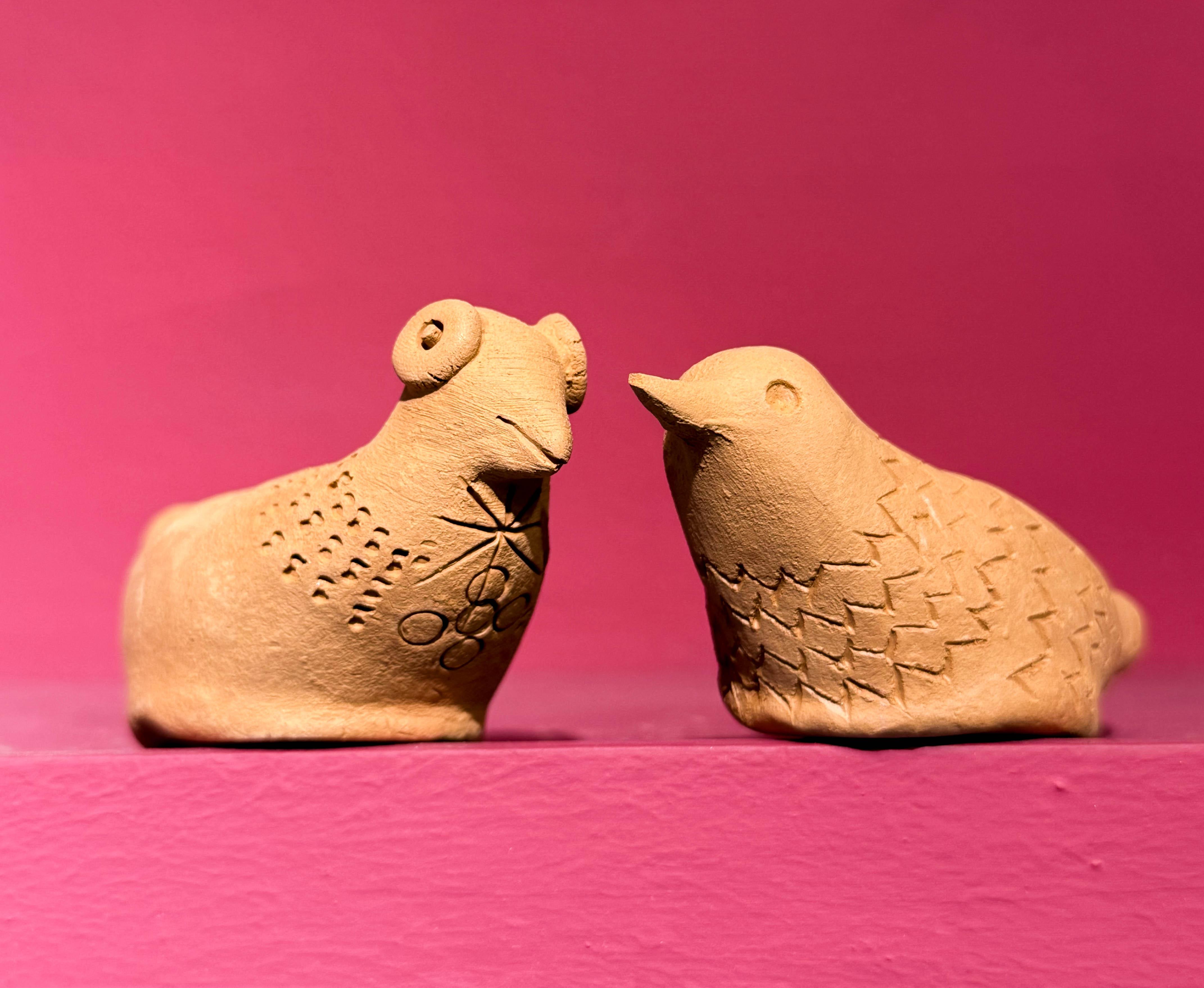
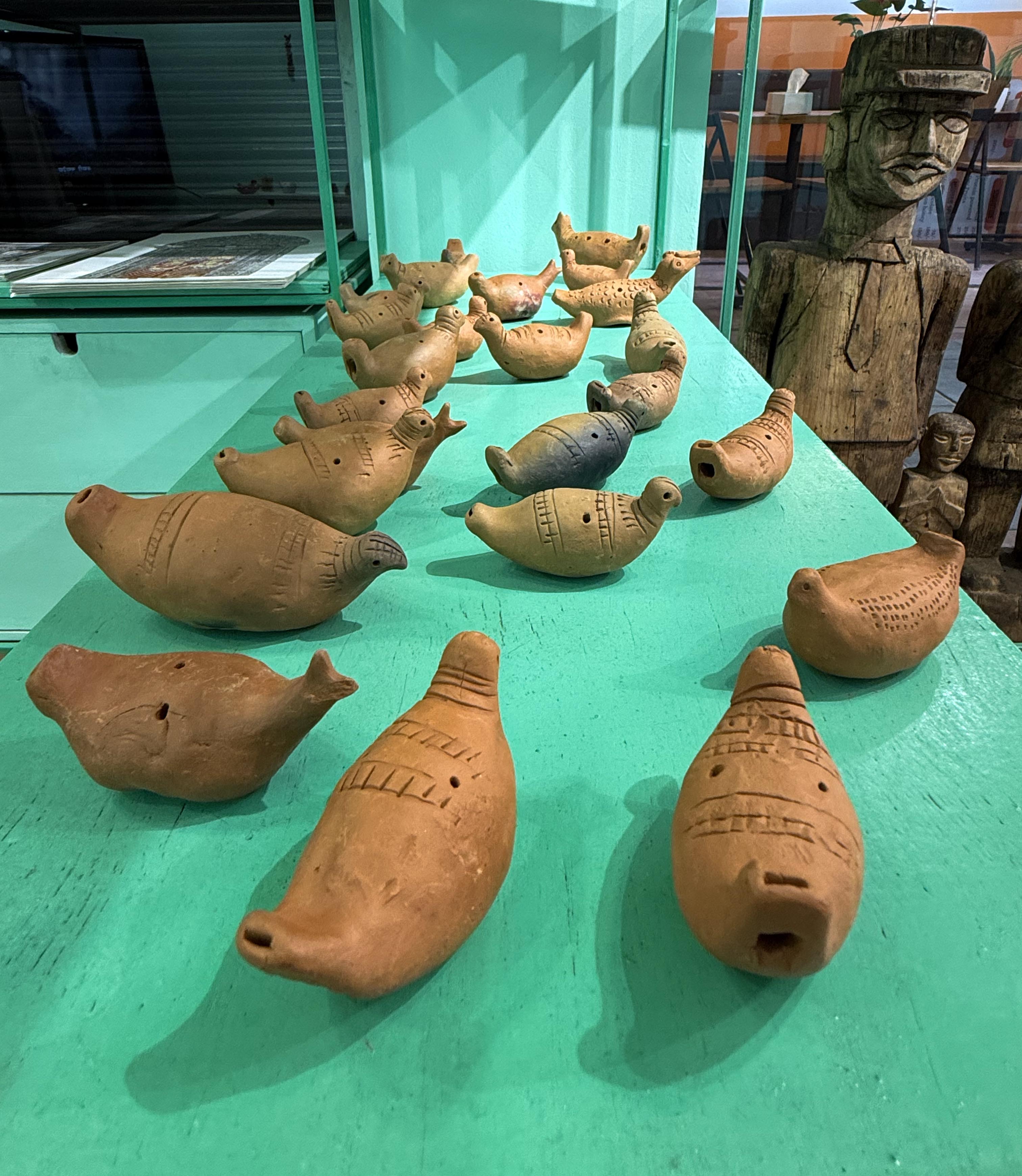
Through this form of love, culture and collective expression, a traditional instrument is handcrafted. Pilaru fits perfectly in an adult’s palm. Made of a special soil called Chimtaiko Maato, it mostly takes the shape of birds native to Madhesh.
There are four air passages in Pilaru. Two small circular holes for the index fingers to coordinate the tones, one thin, flat aperture to blow air into the instrument, and another wider slot right below it to balance the airflow. The size of a Pilaru determines the sharpness of its echoes. The bigger the structure, the lower the pitch.
Oral traditions hold poignant cultural significance in the Adivasi Tharu and Kumhar communities. Carried across generations orally, Pilaru is a vessel of memory, intimacy and shared heritage.
However, negligence in the circulation of factual information and documentation has marginalised the Tharu culture, leaving its traditions and histories largely overlooked and obscured.
Institutions replicated their practices, misinterpreted their meanings, and commodified them without acknowledging the communities that created or preserved them.
This community-led exhibition is a form of resistance and an act of reclaiming Pilaru.
This community-led exhibition, therefore, is a form of resistance and an act of reclaiming Pilaru. It is happening to restore the cultural and emotional significance to the people who have carried it across generations.
The gradual economic and environmental degradation has demotivated the makers to craft Pilarus. The clay initially used in the process is becoming increasingly rare in the field. Even after making them, there is no commercial market for them.
Practised mostly by the Adivasi Tharu and Kumhar communities, making and playing Pilaru is now practised by fewer people with each passing generation. As foreign employment became the only remaining source of income, the younger generation moved away from their community, and traditions began disappearing in their absence.
This exhibition of indigenous art also represents how Pilaru can be ethically commercialised. Acknowledging the origins, crediting the communities and presenting its cultural significance with accuracy, dignity and respect.
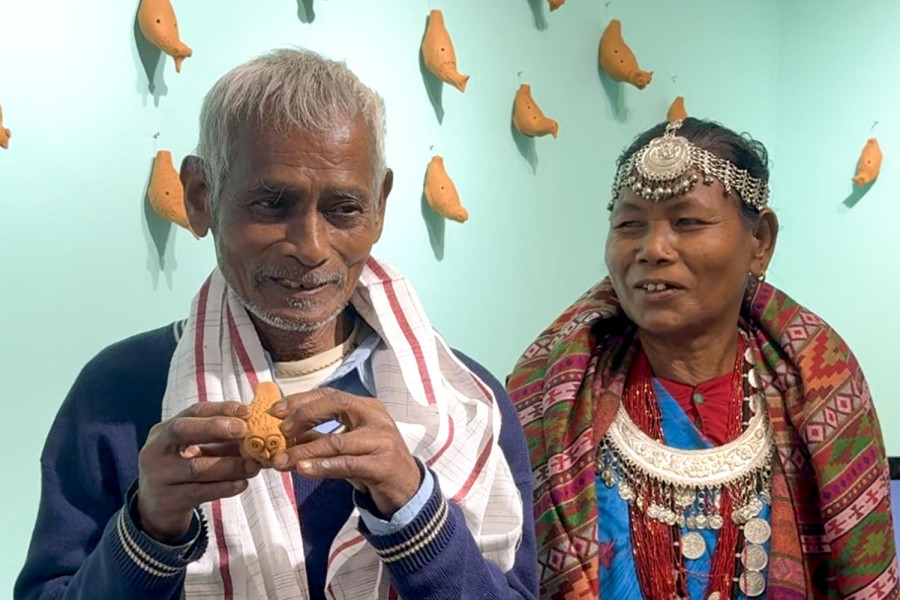
“We could bring and honour the people who still practice making traditional Pilaru. We wanted to show them that it could receive this kind of exposure too,” says artist Lavkant Chaudhary. “Seeing them here, witnessing this exhibition happening meant a lot to my community and me.”
The rhythmic flow of Sajana and Maina, traditional Tharu songs, accompanies Pilaru. Sung especially by women, these songs carry stories of love, labour and belonging, sustaining oral histories through voice and memories. Pilaru also becomes a companion in their longing while they visit the memories of their relatives and loved ones.
The clay is first moulded into the shape of diyoand later enclosed in the process. Some creators give them the shape of birds, others leave them in simpler, more traditional forms.
The process of firing the Pilarus carries its own cultural significance.
“While it produces sound even in its raw form, the tones become richer and more refined after firing,” explains Chaudhary.
A mixture of paral (paddy straw) and daura(wood) is layered with wet clay to form a semi-circular structure. Traditionally, it is believed that while layering the soil, the final line must be drawn in a singular stroke of breath—an offering made by the makers for the Pilarus to not break inside it. Alcohol, too, is offered during the process.
There are three holes in this structure. One to place the fire inside, and the other two to let the smoke circulate. Pilarus are left overnight and taken out the following morning, ready for use.
This process is repeated with each firing, becoming a technical ritual across generations.
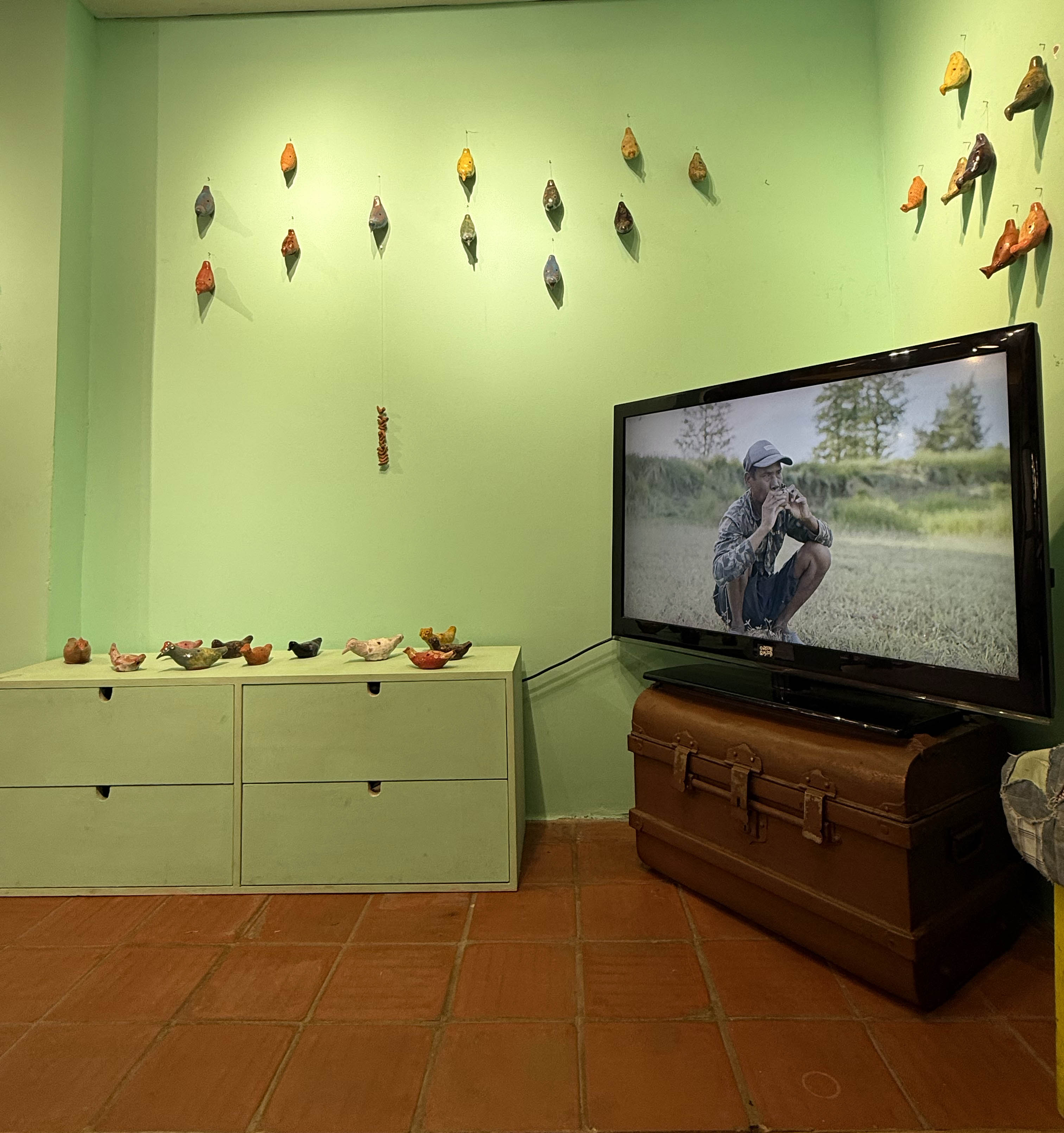
In the exhibit, more than 200 Pilarus, made by Santu Chaudhary, Ruinu Tharu and Lavkant Chaudhary, are displayed.
Most Pilarus in the exhibition have earthy colours and raw textures. However, some are glazed. Lavkant Chaudhary is a Fine Arts graduate from Tribhuvan University. For him, the modern arts approach clashes with his cultural practice.
“When I’m studying arts, we are always taught to pursue perfection—a westernised approach, I believe,” he says. “But making Pilaru traditionally requires us to embrace irregularity, spontaneity and the rawness of the material itself. With the perfectionist mindset that I have built now, it becomes difficult for me to surrender to the process in the way our elders did.”
Yet, within this lies a balance and negotiation between inherited knowledge and contemporary artistic practice, making Pilaru, as he describes, an archive of breath, memory and survival.
In these communities, Pilaru exists as a continuity of life. With every tone it produces, there is both presence and absence of the makers who continue the practice and of those who drifted away.
Pilaru is therefore about preservation, recognition, resistance and a question, “Who has the right to carry a sound, to tell a story and to claim a tradition?”




 13.8°C Kathmandu