What the prime minister’s asset disclosure tells us about Nepal’s quietly growing influencer economy
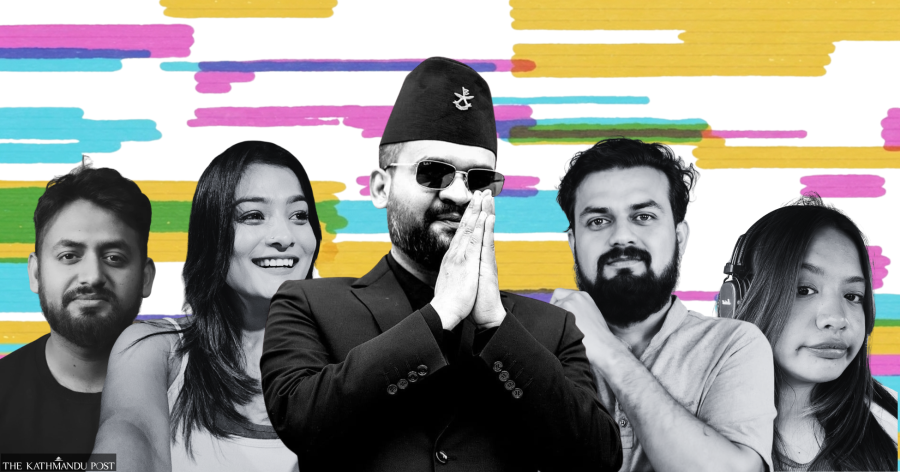
Creators in Nepal pulled in Rs 3.53 billion from digital platforms last fiscal year, and the current year is already on track to surpass it. Post Illustration
When Prime Minister Balendra Shah filed his mandatory asset disclosure, one line stood out: he listed Rs 14.6 million in cash and identified his primary income sources as Facebook, YouTube, and TikTok. His 4.6 million Facebook followers, 1.3 million YouTube subscribers, and 465,000 TikTok followers, he said, were the engines behind that wealth.
The disclosure sparked an obvious question — can social media followers actually be listed as an asset? Nepal Rastra Bank spokesperson Guru Prasad Paudel says yes, at least within existing regulatory language. “The Rastra Bank has a category for audiovisual and related services under which remittances can be received,” Paudel told Kantipur. “What the prime minister has described falls under that category, and so it can legally be cited as an income source.”
Whether or not the disclosure holds up to legal scrutiny, it has done something more consequential: it formally acknowledges, in a government document, that Nepal’s creator economy is real, substantial, and growing. The prime minister’s bank balance is a small and visible tip of a much larger structure. Thousands of young Nepalis are now earning significant sums — in foreign currency — from their bedrooms.
Nepal Rastra Bank data shows that in fiscal year 2024-25, Nepal received Rs 3.53 billion from digital platforms including YouTube, Facebook, and TikTok. In just the first eight months of the current fiscal year, that figure has already reached Rs 2.90 billion — up from Rs 2.24 billion in the same period the year before. Google, which owns YouTube, accounts for the largest share of those inflows at 67 percent. Meta — Facebook and its related platforms — accounts for 12.21 percent. Film and animation production contributes 6.33 percent, and everything else, including TikTok and Distrokids, makes up the remaining 14.10 percent.
That figure, Paudel says, is almost certainly an undercount. Direct brand deals struck between creators and companies fall outside this category entirely, as does any money received under remittance or other general headings. “Only the amount received under the specific monetisation heading is reflected here,” he said. The classification itself is relatively new — previously, all such receipts were recorded under a miscellaneous category, but Nepal Rastra Bank has recently begun separating them out in line with the sixth edition of the IMF’s Balance of Payments Manual. “This system was introduced only recently, and we are still in the process of adapting to it,” Paudel added.
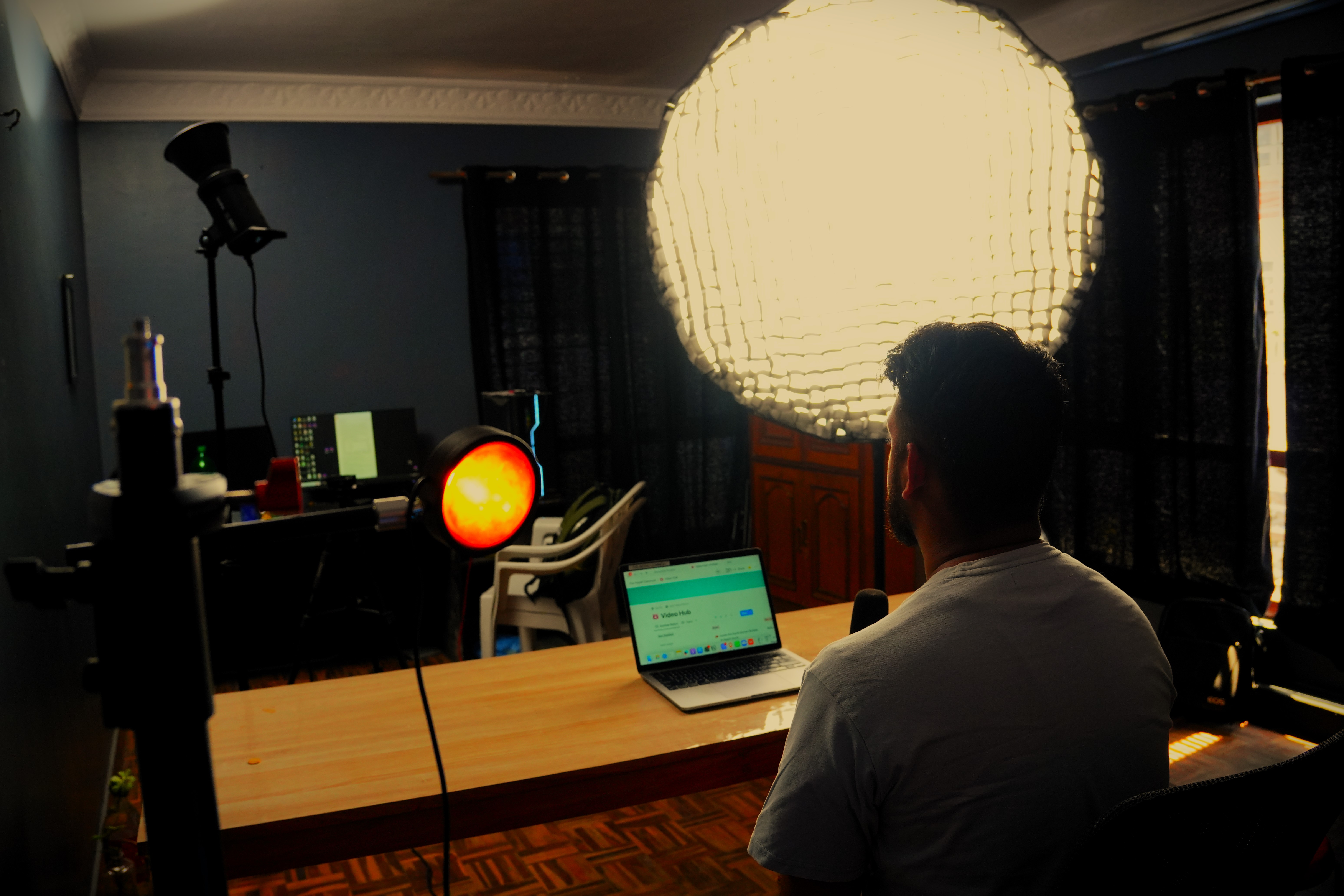
The question “Can you really make that much from social media?” has a straightforward answer from someone who does. Dipesh Tripathi has been making explainer videos on YouTube since 2022 — contemporary, historical, social — under a channel called The Nepali Comment, which now has 442,000 subscribers. He earns between Rs 300,000 and Rs 400,000 a month from the platform. His monthly costs — production, research, salaries for his 10-person team — run to roughly Rs 350,000, covered entirely by YouTube ad revenue. What comes in from brand sponsorships on top of that is profit.
“If you just want to make money — go sensational,” Tripathi says. “But that’s not what we do. We want our content to be useful and to contribute to accurate public discourse. So our revenue has a ceiling, and we're fine with that.”
Elena Gurung, known online as “Elena Don,” has been creating content for over a decade. She works professionally in a psychology and mental health organisation and treats content creation as a parallel track rather than a full-time pursuit.
“I’ve been at it for 10 or 11 years, but it’s only been the last eight that it’s actually generated meaningful income,” she says. “I don’t give it full-time attention. I work on what interests me. But even so, the earnings are good. If I went full-time, I could comfortably earn more than a senior corporate salary.”
Photo: Courtesy of The Nepali Comment
This economy is not confined to Kathmandu. Saroj Karki runs his channel “Project Kura” from Biratnagar, where he employs seven people full-time to produce explainer content for his 320,000 subscribers. “YouTube monetisation alone is difficult to survive on,” he says. “We need monetisation plus brand sponsorship deals.” He earns an average of $3,000 to $4,000 a month from the platform — roughly Rs 400,000 to Rs 500,000.
Not everyone is in it full-time, and for many, that’s precisely the point. Subhana Budhathoki creates on Instagram and TikTok alongside a consultancy job, earning up to Rs 50,000 a month from brand deals. “You don’t have to make this everything,” she says. "I do brand collaborations part-time, and it's satisfying.”
Istu Karki — 66,900 Instagram followers, 719,000 on Facebook — works as a full-time creator combining platform revenue with brand work, though she is candid about its limits. “If you want to build a mansion and live extravagantly, this alone probably won't get you there,” she says. Ekta Tandulkar, with 86,000 Instagram followers and six years in the business, is more direct about what the platform has given her. “It’s made it much easier to do brand collaborations and promote my own business,” she told Kantipur.
To understand how Nepali creators make money, it’s important to understand how the money moves in the digital creator ecosystem. Creators earn through two primary channels. The first is platform monetisation: YouTube, via Google AdSense, pays creators roughly 60 percent of ad revenue generated on their videos, keeping the rest. The second is influencer marketing — direct payment from brands for sponsored content, which the creator keeps in full.
The rate per thousand views — CPM, or cost per mille — is the variable that determines how much the first channel pays. Monayac Karki, who runs the influencer management company Uptrendly, explains the logic plainly. “The topic you cover determines your CPM,” he says. “Entertainment, like dohari music, pays less. Banking or AI content pays significantly more. Geography matters too, Karki says: a viewer from Jumla might generate Rs 50, while a viewer in New York or London drives CPM far higher, because advertisers in those markets compete more fiercely for their attention.
Each platform has its own logic. YouTube rewards depth: viewers arrive to learn, to research, to watch detailed reviews, and a strong video can accumulate views for months or years after it is published. Technology, education, automobiles, real estate, and tourism content perform especially well, and monetisation here is the most reliable. Instagram, with roughly 3.6 million Nepali users who skew urban, educated, and between 18 and 35, has become the richest platform for commercial creators. Reels have significantly expanded organic reach, and fashion, beauty, lifestyle, and restaurant content sells most effectively here.
Facebook, Nepal’s largest platform at 13.5 million registered users, spans every age group, income level, and geography in the country. As of last September, Meta officially launched content monetisation in Nepal, opening a new revenue stream for page operators based purely on views. TikTok operates on a different principle altogether: follower count is largely irrelevant. A creator with 2,000 followers can go viral overnight if the content is strong, making it especially attractive to brands that want an outsized impact on a limited budget.
There was a time when a Nepali brand that wanted to reach customers had no real choice but to go through print, radio, or television. That’s no longer true, and the shift has accelerated faster than most traditional media businesses anticipated. Influencer marketing now commands a significant and growing share of advertising budgets.
The trend has taken such a hold in the Nepali market that major advertisers operate with the premise that Nepali consumers are more likely to buy something recommended by someone they can relate to than something pushed through a banner ad. E-commerce platforms like Daraz prioritise influencer campaigns over traditional advertising during high-sales periods like Dashain and 11.11. Last May, Ncell launched a programme called “League of Creators” specifically to identify and develop content creators, offering mentorship and practical training in digital storytelling. More than 1,300 creators applied, of which 50 were selected for the programme.
A 2024 Sprout Social report found that approximately 49 percent of consumers make purchases daily or weekly based on influencer posts, and that 30 percent said their trust in influencers had grown over the previous six months. Among Gen Z, the influence rate reaches 87 percent. Although there are no comparable figures for Nepal, the global data provides a hint at the impact the influencer ecosystem has on businesses every day.
Screenshot from a video shows Hemraj Rai eating a sandwich from Newaz Sandwich in Patan.
The effect is visible at the most local level. Suraj Bajracharya, who runs Newaz Sandwich in Patan’s Pimbhaal neighbourhood, is among those blown away by influencer impact. When a content creator made a video about his shop last year in April, he said his daily sales went from roughly 100 sandwiches to 300. “Whatever the creator ate, customers came in and ordered the same things,” he told Kantipur.
Hemraj Rai, the creator of the video about the sandwiches, says he only found out later how much business the shop had generated. It didn’t surprise him, he said, but it did motivate him. “Digital content allows audiences to make informed choices about where they can find better services,” he said. “When a business sees growth because of a video we created, it gives us even greater encouragement.”




 21.66°C Kathmandu