How Nepal’s ‘gender responsive’ budget fails the women it claims to serve
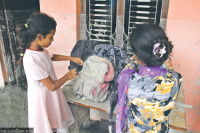
Nepal’s gender budgeting system has become a paper exercise—reporting perfect compliance while failing to track whether programmes actually improve women’s lives.Participants pictured during a focus group discussion in Madi Municipality. Photo: Courtesy of Actionaid Nepal
Dil Kumari BK, a resident of Madi Municipality’s ward 3, had watched enough of her community’s men leave for foreign employment to know that if Dalit women in Gulmeli Tole were going to build anything, they would have to build it themselves. She had first joined Sunaulo Mahila Samuha, a women’s group in the area. But the group was far from her settlement and there were no Dalit women there. She realised in time that Dalit women needed their own space, built on proximity and shared experience. So she went door to door in her own tole and formed Mili Juli Samuha, which included 22 members, all Dalit, all from the same tole, most of them wives and mothers whose husbands were abroad.
When Madi Municipality introduced a programme targeting Dalits—training in Panche Baaja—Dil Kumari and 15 of her members signed up. However, five days of training was not enough to build confidence, so the women went back to the municipality and asked for more. The municipality then listened. It extended the training to ten days and gave them a full set of instruments. For the women of Mili Juli Samuha, it was a rare moment: the government had actually heard them.
To date, they have performed at one wedding. They earned Rs15,000 and shared it among the group. The income is modest and it may stay modest. Madi Municipality is predominantly Janajati, Tharu, and Madheshi. Panche Baaja is not widely used in those communities’ ceremonies. There is no market mismatch report, no follow-up assessment, no market linkage support attached to the programme. The training was delivered. The budget line was coded. The box was ticked.
A study released this week by ActionAid International Nepal found that the Ministry of Women, Children, Gender and Sexual Minorities and Social Security has classified 100 percent of its budget as ‘‘directly gender responsive’’ for three consecutive fiscal years—not because anyone assessed whether programmes actually benefit women, but because no one assessed anything at all. The coding happens when an IT operator enters a budget heading into a government software system and picks ‘‘direct’’ from a dropdown menu. No indicators. No scoring. No analysis. Meanwhile, between 44 and 59 percent of that perfectly-classified budget goes unspent each year—returning to the treasury while women like Dil Kumari wait for a room to store their instruments.
The study was conducted by Himal Innovative Development and Research Pvt. Ltd. in collaboration with ActionAid International Nepal and Chitwan Active Women Foundation and Makwanpur Women Upliftment Society. The research covered three fiscal years from 2022-23 to 2024-25 and drew on 24 key informant interviews and six focus group discussions conducted at both federal and local levels—engaging government officials, policy stakeholders, and marginalised community groups—alongside five in-depth case studies selected for their gender integration in budgeting, participation, and measurable gender equality outcomes. It covered the Ministry of Women, Children, Gender and Sexual Minorities and Social Security, and three municipalities: Shankharapur in Kathmandu, Manahari in Makwanpur, and Madi in Chitwan. Dil Kumari BK and Santoshi Bankariya were among the key informant interviewees.
The core problem the study identifies is a misunderstanding so fundamental it has been built into the system itself. ‘‘Gender responsive budgeting is not women-targeted budgeting,’’ said Advocate Indu Tuladhar, research lead of the study. ‘‘It is not a separate fund set aside for women. It is a lens applied across roads, water, health, education, agriculture that asks how every rupee of government spending affects women and marginalised community differently.’’ Nepal's ministries and local governments, she said, have been doing the former while reporting as though they are doing the latter—classifying budgets as gender responsive without any analysis of whether they actually are.
Back in Gulmeli Tole of Sankhuwasabha District, the problem Dil Kumari describes goes beyond the market mismatch. Although budgets are reportedly allocated for Dalit women, those funds are often the first to be cut or reallocated. Most women in her community do not know how much is earmarked for them or what they are entitled to claim. Information travels through town criers and neighbourhood assemblies: informal, unreliable, exclusionary. That is how Mili Juli Samuha learned about the Panche Baaja programme. They count themselves lucky.
Outside the training room, the women are still called ‘‘baaja bajayera khane haru’’—a phrase that reduces what they have built to a caste-marked survival tactic rather than a dignified livelihood. Many of the members are uneducated. Keeping their children in school is a daily struggle. Municipal scholarships for Dalit children exist but reach only a few. What Dil Kumari says she needs right now is not another programme. It is a room, a community space where the group can safely store their instruments and practice without interruption. That room does not exist.
Two hours northwest, in Musedhap, ward 4 of Manahari Rural Municipality in Makwanpur, Santoshi Bankariya is running a soap enterprise.
She is the second person from the Bankariya indigenous community to have completed education to Grade 12. In 2024, Online Khabar named her one of Nepal’s 50 Most Influential Persons. She tutors primary school children in the evenings, facilitates adult literacy classes through what locals call Santoshi Pariyojana, and manages the Bankariya and Chepang Women Soap Industry which is a collective of 25 indigenous women making soap from mugwort, aloe vera, and honey.
The enterprise started after the National Indigenous Women’s Forum trained the women and provided equipment. The group pooled Rs50 each from 15 to 16 members, bought soap base, sold their first batch at a local fair, and earned Rs25,000. Manahari Rural Municipality later then committed Rs100,000 to the enterprise, Rs90,000 of which has been received, and instructed all offices under it to purchase soap exclusively from Santoshi's group. Around 13 women now produce 100 to 150 bars on order, earning approximately Rs5 profit per bar. The profits return to a community fund that women can borrow from.
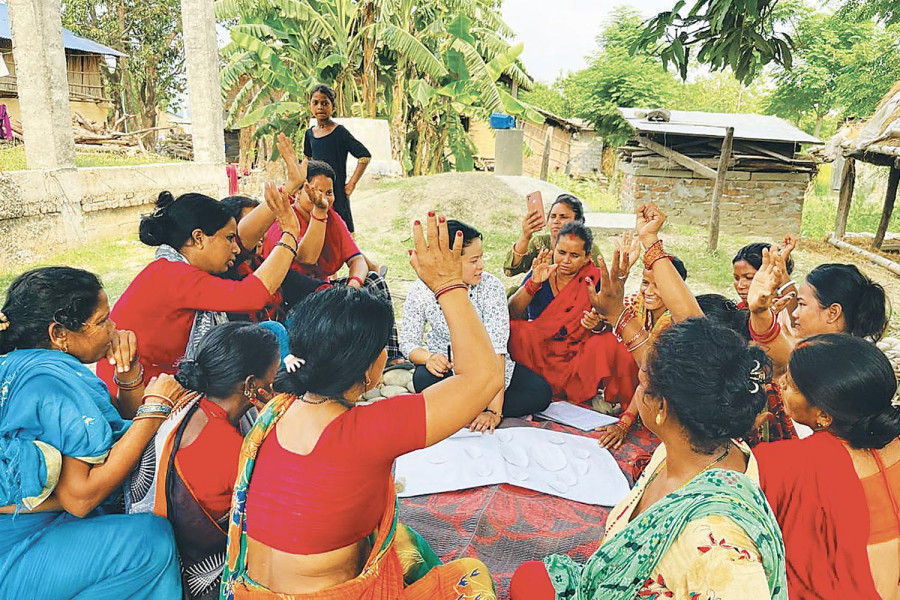
Women from the Mukti Mahila Samuha, Majhuwa, Madi-6 in Chitwan, prepare a collective business proposal for submission to their ward office. Photo: Courtesy of Actionaid Nepal
But the Bankariya community has lived on leased land for generations. They have no ownership certificates. This means the soap enterprise, however successful, cannot be permanently registered, cannot access formal credit, and cannot plan beyond the next production cycle. Santoshi managed a temporary registration only through the intervention of the local ward chairperson.
She is clear about what she needs. It is not the Rs4,000 individual social security allowance the municipality provides. ‘‘Employment and income-generating opportunities are more sustainable than cash allowances,’’ she said. A land ownership certificate would let her register the business properly, access credit, and plan for the future. That certificate is not a gender budget item. It has never been.
The programme that supported her enterprise was coded as gender responsive. The municipality reported compliance. The land question remains unresolved.
AAIN’s study put rupee figures to that. In 2022-23, the ministry had roughly Rs1.78 billion allocated. It spent less than Rs480 million. The following year, Rs1.57 billion was allocated; of which, Rs680 million was spent. The budget shrank further in 2024-25—to Rs1.30 billion—with just Rs650 million disbursed. In each of those years, the ministry’s entire budget was reported, down to the last rupee, as directly gender-responsive.
None of the three surveyed municipalities had formed the GRB Committees mandated since 2012. None were systematically using SuTRA (the Sub-national Treasury Regulatory Application), the government’s digital financial management system through which local governments are required to code and track gender-responsive spending. The guidelines governing the system have not been revised since 2012—nine years before Nepal's federal restructuring changed how local governments function.
‘‘GRB is being used merely as a superficial tool for budget classification,’’ said Kalpana Khanal, economist and public policy researcher. ‘‘Everything from administrative costs to general programmes is being counted toward GRB just because women are involved. The framework and its implementation both need reform.’’
The problem lies in how the classification itself is done. Nepal’s GRB Formulation Guideline of 2012 requires every programme to be scored against five weighted indicators before being classified as Direct, Indirect, or Neutral. ‘‘If the score is above 50 percent, it is direct; between 25 and 50 percent is indirect. Below 25 percent is Neutral,’’ Tuladhar said. ‘‘This process was not followed.’’ Instead, the Ministry of Finance codes the ministry’s entire budget as 100 percent direct GRB without activity-level assessment.
Secretary Radhika Aryal of the Ministry of Women acknowledged the problem directly. ‘‘AAIN raised the point that there is low understanding even within our own ministry—I accept that,’’ she said. ‘‘This is because we haven’t been formulating budgets based on those five indicators. The budget formulation process in other ministries is the same: they receive a ceiling, create programmes, and enter programme titles into the system. Since they don't enter data according to the indicators, what can the other ministry do? It isn't feasible for them to analyse everything, so wherever ‘women’ are visible, it is simply entered as a gender-responsive budget.’’
When funds remain undistributed at the end of the fiscal year, they return to the treasury. ‘‘Not all allocated money is actually disbursed,’’ Khanal said. ‘‘Currently, our development spending is often only around 60 to 70 percent.’’ What that means is Nepal’s GRB system remains focused on budget classification rather than results, with weak monitoring, inconsistent coding, and little assessment of whether programmes actually reach women and marginalised communities. In practice, that can mean livelihood programmes without market support, scholarships that fail to reach intended students, or services announced in budgets but never fully implemented.
This is not a new problem. It has been relabelled. Similar gaps were identified in Province 1 in 2022—weak implementation, poor market linkage, and limited follow-up—and remain visible in the ActionAid study as well.
Madi Municipality Mayor Tara Kumari Mahato confirmed the study's findings on SuTRA coding. ‘‘We haven’t really been doing that specific coding until now,’’ she said. ‘‘In terms of data entry, it is likely as they said—not coded.’’ She said the municipality reviews programmes internally across its sectors but does not formally classify them using GRB indicators. ‘‘Even if we don't explicitly mark it in the system, we internally know what kind of budget it is.’’
At the national level, no one is checking either. ‘‘The National Planning Commission (NPC) does not do that—the Ministry of Finance does,’’ said Reshu Aryal, Member of the NPC. The NPC sets budget ceilings and macroeconomic indicators. Once those go to the Ministry of Finance, the sectoral analysis is handled there. Classification is self-reported at every level. And LISA, the digital system that was supposed to track local gender budget outcomes, has been shut down. Its replacement, LGPAS (Local Government Performance Assessment System), is not yet operational.
The government announced the new national budget on May 29. Tuladhar does not expect the new budget to fix what decades of neglect have built. ‘‘It is not possible to fix it for this immediate budget because the entire GRB practice has been neglected,’’ she said. ‘‘For next year, they should follow the full process.’’
Khanal is direct about what genuine GRB looks like in practice and what disappears without it. ‘‘If you are building a public building, you should look at it through a GESI lens during the planning phase. This ensures the design includes accessibility, women’s toilets, and changing stations. Without GRB planning, these needs are often ignored.’’ She said that attaching the word ‘‘women’’ to a programme is not enough. ‘‘To be genuine GRB, it must generate a broad, positive impact on society.’’
In Madi, Dil Kumari BK needs a room to store her instruments. In Manahari, Santoshi Bankariya needs a land certificate. Both women have benefited from programmes that the government classified as directly gender responsive. Both are still waiting for the intervention to actually respond to their reality.
Aarya Chand is a reporter at The Kathmandu Post covering social issues. Before moving to the social beat, Chand was an intern covering culture and lifestyle for the Post.




 15.56°C Kathmandu