



 14.81°C Kathmandu
Sat, Oct 24, 2026
Money
Nepal budget has no measures to mop up surging deposits, analysts say
Interest rates have plummeted to historic lows and banks are eager to lend but business houses and entrepreneurs have pulled back from borrowing.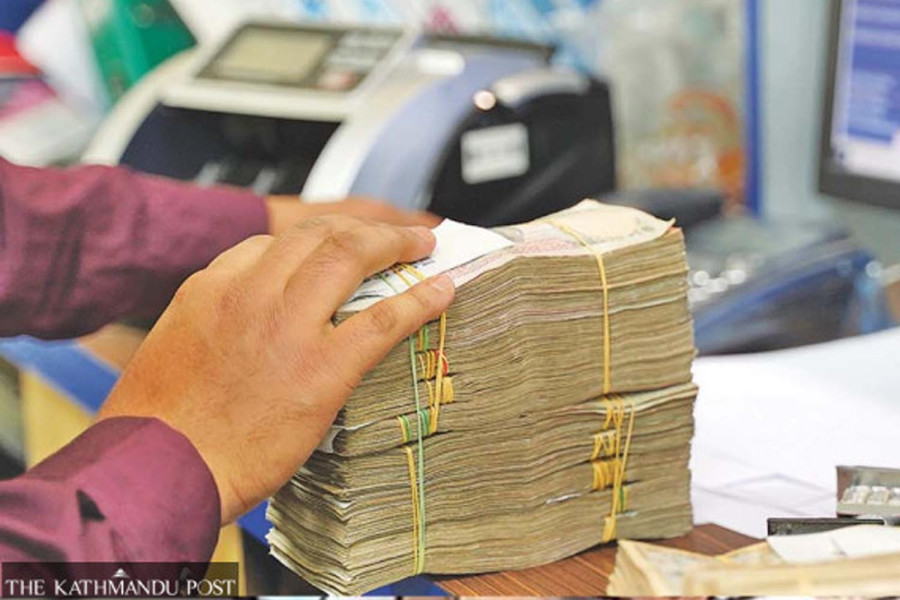
bookmark
Yagya Banjade
Published at : May 31, 2026
Updated at : May 31, 2026 06:44
Kathmandu
The country’s banking system is awash with cash. More than Rs1.4 trillion that can potentially be lent to businesses and households remains parked in the financial institutions, even as policymakers search for ways to revive investment and economic activity.
The abundance of lendable funds comes at a time when remittance inflows continue to break records. By mid-April, foreign exchange reserves had climbed to an unprecedented Rs3.494 trillion, while both the current account and balance of payments remained comfortably in surplus.
Amid these robust external macro-economic indicators, the budget for the fiscal year 2026-27 presented by Finance Minister Swarnim Wagle on Friday has drawn mixed reactions from stakeholders and economists. While the budget introduces several investment-friendly reforms and policies, analysts argue that they fall short of addressing the core structural issues required to deploy the banking sector’s idle funds and revitalise an economy suffering from a prolonged period of low demand.
Even though interest rates have plummeted to historic lows and banks are eager to lend, business houses and entrepreneurs have pulled back from borrowing. Industry insiders say investors are no longer seeking cheap or accessible credit; rather, they are prioritising capital safety and predictable returns on investment.
The domestic private sector remains visibly shaken following recent socio-political upheavals, notably the Gen Z movement that challenged traditional business networks. Experts emphasise that the state has failed to deliver a ‘big push’ or a decisive fiscal shock to revive private-sector morale.
Nar Bahadur Thapa, economist and former executive director of Nepal Rastra Bank, suggested that to kick-start key national infrastructure, the government should have adopted the self-funding off-budget model successfully deployed during the Upper Tamakoshi Hydroelectric Project.
“Allowing strategic infrastructure projects to raise investment directly from the domestic market secures project capital without placing an additional fiscal burden on the state treasury,” said Thapa.
“The government should have used this budget to announce clear development blueprints for high-yield ventures such as the Budhi Gandaki Hydroelectric Project, West Seti, and the Nijgadh International Airport under this specific framework.”
According to Thapa, such an approach would have simultaneously guaranteed long-term capital for crucial national assets while safely soaking up the massive excess liquidity sitting idle in commercial bank vaults.
“The budget speech makes a broad, generic reference to raising project finance outside the standard budgetary system. However, it would have been more impactful had the government specified eligible projects,” said Thapa. “While the government has expressed a formal commitment via this budget to boost investment and restore business confidence, the primary question is how effectively these policies will be executed on the ground.”
Capital formation within the domestic economy has been weak. According to data from the National Statistics Office, Nepal’s total investment-to-GDP ratio stood at a healthy 39.5 percent in the fiscal year 2017-18, but crashed to 28.1 percent in the fiscal year 2024-25.
Statistical officials attribute this sharp contraction to the state’s persistently weak capital expenditure capacity and a parallel drop in private sector fixed capital investment. Over the past decade, private sector investment averaged 19.6 percent of the country’s GDP. However, following the economic disruptions of the Covid-19 pandemic, this ratio contracted continuously, hitting a low of 14.7 percent in the fiscal year 2024-25.
Economists warn that this investment stagnation makes it nearly impossible for Nepal to achieve sustainable, inclusive, and high economic growth rates or generate adequate employment opportunities.
Because Nepal has a low domestic savings rate historically, the gap between domestic savings and investment has been wide. Over the past decade, gross domestic savings averaged just 8.5 percent of the GDP annually, while total investment averaged 33.9 percent. This indicates a negative average saving-investment gap of 25.4 percent.
However, due to the massive surge in remittance inflows from migrant workers, Nepal’s total national savings averaged 35.8 percent of the GDP over the same period. The current slowdown in domestic capital investment means that overall national savings now exceed actual internal investment, resulting in underutilised capital in the domestic financial system.
Min Bahadur Shrestha, former vice-chairman of the National Planning Commission, believes the government has tried to address structural investment bottlenecks through the budget.
“The government appears to have adopted what it calls an ‘Investment Express’ policy. This involves providing regulatory relief and administrative incentives to foreign entrepreneurs, alongside establishing a reliable one-stop service system,” said Shrestha.
“Furthermore, foreign investors will now only need to notify Nepal Rastra Bank when repatriating their investment returns, rather than waiting for long prior approvals. However, these are not entirely new concepts, nor will they trigger an immediate economic leap. Nepal has introduced one-stop windows and hosted multiple international investment summits in the past, to no avail.”
Shrestha explained that institutional bodies like the Investment Board Nepal were set up specifically to accelerate large-scale projects, and numerous investment acts were amended at the direct request of the private sector. Yet foreign direct investment inflows did not pick up. He argued that deeper, institutional factors were at play.
“When foreign capital tried to enter the domestic market, certain segments of the local private sector actively resisted, creating a hostile environment in order to protect their own monopolies,” said Shrestha. “In many instances, foreign ventures were forced to allocate equity shares to local partners without receiving actual capital investment.”
Shrestha dismissed claims that a lack of legal frameworks or budget allocations prevented foreign investment from entering. “The fault lies partly within the domestic private sector. A toxic culture of ‘if we cannot control it, we will destroy it’ has dominated corporate lobbying because these business syndicates had the political power to make or break governments. However, following the recent youth-led political shift, this web of intermediaries is finally beginning to crack.”
The National Statistics Office reported that consumption has gobbled up an average of 91.5 percent of the GDP annually over the past decade. The office concluded that while national savings remain in a comfortable position due to remittance, private sector enthusiasm has stalled due to a complicated operational environment.
For the current fiscal year, Nepal Rastra Bank had set a private sector credit expansion target of 12 percent. However, central bank data up to May 24 showed that while commercial banks collected Rs692 billion in deposits, they managed to disburse only Rs291 billion in credit. Compared to the same period last year, deposit collection has grown significantly, but credit deployment has declined. Up to late May last year, financial institutions had recorded Rs406 billion in deposits and disbursed Rs365 billion in loans.
By May 24, the cumulative lendable liquidity surplus across financial institutions reached Rs1.38 trillion. This accumulation of idle funds has built up continuously over the past three years, driven primarily by the steady growth in remittances. Total bank deposits had reached Rs7.99 trillion by May 24. When factoring in external funds raised by banks through international loans and corporate bonds, the banking sector’s total financial resources exceed Rs8 trillion. Consequently, the industry-wide credit-to-deposit (CD) ratio has dropped to 72.87 percent.
As per central bank directives, commercial banks are permitted to lend up to 90 percent of their total deposits. Currently, total outstanding credit stands at Rs5.88 trillion. While a simple subtraction indicates an available lendable pool of Rs 1.38 trillion, statutory rules require banks to maintain a mandatory 20 percent total liquidity ratio.
Since the cash reserve and liquidity buffers account for about 1 percent of the CD ratio calculation, banks can realistically lend only up to 89 percent of their deposits in daily practice. Even under this stricter calculation, the banking sector holds an idle lendable surplus of Rs 1.3 trillion.
Parashuram Kunwar, a financial analyst and former banker, says Nepal’s economic challenges stem from bureaucratic inertia rather than a lack of policy design. “The final outcome depends entirely on execution of the budget,” said Kunwar. “Once the private sector sees these newly announced legal reforms being applied transparently, investor confidence will return over time. We must monitor the first quarter of the fiscal year to see if the government actually follows through on its promises.”
Birendra Raj Pandey, president of the Confederation of Nepalese Industries (CNI), welcomed the government's decision to lower customs duties on 273 industrial raw materials.
“Maintaining a clear tax differential between imported finished goods and raw materials will make local manufacturing competitive and accelerate domestic industrialisation,” said Pandey. He said the exemption of excise duties on 360 items would reduce the cost of doing business. Furthermore, Pandey pointed out that raising the personal income tax exemption threshold from Rs500,000 to Rs1 million, alongside a 10 percent reduction in the maximum income tax rate, would increase disposable income, lift consumer spending, and revive aggregate market demand.
In his budget speech, Minister Wagle said the government would introduce legal and policy measures to promote investments, execute economic reforms, and streamline public service delivery.
“We will amend the Company Act to bring absolute clarity on conflicts of interest and corporate disclosures, while simplifying business exit and liquidation processes,” said Wagle. “We will also sign double taxation avoidance and foreign investment protection agreements with additional sovereign nations.”
Moreover, “the Insolvency Act, 2006 will be amended to resolve financial distress within small and medium enterprises, and a new limited liability partnership law will be drafted to encourage angel investors, venture capital, and private equity funds,” said Wagle.
The government also announced plans to ease foreign investment rules for non-resident Nepalis and streamline overseas technology transfers. The budget stated that the Foreign Investment and Technology Transfer Act will be amended so that international firms will no longer require prior approval from the central bank to repatriate profits, with a simple notification system sufficing.
“We will make arrangements to allow foreign investors, international organisations, and branches of multinational companies investing in Nepal to take apartments on long-term leases for residential purposes. This will be permitted in residential buildings or locations specified by the government, up to a maximum of 25 percent of the total units in a building. To guarantee financial access for small and medium-sized entrepreneurs, we will secure loans using a ‘first-loss recovery’ mechanism,” reads the budget.
Additionally, the government has introduced a 50 percent income tax rebate on earnings generated from information technology service exports, positioning the IT sector as a primary driver of future economic growth. To mitigate the risk of currency fluctuations for international builders, Wagle announced that a formal foreign exchange hedging mechanism with affordable premium rates will go live next fiscal year.
Yagya Banjade
Banjade covers government finance, banking, capital markets, and the economy for Kantipur Daily.




Most Read from Money

Why does an hour long flight to Dhangadhi cost more than a flight to New Delhi?

Nepal travel agents threaten to stop selling Thailand trips over visa rules
Malaysia rejects Nepal’s demand to open recruitment to all manpower agencies

No school, but a graduation cap for women dairy farmers
Nepal arrests four medical service providers as Malaysia recruitment row deepens
Editor's Picks




E-PAPER | October 24, 2026

×