Teen’s fatal shooting in Siraha still a mystery as forensic probe begins
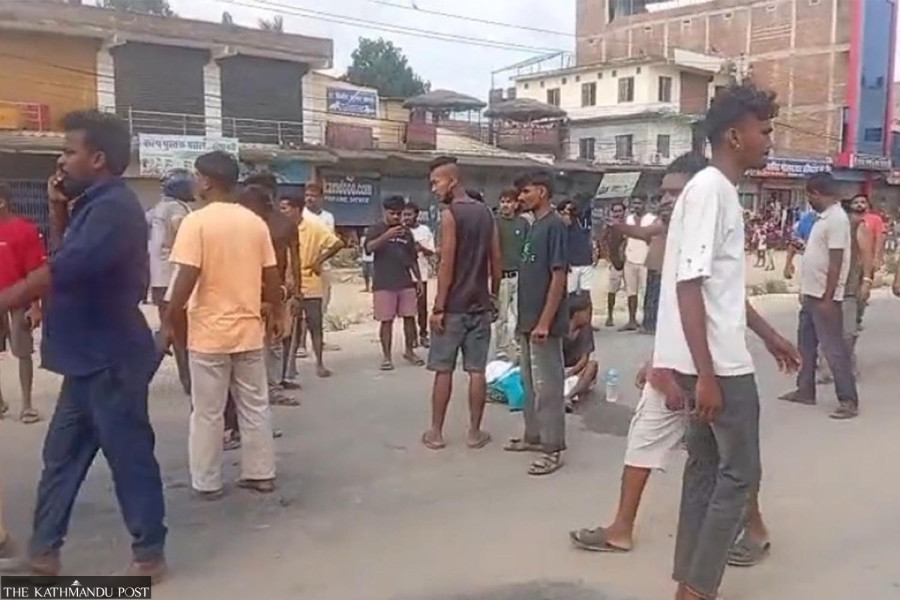
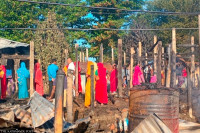
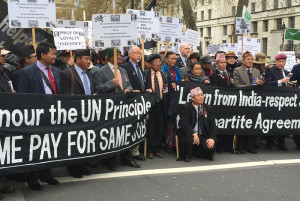
Home ministry-formed committee, led by Joint Secretary Pushparaj Shahi, has yet to determine who fired the fatal shot.People gather on a street in Golbazar, Siraha, on July 30, after unrest spread to Madhesh towns following communal tensions that began in Sunsari on July 27. Post Photo
The mystery surrounding the fatal shooting of a 15-year-old boy during unrest in Siraha has deepened after Nepal’s three security agencies denied firing the bullet that killed him, prompting authorities to expand the investigation with ballistic and forensic experts.
Ganesh Yadav, a resident of ward 2 in Aurahi Rural Municipality, was shot in the neck during violence in Golbazar on July 30, four days after communal tensions triggered by a clash between two communities in Dewanganj of Sunsari spread across Madhesh Province.
His body remained in Golbazar Chowk for nearly three hours as grieving relatives demanded answers. A video showing his elder brother, Kamlesh Yadav, aged 18, breaking down while informing relatives about the shooting quickly went viral, adding to public anger and fuelling tensions.
Home Minister Sudan Gurung travelled to Madhesh Province shortly after the incident and met Ganesh’s father Ram Briksh Yadav in Siraha. The family agreed to collect the body only after signing a seven-point agreement with the government. Yet the central question remains: whose bullet killed the teenager?
Chief District Officer Surendra Paudel of Siraha said that local authorities had been briefed that Nepal Police personnel fired only blank rounds and rubber bullets in their efforts to control the situation. “We have also been informed that the Armed Police Force did not fire live ammunition,” Paudel told Kantipur.
Deputy Inspector General Abi Narayan Kafle, the Nepal Police spokesperson, said the Madhesh Province Police Office had formed an investigation committee led by Superintendent Bhesh Raj Rijal on the day of the incident. He added that the home ministry had also constituted a separate committee to examine the broader circumstances surrounding the unrest.
A curfew had been imposed in Golbazar as violence escalated, and Nepali Army personnel were also deployed to assist civil authorities. However, the army has likewise denied firing live ammunition. Nepali Army spokesperson Brigadier General Rajaram Basnet said he could not comment on the issue because it was under investigation.
The home ministry-formed committee, led by Joint Secretary Pushparaj Shahi, has also yet to determine who fired the fatal shot. A member of the panel said identifying the source of the bullet had become one of the most challenging aspects of the inquiry.
“The question of who fired the bullet has been more complicated than it initially appeared, and we are treating it as our top priority,” the committee member told Kantipur.
As uncertainty persisted, the ministry expanded the investigation team by adding two officials from the Nepal Police Forensic Science Laboratory to conduct detailed ballistic and forensic examinations, raising hopes that scientific analysis will establish responsibility for the teenager’s death.
The newly added investigators are Inspector Dipesh Awasthi and Superintendent of Police Manohar Singh Dhami, who specialise in ballistic and forensic analysis. They joined an existing panel comprising Nepal Police Superintendent Mohan Kumar Thapa, Armed Police Force Superintendent Naresh Bhandari, Central Police Forensic Science Laboratory Deputy Superintendent Pawan Kumar Dhungana, and Home Ministry Under Secretary Kul Shekhar Aryal.
A home ministry official said the team was strengthened because scientific evidence was considered essential to determine which weapon fired the fatal shot. Ballistic testing can identify the firearm used and estimate the firing distance, findings investigators believe will help reconstruct the sequence of events.
Buddha Narayan Sahani, head of the National Human Rights Commission’s Madhesh office, said that there was still no confirmed answer despite widespread speculation. “Many claims have been made, but nothing has been conclusively established,” he told Kantipur, adding that the commission was conducting its own assessment.
According to security officials, similar incidents in the past have also been marked by uncertainty over which party fired the fatal shot.
Former Additional Inspector General of Nepal Police Uttam Raj Subedi said uncertainty over responsibility was not unprecedented in crowd-control operations involving multiple security agencies.
“Ballistic examination can determine which weapon fired the bullet,” he said. “Once investigators establish which personnel were deployed and which weapons they carried, identifying responsibility should not be difficult.”
Subedi added that investigators must also consider the possibility that someone outside the security forces fired the shot if no agency accepts responsibility.
Ganesh’s father, Ram Briksh Yadav, has consistently maintained that the government is responsible for his son’s death. “The government killed my child. Whoever fired the bullet must be punished. I want justice,” he said. He repeated the same demand when Home Minister Gurung visited his home on July 31.
Under the second point of agreement signed by Gurung, the government committed to an impartial and effective investigation into the Golbazar incident and immediate legal action against those found responsible.
Accordingly, the Shahi-led team began its inquiry. After arriving in Siraha, the committee started inspecting the incident site, collecting evidence and other relevant facts, and holding consultations with local residents and other stakeholders.
Investigators also held an all-party meeting at Golbazar Municipality, met business owners to document losses caused during the unrest, and separately consulted representatives of the Muslim community on the causes of the violence and ways to restore social harmony.
The committee is also examining whether security personnel followed established procedures governing the use of force. International human rights standards require lethal force to be used only as a last resort, while Nepal’s Local Administration Act allows live ammunition only under exceptional circumstances after clear warnings are issued. Residents have alleged that no such warning was given.
The Siraha shooting came only days after police firing during communal violence in Sunsari’s Dewanganj left several people dead and injured, renewing concerns over the use of lethal force during crowd control.
According to the Local Government Act 1972, security personnel may resort to live fire only as a last resort when law and order cannot be maintained by any other means. Before opening fire, authorities are required to give a clear warning to the crowd. International crowd-control principles likewise require security forces to exercise restraint and use the minimum force necessary to bring a situation under control.
Local residents, however, say no warning was issued before shots were fired. Clause 6(B) of the Local Government Act states that if a crowd refuses to disperse and firing becomes unavoidable, a written and signed order must be issued, and shots should be aimed below the knees.
However, most of those injured in the Sunsari incident received gunshots above the knees. Ganesh was shot in the neck. His post-mortem examination was conducted at the BP Koirala Institute of Health Sciences in Dharan, and the hospital says the report has already been prepared.




 14.4°C Kathmandu