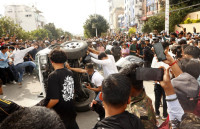
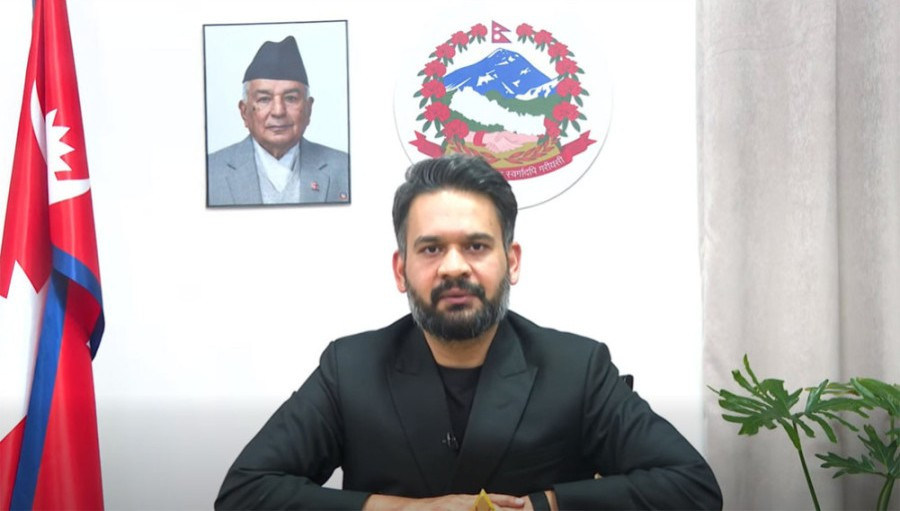
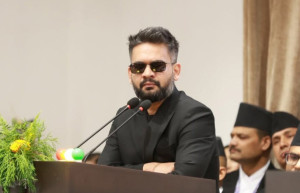
On Thursday evening, Prime Minister Balendra Shah finally addressed the nation after days of unrest across the Tarai-Madhesh triggered by a communal clash in Dewanganj, Sunsari. Since recent events in regions of the southern plains placed the country in a precariously tense situation, it was only right that PM Shah finally took off his sunglasses and peered into the eyes of all citizens, urging them to exercise restraint and maintain societal harmony. The loss of three young lives—Jay Prakash Mehta, Om Prakash Mehta and Ganesh Yadav—and the injuries to scores of citizens and security personnel represent a dreadful tragedy that has heightened a sense of insecurity across the country. With curfews placed in several districts and the spectre of arson and vandalism looming, the fear persists that the situation could spiral beyond control, leading to irreparable damage to the national fabric.
PM Shah’s address to the nation on Thursday was a necessary intervention comprising an appeal for restraint and wisdom. The PM rightly asserted that religion is a “force that unites society and spreads love,” noting that “no religion or culture in the world teaches violence, hatred or division.” By emphasising that the fundamental essence of all religions is compassion, kindness, love and peace, he has sought to steer the public discourse away from the flames of retaliation scourging the Tarai-Madhesh. Such a message is vital in a society that has historically remained liberal towards diverse identities, viewing a mosaic of religions, castes and languages as a defining strength rather than a source of fracture.
Whilst the PM’s commitment to an impartial investigation and his consultation with President Ramchandra Paudel after the broadcast signal mature high-level engagement, the state must also acknowledge its earlier shortcomings. In the initial days of the unrest, security forces struggled with crowd management, and the government’s subsequent reliance on security-centric measures over political strategy was notable. The promotion of harmony now requires more than just the presence of law enforcement. It demands an inclusive strategy of social support and proactive political dialogue.
Furthermore, the inactivity of people’s representatives, particularly those from the Rastriya Swatantra Party who received a significant mandate in these regions, is a matter of concern. True leadership is defined by the ability to manage crises and provide reassurance directly to the electorate. There is an urgent need for representatives at all levels to visit their constituencies, fostering an atmosphere of trust rather than remaining silent in the face of communal tension.
The role of civil society, the media and social media users is equally indispensable. It is imperative to discourage provocative speech and the dissemination of false or unverified information that incites communal disharmony. Instead, the focus must shift towards the promotion of factual, restrained expression that celebrates co-existence.
Ultimately, the responsibility to ‘clear the clouds of unrest’ lies with both the state and the citizenry. Every individual must exercise the wisdom to analyse long-term consequences and reject the malicious interpretations of those seeking to destabilise the nation for ulterior motives. National unity has always been the greatest strength of Nepal during its most challenging periods.
The advancement of security and social harmony within the collective consciousness of a nation must remain the paramount objective of any responsible administration. However, the cultivation of such a climate cannot be achieved through the solitary efforts of the state. It necessitates a sustained, open dialogue and the unwavering support of every stakeholder within the national tapestry. In the words of the Beatles, the entire nation needs to ‘come together, right now’. The government must now act without further delay, prioritising open communication and ensuring that the preservation of social harmony remains the supreme duty of the state. Only through such a concerted effort can the nation transition from this period of unrest towards a future defined by peace and mutual respect.




 15.26°C Kathmandu