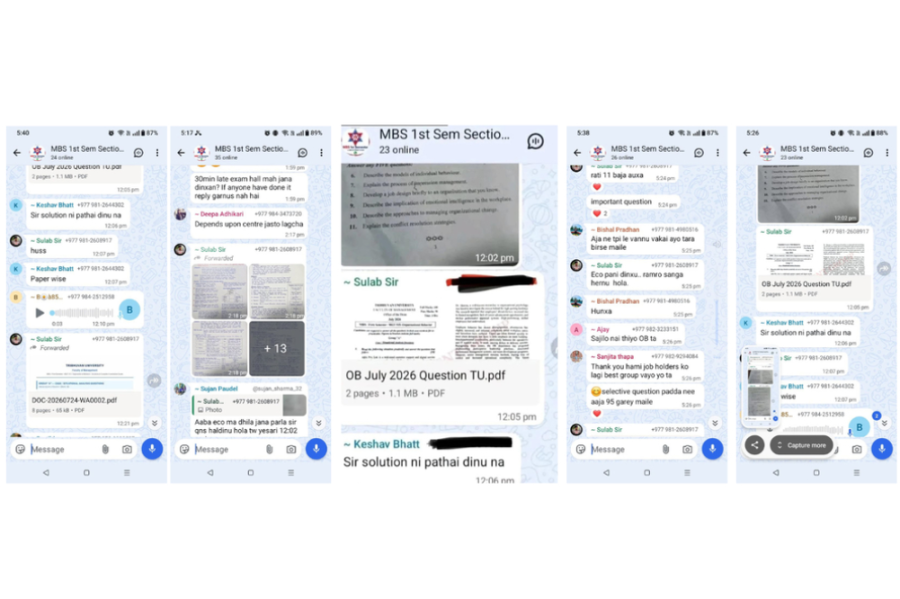
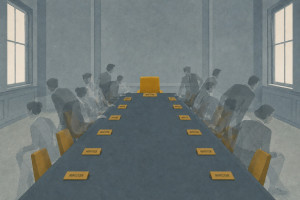
The integrity of higher education in Nepal faced a digital betrayal on Friday. Within five minutes of the commencement of the Tribhuvan University’s Master of Business Studies (MBS) first-semester examination for ‘Organisational Behaviour’, the question paper was circulating on a WhatsApp group. A teacher known online as ‘Sulav Sir’, later identified as Sandip Singh, shared the paper and subsequently provided a 16-page handwritten solution while the test was still underway. This brazen act of academic fraud allowed at least 35 active members in a group of over 1,000 to discuss answers in real-time.
Friday’s paper leak is not an isolated case but rather a symptom of a recurring and systemic issue that has plagued Nepal for decades. From the Secondary Education Examination leaks in 2019 to the cancelled MBBS entrance exams in 2014, the history of examination compromises in Nepal is a long and shameful record.
The leak of an examination paper is a blow to the entire student community. For thousands of candidates, these examinations are the culmination of years of study and financial sacrifice by their families. A paper leak shatters the mental health of students by causing stress and anxiety. In many cases, the sudden loss of a fair opportunity drives students toward clinical depression. Families also suffer financial losses from money spent on examination fees, coaching and travel. Honest students lose their motivation to study.
In this context, the response from Education Minister Sasmit Pokharel has been a welcome departure from the usual administrative inertia. He ordered the Nepal Police leadership to conduct a swift, round-the-clock investigation. This rapid coordination led to the arrest of five suspects by the Central Investigation Bureau (CIB) within 24 hours of the incident. Only one remains in custody now. Such swift action is rare in Nepal, where masterminds of past academic rackets have often avoided investigation.
Nepal can draw critical lessons from the recent chaos in neighbouring India. Union Education Minister Dharmendra Pradhan resigned following weeks of mass youth demonstrations organised by the Cockroach Janta Party (CJP) after the NEET-UG 2026 medical entrance exam was compromised. The Indian government’s initial hesitation and delay in taking high-level accountability only served to fuel public fury and destroy trust in national testing bodies. Nepal must avoid this trajectory by maintaining absolute transparency. The university must establish a clear policy on what constitutes a compromising threshold for an examination.
The current demand for immediate resignation of Minister Pokharel is illogical. Political figures, such as UML leader Mahesh Basnet, are calling for the Minister to step down by citing the moral precedent set in India. This demand is misplaced. Unlike the situation in India where the government hesitated, Pokharel has driven a crackdown on the perpetrators. Preliminary findings indicate that the leak was carried out by a private teacher, not an internal employee of Tribhuvan University. A minister should not be forced out because of the rogue actions of an individual outside the university’s direct payroll. Basnet is simply trying to politicise a serious academic crisis for partisan gain.
For now, the government must set a good precedent by going to the root of this incident. Swift action must be taken not just against individuals but against the structural flaws that allow these leaks to recur. Growing commercialisation of education is a primary driver of these scandals. Many institutions now care more about artificially inflating results than they do about the quality of their students. Political patronage has often protected these academic syndicates in the past, leading to a culture of impunity.
The government must ensure that digital security of examination halls becomes a priority. This includes enforcing absolute bans on personal smart devices in examination halls and utilising signal jamming. The current investigation by the CIB must be fast-tracked to ensure that perpetrators face immediate legal consequences. Nepal needs a system that treats academic merit as sacred. Only by addressing the root causes and ignoring political theatre can the university regain its credibility.




 15.69°C Kathmandu